

Try 100% Updated AZ-140 Exam Questions [2024]
Pass AZ-140 Exam - Real Questions and Answers
The Microsoft AZ-140 exam covers a wide range of topics related to Azure Virtual Desktop, including configuring host pools and session hosts, managing user access and identity, configuring virtual networks, and implementing security and compliance measures. It also covers advanced topics such as managing applications and optimizing the performance of virtual desktops. By passing the AZ-140 exam, IT professionals can demonstrate their ability to design, implement, and manage Azure Virtual Desktop solutions that meet the needs of their organization. Configuring and Operating Microsoft Azure Virtual Desktop certification is highly valued by employers who are looking for skilled IT professionals to manage their Azure Virtual Desktop environments.
NEW QUESTION # 24
You plan to deploy Windows Virtual Desktop.
Users have the devices shown in the following table.
From which device types can the users connect to Windows Virtual Desktop resources by using the Remote Desktop client app and the Remote Desktop web client? To answer, select the appropriate options in the answer area.
NOTE: Each correct selection is worth one point.
Answer:
Explanation:
Explanation
Reference:
https://docs.microsoft.com/en-us/azure/virtual-desktop/connect-web
https://docs.microsoft.com/en-us/azure/virtual-desktop/connect-android
https://docs.microsoft.com/en-us/azure/virtual-desktop/connect-macos
NEW QUESTION # 25
You need to evaluate the RDS deployment in the Seattle office. The solution must meet the technical requirements.
Which three actions should you perform in sequence? To answer, move the appropriate actions from the list of actions to the answer area and arrange them in the correct order.
Answer:
Explanation:
Explanation
Reference:
https://docs.microsoft.com/en-us/azure/cloud-adoption-framework/migrate/azure-best-practices/contoso-migratio
NEW QUESTION # 26
You have an Azure subscription that contains the resources shown in the following table.
You create a recovery services vault named Vault1.
Which resources can you back up using Azure Backup to Vault1?
- A. AVDVM-0, Image1 and Image2 only
- B. AVDVM-0 and share1 only
- C. AVDVM-0. share1. Image1 and Image2
- D. AVDVM-0 only
- E. AVDVM-0. share1 and Image1 only
Answer: C
Explanation:
Reference:
https://www.techrepublic.com/article/how-to-create-a-backup-recovery-service-with-microsoft-azure/
NEW QUESTION # 27
You need to implement network security to meet the security requirements and the performance requirements.
Which two actions should you perform? Each correct answer presents a complete solution.
NOTE: Each correct selection is worth one point.
- A. Deploy a network security group (NSG) and two application security groups.
- B. Filter traffic by using inbound rules.
- C. Deploy an Azure Firewall instance and Azure Firewall Manager.
- D. Filter traffic by using outbound rules.
- E. Deploy two Azure Firewall instances and Azure Firewall Manager.
- F. Filter traffic by using infrastructure rules.
Answer: D,E
Explanation:
Reference:
https://docs.microsoft.com/en-us/azure/firewall/protect-windows-virtual-desktop
NEW QUESTION # 28
You have an Azure Virtual Desktop personal host pool. Each session host in the pool that has an operating system disk and a data disk.
You need to back up the session host data disks.
Which three actions should you perform in sequence? To answer, move the appropriate actions from the list of actions to the answer area and arrange them in the correct order.
Answer:
Explanation:
1 - Create a Recovery Services vault.
2 - Grant permissions for the vault.
3 - Create a backup policy and congigure a backup.
NEW QUESTION # 29
You have an Azure subscription that contains the virtual machines shown in the following table.
You create a shared image gallery as shown in the SharedGallery1 exhibit. (Click the SharedGallery1 tab.)
You create an image definition as shown in the Image1 exhibit. (Click the Image1 tab.)
For each of the following statements, select Yes if the statement is true. Otherwise, select No.
NOTE: Each correct selection is worth one point.
Answer:
Explanation:
Reference:
https://www.robinhobo.com/windows-virtual-desktop-wvd-image-management-how-to-manage-and-deploy-custom-images-including-versioning-with-the-azure-shared-image-gallery-sig/
NEW QUESTION # 30 

Answer:
Explanation:
NEW QUESTION # 31
You have an Azure subscription that contains the virtual machines shown in the following table.
You create a shared image gallery as shown in the SharedGallery1 exhibit. (Click the SharedGallery1 tab.)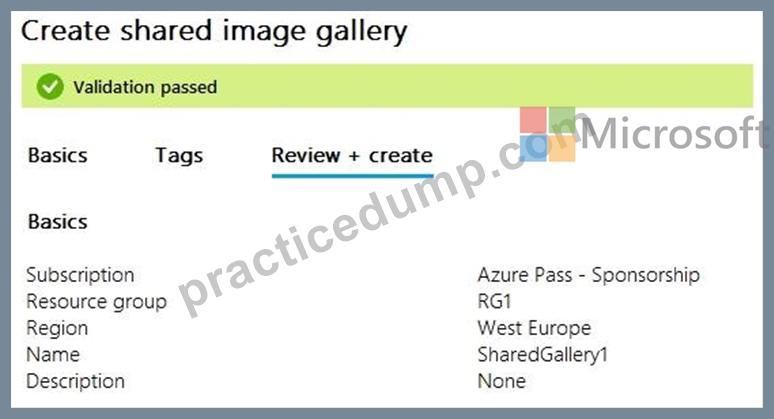
You create an image definition as shown in the Image1 exhibit. (Click the Image1 tab.)
For each of the following statements, select Yes if the statement is true. Otherwise, select No.
NOTE: Each correct selection is worth one point.
Answer:
Explanation:
Explanation
Reference:
https://www.robinhobo.com/windows-virtual-desktop-wvd-image-management-how-to-manage-and-deploy-cust
NEW QUESTION # 32
Your company has 60,000 users.
You plan to deploy Azure Virtual Desktop.
You need to recommend a storage solution for the FSLogix profile containers. The solution must provide the highest possible lOPS and the lowest latency desktop experience What should you recommend?
- A. Azure Data Lake Storage
- B. Azure Blob storage Premium
- C. AzureNetAppFiles
- D. Azure Files Standard
Answer: C
NEW QUESTION # 33
You are automating the deployment of an Azure Virtual Desktop host pool.
You deploy the Azure Resource Manager (ARM) template shown in the following exhibit.
Use the drop-down menus to select the answer choice that completes each statement based on the information presented in the Dockerfile.
NOTE: Each correct selection is worth one point.
Answer:
Explanation:
Explanation
Graphical user interface, text, application Description automatically generated
Reference:
https://docs.microsoft.com/en-us/azure/virtual-desktop/virtual-desktop-fall-2019/configure-host-pool-personal-de
NEW QUESTION # 34
You have a hybrid Azure Active Directory (Azure AD) tenant named contoso.com that contains the users shown in the following table.
You have an Azure Virtual Desktop host pool. All the session hosts have a folder named C:\Folder1.
You create an FSLogix Application Masking rule as shown in the following exhibit.
You create assignments for the Application Masking rule as shown in the following exhibit.
For each of the following statements, select Yes if the statement is true. Otherwise, select No.
NOTE: Each correct selection is worth one point.
Answer:
Explanation:
Reference:
https://docs.microsoft.com/en-us/fslogix/application-masking-rules-ht
https://docs.microsoft.com/en-us/fslogix/application-masking-users-groups-ht
NEW QUESTION # 35
-
You have an Azure Virtual Desktop deployment that contains the resources shown in the following table.
You need to perform the following configurations:
* Enable a managed identity for App1.
* Enable Clipboard redirection for App1.
On which resources should you perform the configurations? To answer, select the appropriate options in the answer area.
NOTE: Each correct selection is worth one point.
Answer:
Explanation:
Explanation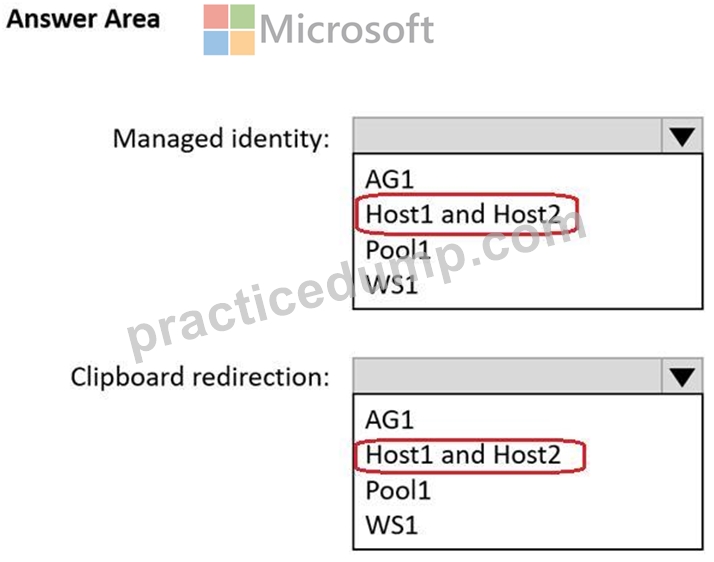
NEW QUESTION # 36
You have a Azure Virtual Desktop deployment.
In Azure Advisor, you discover the following recommendation related to Azure Virtual Desktop:
* Impact Medium
* Description: No validation environment enabled
* Potential Benefit Ensure business continuity through AVD service deployments
* Impacted Resource:' Host Pool
What can you validate by implementing the recommendations?
- A. Capacity requirements of the session hosts
- B. Security settings of Azure Virtual Desktop
- C. Preview features for Azure Virtual Desktop
- D. Azure Site Recovery failover of the session hosts
Answer: D
Explanation:
Reference:
https://docs.microsoft.com/en-us/azure/virtual-desktop/azure-advisor-recommendations
https://docs.microsoft.com/en-us/azure/virtual-desktop/disaster-recovery
NEW QUESTION # 37
You have an Azure Virtual Desktop host pool. The pool contains session hosts that run Windows 10 Enterprise multi-session.
You connect to a Remote Desktop session on Pool1 and discover an issue with the frequency of screen updates.
You need to identify whether the issue related to insufficient server, network, or client resources. The solution must minimize how long it takes to identify the resource type.
What should you do?
- A. From within the current session, use the Azure Virtual Desktop Experience Estimator.
- B. From Azure Cloud Shell, run the
Get-AzOperationalInsightsWorkspaceUsage cmdlet and specify the DefaultProfile parameter. - C. From Azure Cloud Shell, run the Get-AzWvdUserSession cmdlet and specify the UserSessionId parameter.
- D. From within the current session, use Performance Monitor to display the values of all the RemoteFX Graphics(*)\Frames Skipped/Second counters.
Answer: D
NEW QUESTION # 38
-
You have an Azure Virtual Desktop host pool named HostPool1 that must support 60 sessions.
The session hosts for HostPool1 are configured as shown in the following exhibit.
Use the drop-down menus to select the answer choice that completes each statement based on the information presented in the graphic.
NOTE: Each correct selection is worth one point.
Answer:
Explanation:
Explanation
Graphical user interface, text, application, email Description automatically generated
NEW QUESTION # 39
Your company has a main office and two branch offices. Each office connects directly to the internet. The router in each branch office is configured as an endpoint for the following VPNs:
* A VPN connection to the main office
* A site-to-site VPN to Azure
The routers in each branch office have the Quality of Service (QoS) rules shown in the following table.
Users in the branch office report slow responses and connection errors when they attempt to connect to Windows Virtual Desktop resources.
You need to modify the QoS rules on the branch office routers to improve Windows Virtual Desktop performance.
For which rule should you increase the bandwidth allocation?
- A. Rule1
- B. Rule2
- C. Rule4
- D. Rule3
Answer: D
Explanation:
Explanation
https://docs.microsoft.com/en-us/azure/virtual-desktop/safe-url-list
Any Remote Desktop clients you use must have access to the following URLs:
Remote Desktop clients
Address Outbound TCP port
*.wvd.microsoft.com 443
*.servicebus.windows.net 443
go.microsoft.com 443
aka.ms 443
docs.microsoft.com 443
privacy.microsoft.com 443
query.prod.cms.rt.microsoft.com 443
NEW QUESTION # 40
You are automating the deployment of an Azure Virtual Desktop host pool.
You deploy the Azure Resource Manager (ARM) template shown in the following exhibit.
Use the drop-down menus to select the answer choice that completes each statement based on the information presented in the Dockerfile.
NOTE: Each correct selection is worth one point.
Answer:
Explanation:
Reference:
https://docs.microsoft.com/en-us/azure/virtual-desktop/virtual-desktop-fall-2019/configure-host-pool-personal-desktop-assignment-type-2019
NEW QUESTION # 41
You have an Azure Virtual Desktop deployment.
You plan to deploy Update Management to manage automated updates for server-based session hosts.
You need to configure the prerequisites for Update Management.
Which two actions should you perform? Each correct answer presents part of the solution.
NOTE: Each correct selection is worth one point.
- A. Enable the Application Insights Agent.
- B. Create an Azure Service Health alert rule.
- C. Create an Azure Automation account.
- D. Configure Azure Network Watcher.
- E. Create a Log Analytics workspace.
Answer: C,E
Explanation:
https://learn.microsoft.com/en-us/azure/architecture/hybrid/azure-update-mgmt
Topic 1, Litware, Inc
To start the case study
To display the first question in this case study, click the Next button. Use the buttons in the left pane to explore the content of the case study before you answer the questions. Clicking these buttons displays information such as business requirements, existing environment, and problem statements. If the case study has an All Information tab, note that the information displayed is identical to the information displayed on the subsequent tabs. When you are ready to answer a question, click the Question button to return to the question.
Overview
Litware, Inc. is a pharmaceutical company that has a main office in Boston, United States, and a remote office in Chennai, India.
Existing Environment. Identity Environment
The network contains an on-premises Active Directory domain named litware.com that syncs to an Azure Active Directory (Azure AD) tenant named litware.com.
The Azure AD tenant contains the users shown in the following table.
All users are registered for Azure Multi-Factor Authentication (MFA).
Existing Environment. Cloud Services
Litware has a Microsoft 365 E5 subscription associated to the Azure AD tenant. All users are assigned Microsoft 365 Enterprise E5 licenses.
Litware has an Azure subscription associated to the Azure AD tenant. The subscription contains the resources shown in the following table.
Litware uses custom virtual machine images and custom scripts to automatically provision Azure virtual machines and join the virtual machines to the on-premises Active Directory domain.
Network and DNS
The offices connect to each other by using a WAN link. Each office connects directly to the internet.
All DNS queries for internet hosts are resolved by using DNS servers in the Boston office, which point to root servers on the internet. The Chennai office has caching-only DNS servers that forward queries to the DNS servers in the Boston office.
Requirements. Planned Changes
Litware plans to implement the following changes:
Deploy Windows Virtual Desktop environments to the East US Azure region for the users in the Boston office and to the South India Azure region for the users in the Chennai office.
Implement FSLogix profile containers.
Optimize the custom virtual machine images for the Windows Virtual Desktop session hosts.
Use PowerShell to automate the addition of virtual machines to the Windows Virtual Desktop host pools.
Requirements. Performance Requirements
Litware identifies the following performance requirements:
Minimize network latency of the Windows Virtual Desktop connections from the Boston and Chennai offices.
Minimize latency of the Windows Virtual Desktop host authentication in each Azure region.
Minimize how long it takes to sign in to the Windows Virtual Desktop session hosts.
Requirements. Authentication Requirements
Litware identifies the following authentication requirements:
Enforce Azure MFA when accessing Windows Virtual Desktop apps.
Force users to reauthenticate if their Windows Virtual Desktop session lasts more than eight hours.
Requirements. Security Requirements
Litware identifies the following security requirements:
Explicitly allow traffic between the Windows Virtual Desktop session hosts and Microsoft 365.
Explicitly allow traffic between the Windows Virtual Desktop session hosts and the Windows Virtual Desktop infrastructure.
Use built-in groups for delegation.
Delegate the management of app groups to CloudAdmin1, including the ability to publish app groups to users and user groups.
Grant Admin1 permissions to manage workspaces, including listing which apps are assigned to the app groups.
Minimize administrative effort to manage network security.
Use the principle of least privilege.
Requirements. Deployment Requirements
Litware identifies the following deployment requirements:
Use PowerShell to generate the token used to add the virtual machines as session hosts to a Windows Virtual Desktop host pool.
Minimize how long it takes to provision the Windows Virtual Desktop session hosts based on the custom virtual machine images.
Whenever possible, preinstall agents and apps in the custom virtual machine images.
NEW QUESTION # 42
You have an Azure Virtual Desktop deployment that has just-in-time (JIT) VM access enabled.
You need to request access to a session host by using JIT VM access.
Which three virtual machine settings can you use to request access? To answer, select the appropriate settings in the answer area.
NOTE: Each selection is worth one point.
Answer:
Explanation:
Explanation
Connect:
https://learn.microsoft.com/en-us/azure/defender-for-cloud/just-in-time-access-usage#request-access-to-a-jit-ena Microsoft Defender for Cloud:
https://learn.microsoft.com/en-us/azure/defender-for-cloud/just-in-time-access-usage#work-with-jit-vm-access-u Configuration:
https://learn.microsoft.com/en-us/azure/defender-for-cloud/just-in-time-access-usage#enable-jit-on-your-vms-fro
NEW QUESTION # 43
......
The AZ-140 certification exam is aimed at IT professionals who have experience in managing desktop and application virtualization technologies. AZ-140 exam is ideal for those who work in IT departments, managed service providers, or cloud solution providers. Configuring and Operating Microsoft Azure Virtual Desktop certification exam is also suitable for individuals who are interested in pursuing a career in cloud computing or virtualization.
Microsoft AZ-140 exam is intended for IT professionals with experience in desktop and application virtualization, Windows Virtual Desktop, Azure infrastructure, and related technologies. Candidates should have a solid understanding of Azure services and features, including Azure Active Directory, Azure Resource Manager, Azure Monitor, and Azure Security Center. They should also be familiar with virtualization concepts, such as virtual machines, virtual networks, and remote desktop services.
AZ-140 Exam Questions Get Updated [2024] with Correct Answers: https://certkingdom.practicedump.com/AZ-140-practice-dumps.html