

Prepare Important Exam with B2B-Commerce-Developer Exam Dumps(2023)
Pass Exam Questions Efficiently With B2B-Commerce-Developer Questions
The B2B-Commerce-Developer Certification Exam is one of the most sought-after certifications in the Salesforce ecosystem due to the popularity of the Salesforce B2B Commerce platform. The demand for skilled B2B commerce developers continues to grow as more businesses adopt digital commerce strategies. Salesforce Accredited B2B Commerce Developer certification can set individuals apart in the job market and provide them with the opportunity to advance their careers.
Salesforce B2B-Commerce-Developer Certification Exam is a challenging and rewarding certification that can help developers advance their careers in the B2B Commerce field. It is a valuable credential for professionals who want to demonstrate their expertise in B2B Commerce and their ability to develop solutions using the Salesforce platform.
NEW QUESTION # 81
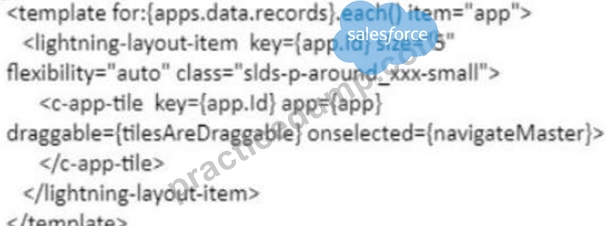
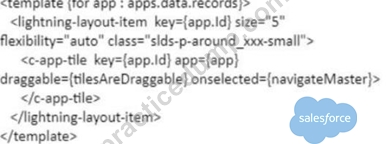
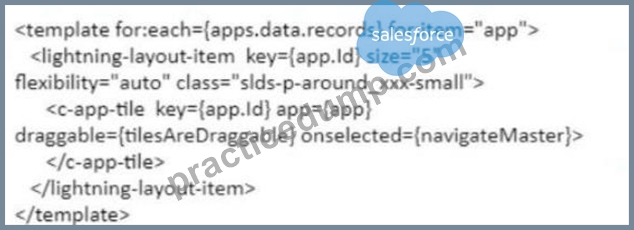
A developer needs to loop through a series of child components which are tiles. What is the correct syntax for this if the child component is called appTile?
- A.
- B.

- C.
- D.
Answer: D
Explanation:
The correct syntax for looping through a series of child components which are tiles is option A. Option A uses the for:each directive to iterate over a collection of items and render a template block for each item. The for:each directive requires an expression that evaluates to an array or an iterable object and an item alias that represents the current item in the iteration. The item alias can be used to access the item's properties or pass them to child components. In option A, the expression is appTiles, which is an array of objects that represent app tiles, and the item alias is appTile, which represents the current app tile object in the iteration. The appTile object's properties, such as name, description, and icon, are passed to the app-tile child component using attributes. Option B is incorrect because it uses an invalid syntax for the for:each directive. The for:each directive requires a colon (:) after the for keyword, not an equal sign (=). Option C is incorrect because it uses an invalid syntax for the for:each directive. The for:each directive requires an item alias that represents the current item in the iteration, not a key alias that represents the current index in the iteration. Option D is incorrect because it uses an invalid syntax for the template tag. The template tag requires a closing tag (</template>), not a self-closing tag (<template/>). Salesforce Reference: Lightning Web Components Developer Guide: Iterate Over a Collection, Lightning Web Components Developer Guide: Template Syntax
NEW QUESTION # 82
A developer is creating a component to implement a custom Terms and Conditions checkbox at checkout in the Aura Commerce template.
Which method should the developer implement on the Lightning web component to ensure the user accepts the terms and conditions?
- A. ComponentValidity
- B. Validate
- C. CheckValidity
- D. SaveCheckout
Answer: B
Explanation:
To implement a custom Terms and Conditions checkbox at checkout in the Aura Commerce template, a developer should add a Desired Delivery Date input field during the checkout flow. The Desired Delivery Date input field allows the customer to enter a date when they want their order to be delivered. The developer can use the @api decorator to expose this field as a public property of the Lightning web component and bind it to the ccCheckoutOrder object. The developer can also use the @wire decorator to get the current cart object and use its properties, such as shipping address and shipping method, to calculate and display an estimated delivery date based on the desired delivery date. The developer can also add validation logic to ensure that the desired delivery date is valid and acceptable. Adding the Expected Delivery Date field to the order confirmation email is not a good solution, as it does not allow the customer to choose or see their delivery date before placing their order. Displaying the Expected Delivery Date on the order page with a Lightning web component is not a good solution either, as it does not allow the customer to enter or change their delivery date after placing their order. Configuring an email alert to the customer when the Expected Delivery Date changes is not a good solution either, as it does not provide a consistent or reliable way of informing the customer about their delivery date. Salesforce Reference: B2B Commerce Developer Guide: Checkout Flow, B2B Commerce Developer Guide: Checkout Order Object, Lightning Web Components Developer Guide: Communicate with Properties
NEW QUESTION # 83
Ursa Major is planning to implement Salesforce B2B Commerce, and a developer needs to configure taxes for their storefront. The company operates in multiple states, each with different tax rates and tax rules.
What are two ways the developer should configure taxes in B2B Commerce?
- A. Use a different pricebook for each state.
- B. Configure tax rates and rules for each state in Salesforce B2B Commerce.
- C. Use the Salesforce out-of-the-box tax calculator.
- D. Configure a tax engine using third-party software.
Answer: B,D
Explanation:
Two ways that a developer should configure taxes in B2B Commerce for Ursa Major are: configure a tax engine using third-party software and configure tax rates and rules for each state in Salesforce B2B Commerce. Configuring a tax engine using third-party software allows the developer to integrate with an external tax service provider that can calculate and apply accurate and up-to-date tax rates and rules for different states and jurisdictions. The developer can use the sfdc_checkout.TaxCalculations interface or the RegisteredExternalService object to connect to the third-party tax service provider's API or service. Configuring tax rates and rules for each state in Salesforce B2B Commerce allows the developer to implement their own custom tax calculation logic using Apex code. The developer can use custom objects, such as TaxRate__c and TaxRule__c, to store and manage tax rates and rules for different states and products. The developer can also use the sfdc_checkout.TaxCalculations interface to define how to retrieve and apply tax rates and rules for a cart or an order. Using a different pricebook for each state is not a good way to configure taxes in B2B Commerce, as it can create complexity and inconsistency in pricing and discounting logic. Using the Salesforce out-of-the-box tax calculator is not a good way either, as it does not support complex or dynamic tax scenarios that may vary by state or jurisdiction. Salesforce Reference: [B2B Commerce Developer Guide: Tax Integration], [B2B Commerce Developer Guide: Tax Calculations Interface], [B2B Commerce Developer Guide: TaxRate Object], [B2B Commerce Developer Guide: TaxRule Object]
NEW QUESTION # 84
Which two Salesforce B2B Commerce visualforce pages must be enabled at a Salesforce Community level to make the out of the box SEO functionality available? (2 answers)
- A. SizeMap
- B. CCSizeIndex
- C. CCCatSiteMap
- D. ProductMap
Answer: B,C
Explanation:
Two Salesforce B2B Commerce Visualforce pages that must be enabled at a Salesforce Community level to make the out of the box SEO functionality available are:
CCSizeIndex: This page generates a sitemap.xml file, which is a file that lists all the pages and resources on a site that can be crawled by web crawlers. The page uses the configuration settings CO.SiteMapIncludeProducts and CO.SiteMapIncludeCategories to specify which products and categories should be included in the sitemap.
CCCatSiteMap: This page generates a category sitemap file, which is a file that lists all the categories on a site that can be crawled by web crawlers. The page uses the configuration setting CO.SiteMapCategoryDepth to specify how many levels of subcategories should be included in the category sitemap. Salesforce Reference: B2B Commerce and D2C Commerce Developer Guide, Sitemap Files
NEW QUESTION # 85
A user wants to have a Contact Us page in the storefront. This page will be a web-tolead form and it should have the header and footer, essentially the same look and feel as all the pages in the application. How can this requirement be fulfilled?
- A. Page Include
- B. Body Include Begin
- C. Subscriber Page (CC Page)
- D. Subscriber Template
Answer: C
Explanation:
To have a Contact Us page in the storefront that is a web-to-lead form and has the same look and feel as all the pages in the application, the requirement can be fulfilled by creating a Subscriber Page (CC Page). This is a custom Visualforce page that can be added to the storefront and use the standard header and footer components. The page can also include a web-to-lead form that submits data to Salesforce as leads. Salesforce Reference: B2B Commerce and D2C Commerce Developer Guide, Subscriber Pages
NEW QUESTION # 86
What are two considerations to keep in mind when including additional JavaScript files in a Lightning web component?
- A. A module can export named functions or variables
- B. The files must be ES6 modules and must have names that are unique within the component's folder.
- C. Each additional file needs a corresponding .js-meta.xml file.
- D. Additional JavaScript files should be minified before deployment
Answer: A,B
Explanation:
When including additional JavaScript files in a Lightning web component, a developer should keep in mind two considerations: the files must be ES6 modules and must have names that are unique within the component's folder and a module can export named functions or variables. The files must be ES6 modules because LWC uses ES6 modules as the standard for modular JavaScript code. The files must have names that are unique within the component's folder because LWC uses the file name as the module identifier and does not allow duplicate identifiers. A module can export named functions or variables because LWC supports named exports, which allow a module to export multiple values with different names. Each additional file does not need a corresponding .js-meta.xml file, as this is only required for the main JavaScript file of the component. Additional JavaScript files should not be minified before deployment, as this is not necessary or recommended for LWC. Salesforce Reference: [Lightning Web Components Developer Guide: Include JavaScript Files], [Lightning Web Components Developer Guide: ES6 Modules]
NEW QUESTION # 87
How are variables bound when services use the ccSercviceDao classto execute queries?
- A. Apex local variables
- B. Apex class variables
- C. String substitution
- D. Global variables
Answer: C
Explanation:
When services use the ccServiceDao class to execute queries, variables are bound by string substitution. This means that the query string contains placeholders for variables that are replaced by their values at runtime. For example, ccrz.ccServiceDao.getQuery('SELECT Id FROM Account WHERE Name = :name') will replace :name with the value of the name variable.
NEW QUESTION # 88
Salesforce B2B leverages global API's for encapsulating business logic into blocks that can be extended and modified by subscribers. Which three statements are true regarding extending ccServiceProduct and exposing custom fields on the Product Detail Page? (3 answers)
- A. Ensure that any helper methods are defined as private andstatic only.
- B. Create a public with sharing class that extends ccrz.ccServiceProduct.
- C. Create a global with sharing class that extends ccrz.ccServiceProduct.
- D. Override the fetch method and add your subscriber specific code here.
- E. Override the getFieldsMap method and add subscriber specific code.
Answer: C,D,E
Explanation:
To extend ccServiceProduct and expose custom fields on the Product Detail Page, three statements are true:
Override the getFieldsMap method and add subscriber specific code. This method returns a map of field names and field types for the product entity and its related entities. By overriding this method, the subscriber can add their custom fields to the map and make them available for the API.
Create a global with sharing class that extends ccrz.ccServiceProduct. This class will inherit all the methods and properties of the ccServiceProduct class and allow overriding or extending them. The class should be global and with sharing to ensure that it can be accessed by the API framework and respect the sharing rules.
Override the fetch method and add your subscriber specific code here. This method executes the query to fetch the product data and returns a result object. By overriding this method, the subscriber can modify the query or the result object to include their custom fields or logic. Salesforce Reference: B2B Commerce and D2C Commerce Developer Guide, Service Classes, ccServiceProduct Class
NEW QUESTION # 89
A user wants to have a Contact Us page in the storefront. This page will be a web-tolead form and it should have the header and footer, essentially the same look and feel as all the pages in the application. How can this requirement be fulfilled?
- A. Page Include
- B. Body Include Begin
- C. Subscriber Page (CC Page)
- D. Subscriber Template
Answer: C
NEW QUESTION # 90
Numerous flags ... have a direct impact on the result set provided by the Global API's. What Global API Data-Sizing convention flag prevents an API request from propagating to further requests when provided as a Boolean parameter with a value of true?
- A. ccrz.ccAPISizing.REL
- B. ccrz.ccAPISizing.ASSC
- C. ccrz.ccAPI.SZ_ASSC
- D. ccrz.ccAPI.SZ_REL
Answer: C
NEW QUESTION # 91
Which three pages should be enabled for the Guest user profile for a storefront to have anonymous checkout?
(3 answers)
- A. OrderConfirmation
- B. CheckoutNew
- C. OrderView
- D. CCPaymentInfo
- E. Checkout
Answer: A,B,D
NEW QUESTION # 92
Where are handlebar Templates defined in the Cloudcraze managed package?
- A. cc_hk_UserInterface extension
- B. Page Settings configuration
- C. Configuration Setting configuration
- D. uiProperties file
Answer: D
Explanation:
Handlebar Templates are defined in the uiProperties file in the cloudcraze managed package. This file contains various properties that control the behavior and appearance of the user interface components. The handlebarTemplates property defines a map of template names and template contents that are used by the handlebars.js templating engine to generate HTML from JSON data. Salesforce Reference: B2B Commerce and D2C Commerce Developer Guide, UI Properties, Handlebars Templates
NEW QUESTION # 93
How are version related upgrades passed on to subscriber API extensions/overrides?
- A. Extensions and overridden APIs don't support-related upgrades.
- B. The "delegate" allows inherited method calls access to the most recently specified service version
- C. APIs callback with specific versions specified; the user must know which version number to use.
- D. Copy and paste of specific code is "built-in"
Answer: B
NEW QUESTION # 94
What two things happen with the Cart during tax implementation?
- A. New entries are written to the Cart
- B. Previous entries are deleted from the Cart
- C. Previous entries are copied to another object
- D. New entries are written to the Order Summary
Answer: A,B
Explanation:
Two things that happen with the cart during tax implementation are that new entries are written to the cart and previous entries are deleted from the cart. A tax implementation is an integration that calculates and applies tax rates and amounts to a cart or an order based on various factors, such as product type, price, quantity, location, and tax rules. A tax implementation can use either an external tax service provider or custom Apex code to perform the tax calculation. When a tax implementation is invoked for a cart, it writes new entries to the cart with a type of Charge and a charge type of Tax. These entries represent the tax amounts and adjustments that are applied to the cart. Before writing new entries to the cart, the tax implementation deletes any existing entries with a type of Charge and a charge type of Tax from the cart. This ensures that the tax calculation is accurate and up-to-date based on the current state of the cart and avoids any conflicts or inconsistencies with previous tax entries. Previous entries are not copied to another object or modified with the new tax calculation, as these are not valid actions for handling existing tax entries. Salesforce Reference: B2B Commerce Developer Guide: Tax Integration, B2B Commerce Developer Guide: Tax Calculation Flow
NEW QUESTION # 95
How can a developer establish communication between components that are not in the same DOM (Document Object Model) tree?
- A. Use publish-subscribe pattern.
- B. Use dispatch events.
- C. Configure targets property.
- D. Use @api decorators.
Answer: A
Explanation:
To establish communication between components that are not in the same DOM (Document Object Model) tree, a developer can use the publish-subscribe pattern. The publish-subscribe pattern is a messaging pattern that allows components to communicate with each other without being directly connected or aware of each other. The components can publish events to a common channel and subscribe to events from that channel. The channel acts as a mediator that delivers the events to the subscribers. The developer can use a custom library or a Salesforce platform service, such as Lightning Message Service or Platform Events, to implement the publish-subscribe pattern. Configuring the targets property is not a way to communicate between components that are not in the same DOM tree, as it only defines where a component can be used in an app. Using dispatch events is not a way either, as it only works for components that are in the same DOM tree or have a parent-child relationship. Using @api decorators is not a way either, as it only exposes public properties or methods of a component to other components that use it. Salesforce Reference: Lightning Web Components Developer Guide: Communicate Across Salesforce UI Technologies, Lightning Web Components Developer Guide: Communicate with Events, [Lightning Web Components Developer Guide: Communicate with Properties]
NEW QUESTION # 96
What is true about mapping custom fields from Cart to Order Summary?
- A. The automatic Cart to Order mapping of custom fields can be disabled.
- B. A custom field must exist in the Cart and Order Summary objects only to be mapped successfully.
- C. There is a limit of 25 custom fields on a Cart that can be mapped to Order.
- D. All data types are supported for custom fields to be mapped from Cart to Order.
Answer: A
Explanation:
The correct answer for what is true about mapping custom fields from Cart to Order Summary is that the automatic Cart to Order mapping of custom fields can be disabled. A custom field is a field that is added by a developer or an administrator to an object to store additional information or data. A Cart is an object that represents a collection of products and charges that a customer intends to purchase in the storefront. An Order Summary is an object that represents a confirmed purchase of products and charges by a customer in the storefront. A Cart can be converted to an Order Summary when the customer completes the checkout process and confirms their order. By default, Salesforce B2B Commerce automatically maps custom fields from Cart to Order Summary when converting a Cart to an Order Summary. This means that any custom fields that exist on both Cart and Order Summary objects with identical API names and data types will have their values copied from Cart to Order Summary during the conversion. The automatic Cart to Order mapping of custom fields can be disabled by setting the B2BCommerce.CartToOrderMappingEnabled custom setting to false. This will prevent any custom fields from being copied from Cart to Order Summary during the conversion. A custom field must exist in the Cart and Order Summary objects only to be mapped successfully is not true, as it is not the only requirement for mapping custom fields from Cart to Order Summary. The custom fields must also have identical API names and data types, and the automatic Cart to Order mapping of custom fields must be enabled. All data types are supported for custom fields to be mapped from Cart to Order is not true, as some data types are not supported for mapping custom fields from Cart to Order Summary. The supported data types are Boolean, Date, DateTime, Double, Integer, Long, Percent, String, and TextArea. There is a limit of 25 custom fields on a Cart that can be mapped to Order is not true, as there is no such limit for mapping custom fields from Cart to Order Summary. Any number of custom fields that meet the mapping requirements can be mapped from Cart to Order Summary. Salesforce Reference: [B2B Commerce Developer Guide: Custom Field Mapping], [B2B Commerce Developer Guide: Cart Object], [B2B Commerce Developer Guide: Order Summary Object]
NEW QUESTION # 97
Which three statements are true regarding event handling in the Salesforce B2B Commerce managed package?
(3 answers)
- A. Salesforce B2B Commerce relies on a series of Javascript click listener events.
- B. Writing directly to your own custom Backbone JS Views and Models automatically integrates that data into the Salesforce B2B Commerce Backbone Views and Models.
- C. Salesforce B2B Commerce relies on a central event channel for communication across various Salesforce B2B Commerce Backbone Views and Models called CCRZ.pubSub.
- D. CCRZ.pubSub extends the Backbone.Events JavaScript object.
- E. CCRZ.pubSub defines the following three functions which can be used for event handling: trigger, on, and once.
Answer: C,D,E
NEW QUESTION # 98
What are three advantages of using ccLog over the Salesforce
standard System.debug class? (3 answers)
- A. There is no need to create a User Trace Flag.
- B. There is no need to manually set a cookie to debug with the Site Guest User.
- C. Append #ccLog=<Logging Token Name> to the end of the storefront URL in order to get logs in the inspector console.
- D. ccLog can debug syntax errors found in the JavaScript.
- E. There is no need to use string concatenation to easily tag log statements with a subject.
Answer: A,B,E
NEW QUESTION # 99
Which cookie stores the effective account ID when effective account is enabled?
- A. apex__cc_anonymous_Country
- B. apex__currCartId
- C. apex__cclgtkn
- D. apex__effacc
Answer: D
Explanation:
The cookie that stores the effective account ID when effective account is enabled is apex__effacc. This cookie is set by the cc_hk_EffectiveAccount hook when a user switches to another account that they have access to. The cookie value is the ID of the effective account, which is used to determine the pricing, availability, and visibility of products and categories for that account. Salesforce Reference: B2B Commerce and D2C Commerce Developer Guide, Effective Account
NEW QUESTION # 100
......
Salesforce B2B Commerce Developer exam is an excellent opportunity for developers to demonstrate their expertise in the development of B2B commerce solutions using Salesforce. Salesforce Accredited B2B Commerce Developer certification is recognized globally and can help professionals stand out in a competitive job market. If you are a developer with experience in Salesforce B2B Commerce projects, this certification is a great way to showcase your skills and knowledge.
B2B-Commerce-Developer Questions - Truly Beneficial For Your Salesforce Exam: https://certkingdom.practicedump.com/B2B-Commerce-Developer-practice-dumps.html