

Passing Cisco 300-535 Exam Using 2026 Practice Tests
300-535 Study Guide Brilliant 300-535 Exam Dumps PDF
The Automating and Programming Cisco Collaboration Solutions Exam is ideal for network engineers, software developers, and architects who want to advance their skills in Cisco Collaboration technologies. 300-535 exam is an excellent opportunity to gain certification in the programming and automation fields, which are becoming increasingly important in the IT industry. Also, candidates who pass the exam earn the Cisco Certified DevNet Specialist - Collaboration Automation and Programmability certification, which is highly regarded in the industry and indicates their expertise in automating and programming collaboration solutions.
Cisco 300-535 Automating and Programming Cisco Collaboration Solutions certification exam is designed for IT professionals who are interested in automating and programming Cisco Collaboration Solutions. 300-535 exam is a part of the Cisco Certified DevNet Specialist Certification which is designed to help professionals with their programming skills and knowledge of Cisco technologies. 300-535 exam validates the candidate's knowledge and ability to implement Cisco Collaboration Solutions using programming and automation techniques.
Understanding functional and technical aspects of Automation APIs and Protocols Cisco Service Provider Solutions (300-535 SPAUTO)
The following will be asked from you in the CISCO 300-535 exam dumps:
- Identify the JSON instance based on a YANG model
- Use NETCONF and RESTCONF programmability protocols on Cisco devices
- Identify the XML instance based on a YANG model
- Automate service provider network configuration with Cisco NSO
- Implement configuration and operation management using RESTCONF protocol
- Describe and use network automation tools that utilize SSH
- Describe common HTTP authentication mechanisms (basic, token, and oauth)
- Describe and use tools to validate YANG data models on Cisco devices
- Describe how to automate service provider WAN with Cisco WAE
- Implement configuration and operation management using NETCONF protocol
- Compare common data types (JSON, XML, YAML, plain text, gRPC, and protobuf)
- Describe how to automate virtualized resources with Cisco ESC
- Describe and configure network traffic automation with Cisco XTC
- Compare the NETCONF datastores
- Describe the characteristics and use of YANG Data Models (OpenConfig, IETF, and Vendor)
NEW QUESTION # 69
Drag and drop the steps from the left into the correct order on the right to deploy an already created service into NSO. Not all options are used.
Answer:
Explanation:
Explanation
Reference:
https://www.ciscolive.com/c/dam/r/ciscolive/emea/docs/2019/pdf/LABSPG-2442.pdf
NEW QUESTION # 70
Refer to the exhibit. An engineer must change an interface description by adding "-modified" as a suffix. Which code snippet must be added to the box in the code to accomplish this task?
- A.

- B.

- C.
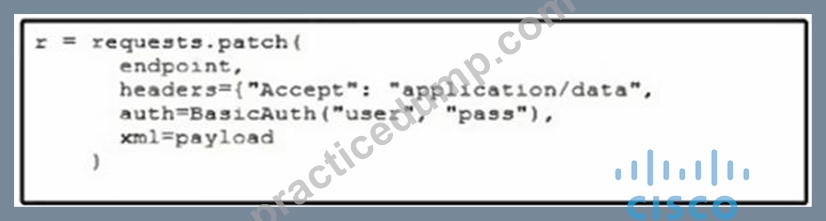
- D.

Answer: A
Explanation:
Chosen option uses the correct requests.patch method, the appropriate Content-type header for YANG-JSON, the correct authentication, and the payload format. This is required to update the interface description through the RESTCONF API.
NEW QUESTION # 71
Refer to the exhibit. An engineer needs a script to immediately change the hostname of the target endpoint. The hostname must revert to the previous hostname after rebooting. Which command must be used?
- A. edited_config = mgr.edit_config(target='failover',
config=config_to_apply) - B. edited_config = mgr.edit_config(target='startup',
config=config_to_apply) - C. edited_config = mgr.edit_config(target='boot',
config=config_to_apply) - D. edited_config = mgr.edit_config(target='running',
config=config_to_apply)
Answer: D
Explanation:
To change the configuration immediately but have it revert after a reboot, the configuration must be applied to the running datastore, not the startup (which persists across reboots). Changes to the running datastore are lost after a reboot unless they are also saved to startup.
NEW QUESTION # 72
When configuring LLQ (strict priority queue) on a traffic class using the Cisco IOS XR priority command on a Cisco ASR9K router, which additional QoS command is required for this traffic class?
- A. police
- B. shape
- C. random-detect
- D. bandwidth
Answer: A
Explanation:
The Low Latency Queueing feature brings strict priority queueing to Class-Based Weighted Fair Queueing (CBWFQ).
NEW QUESTION # 73
Refer to the exhibit. Which lines of code need to be placed on the snippet where the code is missing in the script to connect to a Cisco IOS XR device via NETCONF over port 10000 and download the running-config in XML format?
- A.

- B.

- C.

- D.

Answer: C
Explanation:
This option uses the variables host, PORT, USER, and PASSWORD as defined earlier in the script, and retrieves the running configuration in XML format from a Cisco IOS XR device using NETCONF.
NEW QUESTION # 74
Referring to the Cisco IOS XR configuration exhibit,
which labels will be advertised by the router with this configuration?
- A. No labels will be advertised to any LDP peers.
- B. Labels for all prefixes will be advertised to the 10.1.1.1 LDP peer.
- C. Only the label for 10.1.1.1/32 will be advertised to all the LDP peers.
- D. Labels for all prefixes will be advertised to all the LDP peers.
Answer: C
NEW QUESTION # 75
Drag and Drop Question
The YANG BGP service model is used to configure one or multiple loopback interfaces on routers in a network for iBGP and eBGP sessions. Drag and drop the code snippets from the bottom onto the blanks in the code to ensure that IP addresses are unique on individual routers and network- wide. Not all options are used. The exhibit does not show the entire code.
Answer:
Explanation:
Explanation:
First box (unique): ip
Second box (must): count (/bgp:bgp[device!=current()/../../device]/loopback/ip=current())=0 The unique ip; statement ensures each IP is unique within the loopback list for a device.
The must statement enforces that the loopback IP does not appear on any other device, making it unique network-wide.
NEW QUESTION # 76
Refer to the exhibit.
What are the two outcomes when the RESTCONF POST code is implemented? (Choose two.)
- A. An L3VPN endpoint to a VPN is replaced.
- B. An L3VPN endpoint to a VPN is updated.
- C. A new L3VPN endpoint to a VPN is added.
- D. A new VPN endpoint to a VPN is added.
- E. An L3VPN endpoint to a VPN is merged.
Answer: B,C
NEW QUESTION # 77
Drag and Drop Question
Drag and drop the components of Cisco Network Services Orchestrator from the left onto the correct definitions on the right.
Answer:
Explanation:
NEW QUESTION # 78
Refer to the exhibit.
What is the result of the Ansible task?
- A. It configures a Cisco IOS XR router with BGP AS65000 with two neighbors and redistributes OSPF into BGP.
- B. It configures a Cisco IOS router with BGP on AS500 and redistributes OSPF into BGP.
- C. It validates the BGP configuration on a Cisco IOS XR router, but it is a read-only module and cannot modify the configuration on the router.
- D. It validates the BGP configuration on a Cisco IOS XE router, but it is a check mode-only network module and cannot modify the configuration on the router.
Answer: A
Explanation:
Reference: https://docs.ansible.com/ansible/latest/modules/iosxr_bgp_module.html
NEW QUESTION # 79
Drag and Drop Question
Drag and drop the code snippets from the bottom onto the blanks in the script to add a new loopback interface on a Cisco IOS XE device using RESTCONF. Not all options are used.
Answer:
Explanation:
Explanation:
First blank (path): interface/Loopback
Second blank (header key): Content-Type
Third blank (payload key): interface
Fourth blank (request method): post
NEW QUESTION # 80
Refer to the Cisco IOS XR policy-map configuration exhibit.
What is wrong with the policy-map configuration?
- A. missing the bandwidth command under class one and class two
- B. missing the police command under class one and class two
- C. missing the priority percent command under class one and class two
- D. missing the priority bandwidth command under class one and class two
- E. missing the police command under class three
Answer: B
Explanation:
Hierarchical policing is also supported. In such a configuration, both parent and child policies have class-maps containing policing statements, as in the following example:
!
policy-map child
class gold
police rate percent 50 conform-action set precedence immediate exceed-action drop
!
!
policy-map parent
class match_all
police rate 10000 kbps burst 15000 exceed-action drop
service-policy child
NEW QUESTION # 81
Refer to the exhibit. What is the significance of "*" before the "father" leaf that is shown in the pyang tree output?
- A. It is a node list in a leaf type node.
- B. The node father is read-only in the family list.
- C. The father leaf is a key in the family list type.
- D. The leaf father is read-write in the family list.
Answer: A
NEW QUESTION # 82
After a configuration request is sent using NETCONF, which call releases any locks and resources associated with the session?
- A. <exit-operation>
- B. <close-session>
- C. <close-activity>
- D. <boot-app>
Answer: B
Explanation:
Section: 3.0 Network Device Programmability
Explanation/Reference: https://tools.ietf.org/html/rfc6241
NEW QUESTION # 83
An engineer is deploying a Python script to manage network devices through SSH. Which library based on Paramiko is used?
- A. libssh2
- B. netmiko
- C. paramiko.agent
- D. sshmiko
Answer: B
Explanation:
Reference:
https://pynet.twb-tech.com/blog/automation/netmiko.html
NEW QUESTION # 84
Which HTTP authentication mechanism sends user credentials in plaintext?
- A. Basic authentication
- B. Token authentication
- C. OAuth
- D. All of the above
Answer: A
NEW QUESTION # 85
How can a service package be deployed using NSO?
- A. All of the above
- B. Using the CLI
- C. Using the RESTCONF API
- D. Using the NETCONF API
Answer: A
NEW QUESTION # 86
What is a difference between JSON and XML in regard to data types?
- A. JSON is human-readable, whereas XML is binary.
- B. JSON uses comments, whereas XML supports arrays.
- C. JSON is binary, whereas XML is human-readable.
- D. JSON uses arrays, whereas XML supports comments.
Answer: D
Explanation:
JSON natively supports arrays as a data type, whereas XML allows comments but does not have a native array type.
NEW QUESTION # 87
Which two Python libraries are used to write a script to retrieve network device information using RESTCONF? (Choose two.)
- A. json
- B. PySNMP
- C. ncclient
- D. requests
- E. YANG
Answer: A,D
NEW QUESTION # 88
......
Free 300-535 Test Questions Real Practice Test Questions: https://certkingdom.practicedump.com/300-535-practice-dumps.html