

[Oct-2025] Study resources for the Valid D-PVM-OE-01 Braindumps!
Updated D-PVM-OE-01 Tests Engine pdf - All Free Dumps Guaranteed!
EMC D-PVM-OE-01 Exam Syllabus Topics:
| Topic | Details |
|---|---|
| Topic 1 |
|
| Topic 2 |
|
| Topic 3 |
|
| Topic 4 |
|
| Topic 5 |
|
NEW QUESTION # 93
Refer to the exhibit.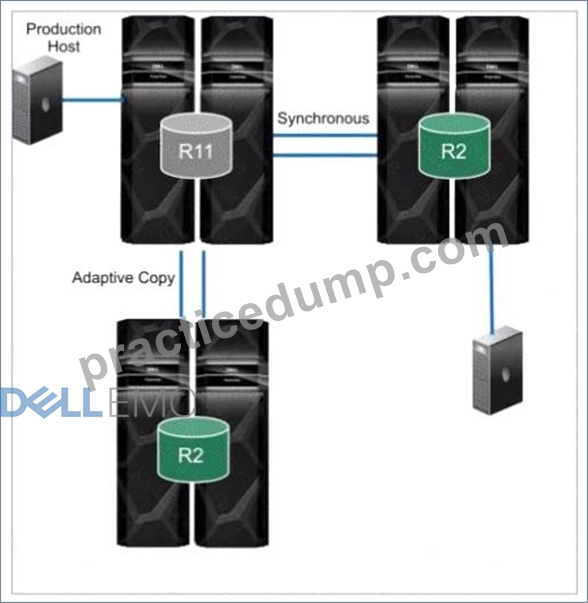
What is the topology shown1?
- A. SRDF/Metro
- B. Concurrent SRDF
- C. Cascaded SRDF
- D. SRDF/Star
Answer: C
Explanation:
Step by Step Comprehensive Detailed Explanation:
The topology shown in the exhibit depictsCascaded SRDF. This SRDF configuration involves three storage arrays (or sites) connected in a chained or cascaded manner.
Here's how it works:
* Primary Site (R1):The production host is connected to the primary storage array (R1).
* Intermediate Site (R2):The primary array (R1) synchronously replicates data to an intermediate array (R2).
* Remote Site (R2):The intermediate array (R2) then asynchronously replicates data to a remote array (also labeled R2 in the diagram).
This cascading setup provides a multi-hop disaster recovery solution, where data is first replicated synchronously to a nearby site for high availability and then asynchronously replicated to a further remote site for disaster recovery.
Why other options are incorrect:
* B. SRDF/Star:SRDF/Star involves a central array replicating to multiple remote arrays in a star-like pattern.
* C. SRDF/Metro:SRDF/Metro is designed for synchronous replication over short distances, typically within a metropolitan area.
* D. Concurrent SRDF:Concurrent SRDF allows multiple SRDF relationships to exist simultaneously for the same device.
References and documents of Dell's public documentation for PowerMax Operate v.2:
* Dell Solutions Enabler 10.0.0 SRDF Family CLI User Guide:This guide provides detailed information about different SRDF configurations, including Cascaded SRDF. You can find this document on the Dell Support website by searching for "Solutions Enabler SRDF Family CLI User Guide."
* Dell PowerMax Family: Essentials and Best Practices Guide:This guide offers a comprehensive overview of SRDF and its functionalities, including various topologies and use cases.
NEW QUESTION # 94
Which VMAX All Flash software package includes Non-Disruptive Migration?
- A. AppSync Starter
- B. Essentials
- C. Pro
- D. FX
Answer: D
Explanation:
https://visiondatacenter.com/products/DELLEMC_VMAX450F/vmax-software-datasheet.pdf
NEW QUESTION # 95
Place the steps to set Host Flags using the Create Host wizard in the correct order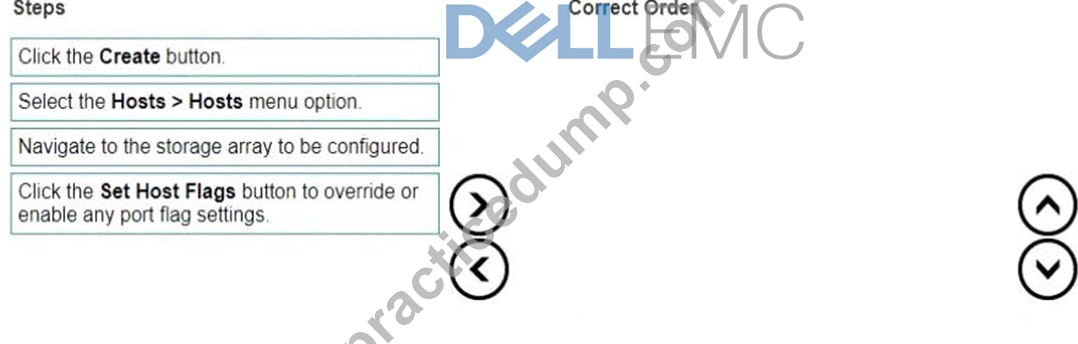
Answer:
Explanation: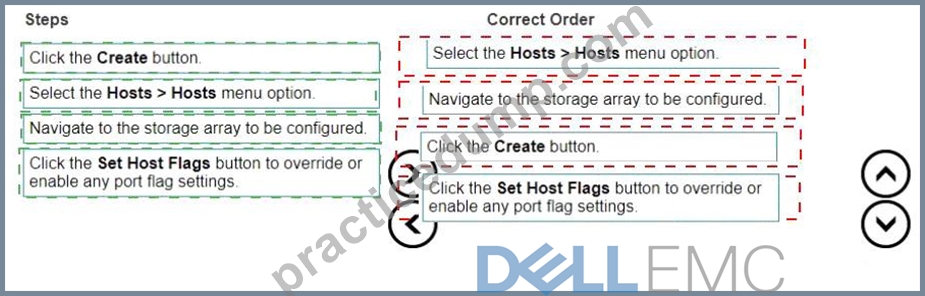
Explanation:
Here's the correct sequence of actions, along with explanations:
Correct Order:
* Select the Hosts > Hosts menu option.
* Why:This is the initial navigation step within Unisphere. You need to go to the "Hosts" section where you can manage and configure host connections to the PowerMax array.
* Navigate to the storage array to be configured.
* Why:In an environment with multiple PowerMax arrays, you need to select the specific array for which you want to configure host settings.
* Click the Create button.
* Why:This initiates the "Create Host" wizard, which will guide you through the process of adding a new host and configuring its settings, including the host flags.
* Click the Set Host Flags button to override or enable any port flag settings.
* Why:Within the Create Host wizard, you'll reach a point where you can configure host flags.
Clicking the "Set Host Flags" button allows you to modify these flags.
* Host Flags:These flags are settings that define how the PowerMax array interacts with the host.
They control things like:
* SCSI support:Different variations of SCSI protocols.
* High availability:Features like auto-negotiation of failover.
* Other host-specific behaviors.
* Select the Hosts > Hosts menu option.
* Navigate to the storage array to be configured.
* Click the Create button.
* Click the Set Host Flags button to override or enable any port flag settings.
NEW QUESTION # 96
SRDF/A has been enabled between two PowerMax arrays. Due to a loss of all RDF links, the SRDF/A session has been placed in a Transmit Idle state.
What happens to the cycle switching and the queue depths?
- A. Cycle switching continues; Transmit queue depth decreases
- B. Cycle switching stops; Transmit queue depth decreases
- C. Cycle switching stops; Transmit queue depth increases
- D. Cycle switching continues; Transmit queue depth increases
Answer: C
NEW QUESTION # 97
Which operation is used to perform Open Replicator migrations with minimal application down time?
- A. Hot push
- B. Cold pull
- C. Cold push
- D. Hot pull
Answer: D
NEW QUESTION # 98
A PowerMax 8000 was initially ordered as a multi-engine system. How does this system differ from a PowerMax 8000 that was initially ordered as a single-engine even if it is upgraded to a multi-engine system at a later time?
- A. Each director has the compression/deduplication module in Slot 9
- B. Each director has one more NVMe Flash module
- C. Each director has one more Universal FE slot
- D. Each director has twice the backend connectivity
Answer: C
NEW QUESTION # 99
An RDF group on a VMAX3 array is being replicated in SRDF/A mode to a remote VMAX3 array To accommodate application growth a new R1 device needs to be added to the RDF group SRDF/A consistency of the existing devices in the RDF group should be maintained when the new device is added.
What is the correct sequence of steps for adding the new R1 device and making it available for application use?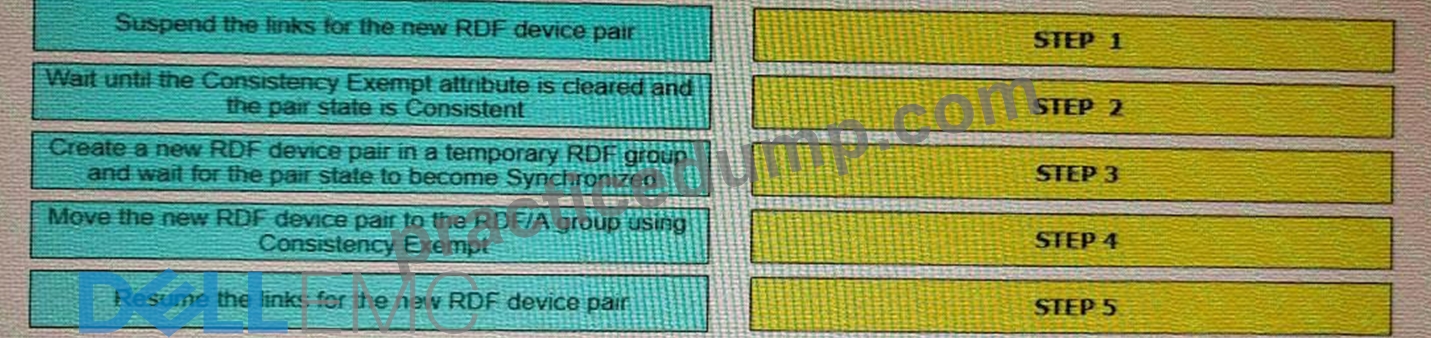
Answer:
Explanation: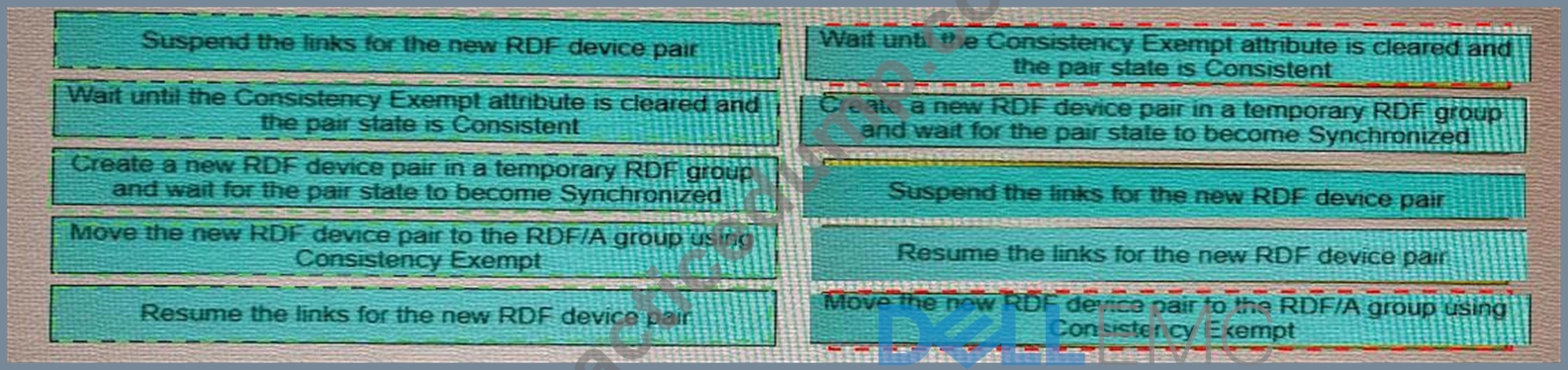
NEW QUESTION # 100
A Fibre Channel Host Bus Adapter (HBA) has failed on a host. You have been tasked with replacing the failed adapter.
What is the correct sequence of steps to successfully replace the adapter?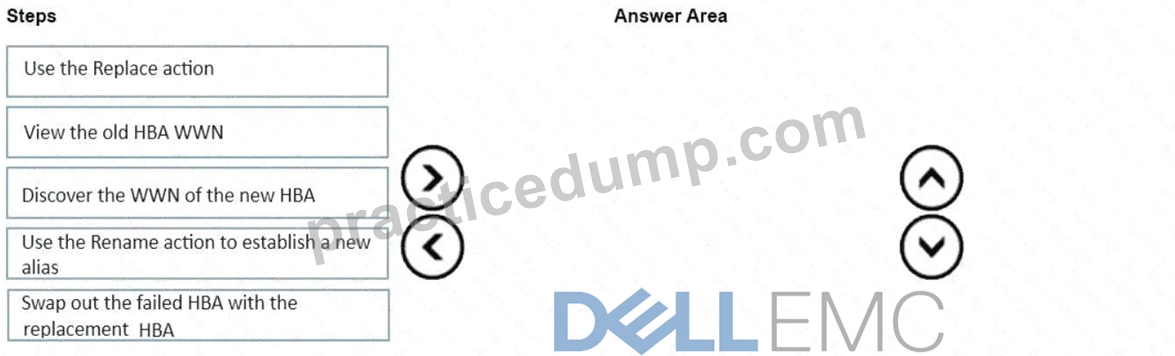
Answer:
Explanation: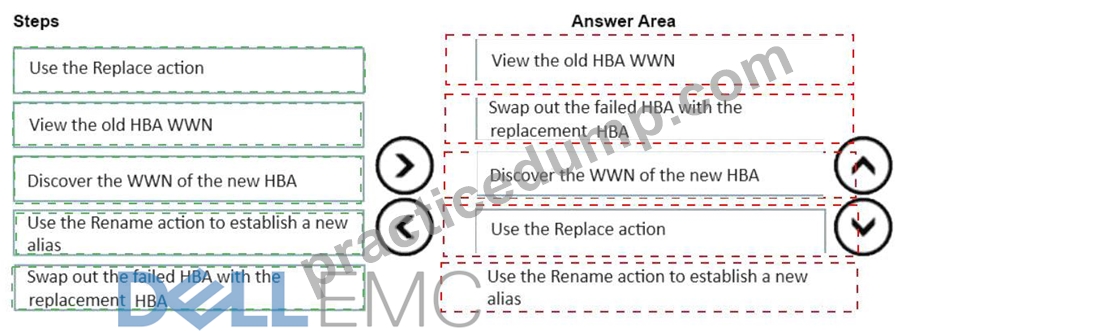
Explanation:
1.view old HBA WWN
2.swap out the old HBA
3.Discover the WWN
4.Use the replace action
5.Use the rename action
NEW QUESTION # 101
The web application server web_host_1 is deprecated. Remove all resources associated with the host to clean up the environment.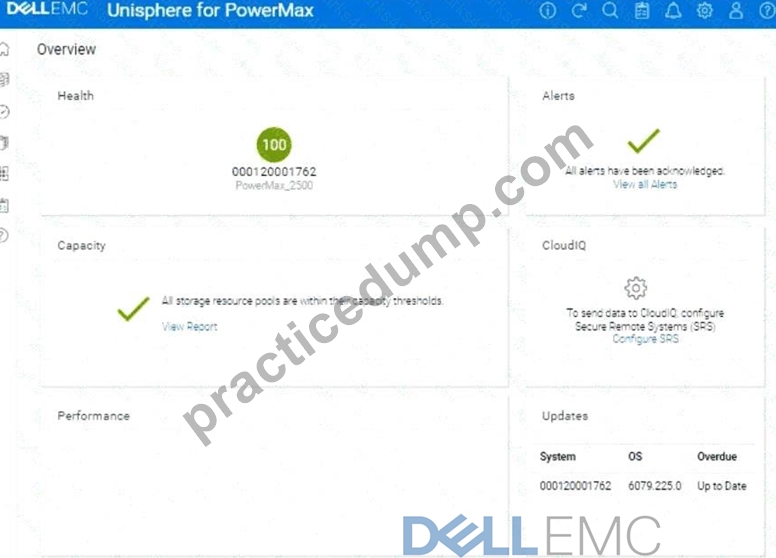
Using the simulator, complete the task.
Answer:
Explanation:
See the explanation for step by step solution.
Explanation:
We need to remove all resources associated with a deprecated web application server named web_host_1 in the Unisphere for PowerMax simulator.
Here's a step-by-step guide on how to accomplish this, based on typical Unisphere functionality and the context of the question:
Steps:
1. Launch the Simulator and Navigate to the Hosts Section
* Open Unisphere for PowerMax in your web browser.
* Log in to the simulator.
* In the left-hand navigation pane, click onHosts>Hosts. This will take you to the Hosts management view.
2. Locate the Host web_host_1
* In the Hosts view, you'll see a list of all configured hosts.
* Find the host named web_host_1. You might need to use the search or filtering options if there are many hosts listed.
3. Identify Associated Resources
* Before deleting the host, it's crucial to identify all resources associated with it. These typically include:
* Masking Views:These define the LUNs that a host can access.
* Storage Groups:These contain the volumes presented to the host.
* Port Groups:These define the connectivity paths (ports) used by the host.
* How to Find Associated Resources:
* Click on the web_host_1 host entry. This should open a details view or properties page for the host.
* Look for tabs or sections labeled "Masking Views," "Storage Groups," or similar.
* Note down the names of any masking views and storage groups associated with web_host_1.
4. Remove the Host from Masking Views
* Navigate toHosts>Masking Views.
* Locate the masking views that you identified in Step 3 as being associated with web_host_1.
* Open each masking view's properties.
* Remove the Host:There should be an option to edit the host list within the masking view. Find web_host_1 in the list of hosts and remove it.
* Save Changes:Save the changes to the masking view.
* Repeatfor all masking views associated with web_host_1.
5. Delete or Modify Storage Groups
* Navigate toStorage>Storage Groups.
* Locate the storage groups that were associated with web_host_1.
* Two Options:
* If the storage group is ONLY used by web_host_1:You can delete the entire storage group.
Select the storage group and click theDeletebutton (or a similar option).
* If the storage group is shared with other hosts:You need to remove the volumes associated with web_host_1 from the storage group.
* Open the storage group's properties.
* Go to the "Volumes" tab.
* Identify the volumes that were presented to web_host_1.
* Select those volumes and choose the option to "Remove from Storage Group" or a similarly worded option.
* Save the changes to the storage group.
6. Delete the Host
* Go back toHosts>Hosts.
* Select web_host_1.
* Click theDeletebutton (or a similar option, like a trashcan icon).
* Confirm that you want to delete the host.
7. Verify Removal (Optional)
* After deleting the host and modifying the storage groups and masking views, you can verify that the resources have been properly cleaned up.
* Check theStorage GroupsandMasking Viewssections again to ensure that web_host_1 is no longer listed and that the storage groups have been either deleted or modified as intended.
NEW QUESTION # 102
When using TimeFinder SnapVX technology, what is the maximum number of target volumes that can be linked to a snapshot on a single source volume?
- A. 0
- B. 1
- C. 2
- D. 3
Answer: D
Explanation:
Step by Step Comprehensive Detailed Explanation:
TimeFinder SnapVX is a snapshot technology in PowerMax that allows you to create point-in-time copies of data. When using SnapVX, you can link target volumes to a snapshot to create writable copies of the data at that specific point in time.
The maximum number of target volumes that can be linked to a single snapshot on a source volume is255.
This limitation ensures efficient management and performance of the SnapVX snapshots and linked targets.
Why other options are incorrect:
* B. 256, C. 512, D. 1024:These numbers exceed the maximum limit of linked targets per snapshot.
References and documents of Dell's public documentation for PowerMax Operate v.2:
* Dell Solutions Enabler 10.0.0 TimeFinder SnapVX CLI User Guide:This guide provides detailed information about SnapVX features and limitations, including the maximum number of linked targets per snapshot. You can find this document on the Dell Support website by searching for "Solutions Enabler TimeFinder SnapVX CLI User Guide."
* Dell PowerMax Family: Essentials and Best Practices Guide:This guide offers a comprehensive overview of PowerMax technologies, including SnapVX. It may provide context for understanding the limitations and best practices for using SnapVX snapshots and linked targets.
NEW QUESTION # 103
Refer to the exhibit.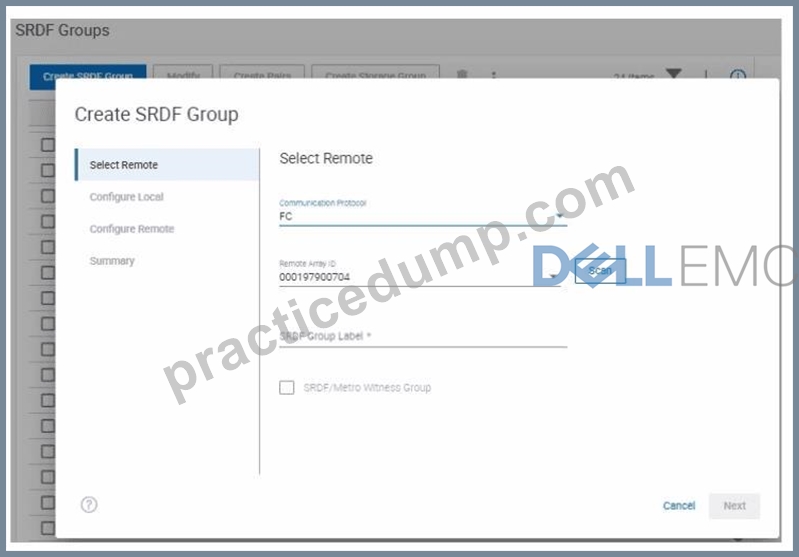
SRDF/Metro has been configured between two arrays using a physical witness.
When creating a new SRDF group for the configuration, why is the option to create an SRDF/Metro Witness Group greyed out?
- A. There can only be one SRDF/Metro Witness Group between two arrays
- B. SRDF/Metro Witness Groups can only be created with CLI.
- C. The SRDF Group Label needs to be left blank when creating an SRDF/Metro Witness Group
Answer: A
Explanation:
Step by Step Comprehensive Detailed Explanation:
SRDF/Metro is a high-availability solution that provides synchronous replication between two storage arrays located within a metropolitan distance. It utilizes a witness to prevent data loss in the event of a split-brain scenario (where communication between the arrays is lost).
In SRDF/Metro, there can be onlyoneWitness Group defined between two specific arrays. This Witness Group manages the witness device that acts as a tie-breaker in case of a communication failure between the arrays.
Since the exhibit shows that SRDF/Metro has already been configured between the two arrays using a physical witness, the option to create another SRDF/Metro Witness Group is grayed out because a Witness Group already exists for that pair of arrays.
Why other options are incorrect:
* B. SRDF/Metro Witness Groups can only be created with CLI:While CLI can be used, Witness Groups can also be created through Unisphere for PowerMax.
* C. The SRDF Group Label needs to be left blank when creating an SRDF/Metro Witness Group:
This is not a requirement. Witness Groups can have labels.
References and documents of Dell's public documentation for PowerMax Operate v.2:
* Dell Solutions Enabler 10.0.0 SRDF Family CLI User Guide:This guide provides detailed information about SRDF/Metro configuration, including the role of the witness and the Witness Group.
You can find this document on the Dell Support website by searching for "Solutions Enabler SRDF Family CLI User Guide."
* Dell PowerMax Family: Essentials and Best Practices Guide:This guide offers a comprehensive overview of SRDF/Metro and its functionalities, including witness configuration and best practices.
NEW QUESTION # 104
Which Unisphere for PowerMax client connection authentication type is irrevocable once it is selected?
- A. Windows AD Domain-based
- B. Multi-factor Authentication
- C. LDAP - SSL
- D. x.509 Common/Principal Name
Answer: D
NEW QUESTION # 105
Which services are active after a Unisphere for PowerMax installation on a Microsoft Windows host?
- A. SMAS and smasdb
- B. SYMAPI and symrdfg
- C. SMASandGNS
- D. SMASandSTP
Answer: A
Explanation:
Step by Step Comprehensive Detailed Explanation:
When you install Unisphere for PowerMax on a Microsoft Windows host, it installs several services necessary for its operation. The two primary services that are active after installation are:
* SMAS (Storage Management Agent Service):This service is responsible for communication between the Unisphere server and the PowerMax storage array. It handles tasks like collecting data, sending commands, and receiving alerts from the array.
* smasdb:This service manages the local database used by Unisphere for storing configuration information, performance data, and other relevant information.
Why other options are incorrect:
* A. SYMAPI and symrdfg:SYMAPI is a command-line interface tool, not a service. symrdfg is a service related to SRDF (Symmetrix Remote Data Facility) replication, which may not be active if SRDF is not configured.
* B. SMASandGNS:GNS is not a standard service associated with Unisphere for PowerMax.
* C. SMASandSTP:STP is not a standard service associated with Unisphere for PowerMax.
References and documents of Dell's public documentation for PowerMax Operate v.2:
* Dell Unisphere for PowerMax 10.0.0 Installation Guide:This guide provides detailed instructions for installing Unisphere for PowerMax on different operating systems, including Windows. It also lists the services that are installed and their functions. You can find this document on the Dell Support website by searching for "Unisphere for PowerMax Installation Guide."
* Dell Unisphere for PowerMax 10.0.0 Online Help:The online help documentation for Unisphere may also provide information about the services it uses and their roles.
NEW QUESTION # 106
Place the steps in the correct order for performing a Non-Disruptive Migration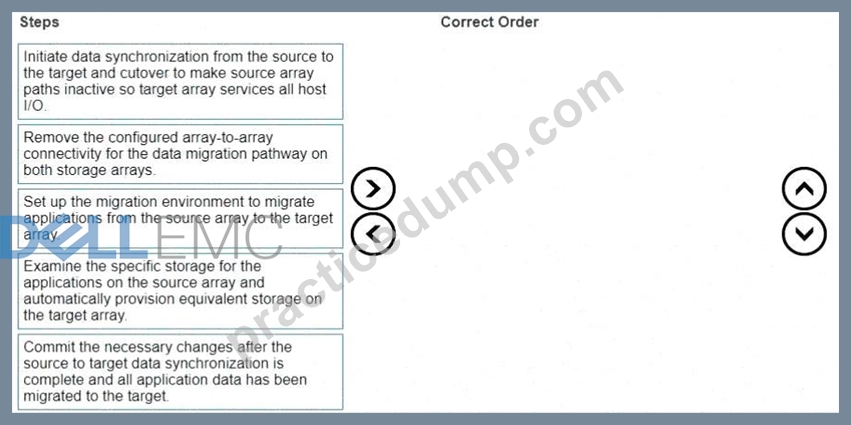
Answer:
Explanation: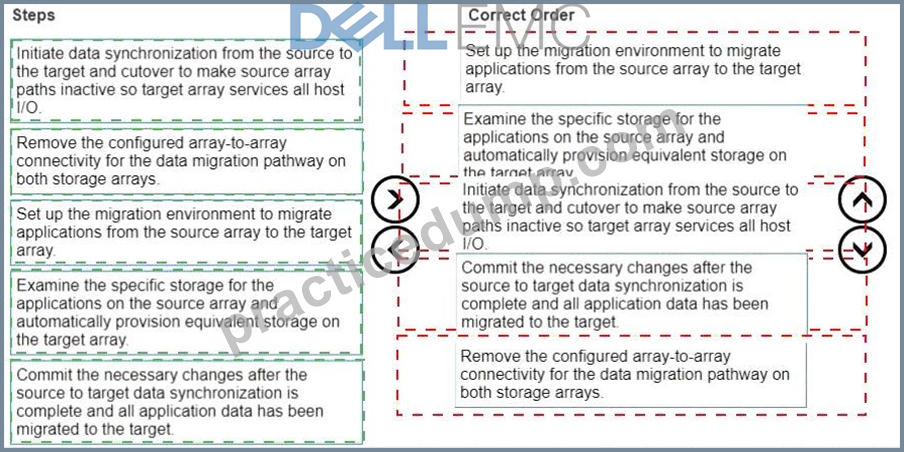
Explanation:
* Set up the migration environment to migrate applications from the source array to the target array.
* Examine the specific storage for the applications on the source array and automatically provision equivalent storage on the target array.
* Initiate data synchronization from the source to the target and cutover to make source array paths inactive so target array services all host I/O.
* Commit the necessary changes after the source to target data synchronization is complete and all application data has been migrated to the target.
* Remove the configured array-to-array connectivity for the data migration pathway on both storage arrays.
Correct Order:
* Set up the migration environment to migrate applications from the source array to the target array.
* Why:This is the initial setup phase, where you configure the necessary settings on both the source and target arrays to enable the migration. This involves actions like:
* Verifying compatibility between the source and target arrays.
* Ensuring that the required licenses are in place (e.g., NDM license).
* Configuring network connectivity (FC or iSCSI) for data transfer between the arrays.
* Examine the specific storage for the applications on the source array and automatically provision equivalent storage on the target array.
* Why:Before migrating data, you need to ensure that the target array has the appropriate storage capacity and configuration to host the applications.
* How:NDM can often automatically provision equivalent storage on the target based on the source configuration. This includes creating storage groups, volumes, and masking views that mirror the source.
* Initiate data synchronization from the source to the target and cutover to make source array paths inactive so target array services all host I/O.
* Why:This is the core of the migration process. Data is copied from the source to the target while the application continues to run. Cutover is the final step where I/O is redirected to the target array.
* How:
* Synchronization:Data is copied in the background.
* Cutover:Once synchronization is complete, a brief cutover is performed. In a well-planned NDM, this cutover is designed to be within the I/O timeout limits of most applications.
* Commit the necessary changes after the source to target data synchronization is complete and all application data has been migrated to the target.
* Why:This step finalizes the migration and makes it permanent.
* What it involves:The migration session is acknowledged and the configuration is finalized on the target array.
* Remove the configured array-to-array connectivity for the data migration pathway on both storage arrays.
* Why:After the migration is complete, the temporary connections used for data transfer between the arrays should be removed to free up resources and maintain a clean configuration.
* What it involves:This typically means removing the FC zones or iSCSI settings that were configured specifically for the NDM process.
NEW QUESTION # 107
You have just presented storage to an ESXi server and want to rescan the storage adapter to ensure the server can see the new volume Based on recommended best practices, what is the preferred method to perform this task?
- A. Run the command from a non-cluster host using the ESX CLI
- B. Use the vSphere Client to perform the rescan of the host
- C. Use the vSphere VSI plugin to rescan the entire cluster
- D. Run the command from the ESXi server with the ESX CLI enabled
Answer: B
NEW QUESTION # 108
SRDF/A has been enabled between two PowerMax arrays in Multi-Session Consistency mode An extended loss of all RDF links occurs. What will the RDF pair states be after link connectivity is restored?
- A. Partitioned
- B. Failed Over
- C. Suspended
- D. Split
Answer: C
NEW QUESTION # 109
On a PowerMax what is the correct sequence of steps to deduplicate data?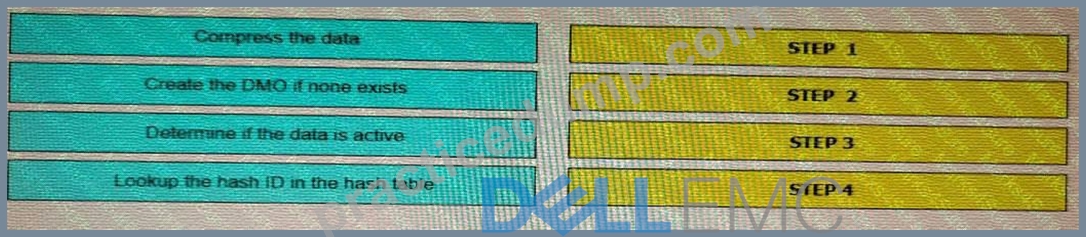
Answer:
Explanation: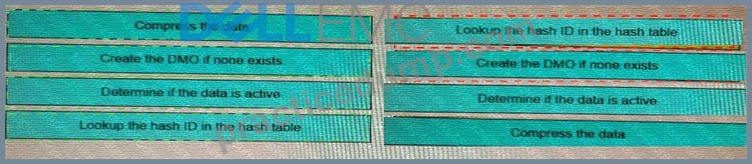
NEW QUESTION # 110
A systems administrator no longer needs the remote replica of a local device. Which step can be performed first in order to perform the deletepair function?
- A. Suspend the SRDF link
- B. Change the pair state to "NR"
- C. Split the SRDF link
- D. Change the type of the group to "regular
Answer: A
NEW QUESTION # 111
What is the default port number to access the Dell EMC vApp Manager for Solutions Enabler?
- A. 0
- B. 1
- C. 2
- D. 3
Answer: C
NEW QUESTION # 112
Four snapshots of a single source volume have been created. The snapshots were created with the same name at 8:00 AM, 10:00 AM, 12:00 PM: and 2:00 PM.
What is the generation number of the snapshot created at 2:00 PM?
- A. 0
- B. 1
- C. 2
- D. 3
Answer: C
Explanation:
Step by Step Comprehensive Detailed Explanation:
In TimeFinder SnapVX, snapshots of a source volume are assigned generation numbers. These numbers indicate the order in which the snapshots were created. The first snapshot taken has a generation number of 0, the second has 1, and so on.
In this case, four snapshots were created at different times:
* 8:00 AM (Generation 0)
* 10:00 AM (Generation 1)
* 12:00 PM (Generation 2)
* 2:00 PM (Generation 3)
Therefore, the snapshot created at 2:00 PM has a generation number of3.
References and documents of Dell's public documentation for PowerMax Operate v.2:
* Dell Solutions Enabler 10.0.0 TimeFinder SnapVX CLI User Guide:This guide provides detailed information about SnapVX features and functionalities, including how generation numbers areassigned to snapshots. You can find this document on the Dell Support website by searching for "Solutions Enabler TimeFinder SnapVX CLI User Guide."
NEW QUESTION # 113
......
D-PVM-OE-01 Dumps Updated Practice Test and 156 unique questions: https://certkingdom.practicedump.com/D-PVM-OE-01-practice-dumps.html