

Free Oct-2025 SPHR Certification Sample Questions certification Exam
Certification Topics of SPHR Exam PDF Recently Updated Questions
NEW QUESTION # 39
Which of the following provides additional pay for work that is considered beyond the minimum requirements of the job?
- A. Pay differential
- B. Seniority-based compensation
- C. Base pay
- D. Performance-based pay
Answer: A
Explanation:
Section: Volume F
Explanation/Reference:
Answer option A is correct.
Chapter: Compensation and Benefits
Objective: Compensation
NEW QUESTION # 40
Which of the following educates employees about the cultural and social differences in other cultures?
- A. Diversity training
- B. Calling meetings
- C. Technical training
- D. Diversity initiative
Answer: A
Explanation:
Explanation/Reference:
Answer option C is correct.
Chapter: Human Resource Development
Objective: Unique Employee Needs
NEW QUESTION # 41
The market your company operates within is changing and management is looking for you an SPHR for advice. They want you to identify risk that may affect the organization and take action to mitigate the identified risk events. What activity is management asking you to do?
- A. Organizational planning
- B. Risk response planning
- C. Enterprise risk management
- D. Identification of risk tolerance
Answer: C
Explanation:
Section: Volume E
Explanation
Explanation/Reference:
Answer option D is correct.
Management is asking you to do enterprise risk management. This process identifies risk events, creates risk responses, and tracks the risk responses for their effectiveness.
Answer option C is incorrect. Organizational planning describes the structuring of an organization, not the identification and response to risk events.
Answer option A is incorrect. Risk tolerance is an organization's willingness to accept risk events. It's the organization's attitude towards risk.
Answer option B is incorrect. Risk response planning is the examination of possible risk responses and the selection of the best response for the situation.
Reference: Professional in Human Resources Certification Study Guide, Sybex, ISBN: 978-0-470-43096-5.
Chapter Four: Workforce Planning and Employment. Official PHR and SPHR Certification Guide, HR Certification Institute, ISBN: 978-1-586-44149-4, Section III, The US Body of Knowledge.
Chapter: Business Management and Strategy
Objective: Strategic Management
NEW QUESTION # 42
What term is used to describe the values, worth, work ethics, attitude, and collective sense of an identity in an organization?
- A. Organizational branding
- B. Organizational culture
- C. Organizational persona
- D. Organizational politics
Answer: B
Explanation:
Reference: Professional in Human Resources Certification Guide, Sybex, ISBN: 978-0470-43096-5. Chapter 5: Human Resource Development. Official PHR and SPHR Certification Guide, HR Certification Institute, ISBN: 978-1-586-44149-4, Section III, The US Body of Knowledge.
Chapter: Human Resource Development
Objective: Organization Development
NEW QUESTION # 43
A decision about outsourcing specialized labor would most likely be made at which stage of the organizational life cycle?
- A. Growth
- B. Maturity
- C. Decline
- D. Startup
Answer: D
Explanation:
Explanation/Reference:
Answer option A is correct.
When funding is low due to startup conditions, a decision must be made regarding obtaining the talent necessary to do the work. Because organizations at this stage do not typically have the funds to develop employees from within such as in the growth and maturity stage (D, C), they often must choose which positions are critical to day-to-day operation and outsource the rest.
Chapter: Business Management and Strategy
Objective: Review Questions
NEW QUESTION # 44
Which of the following creates a variety of affirmative action obligations for employers with federal government contracts?
- A. Equal Employment Opportunity Commission (EEOC)
- B. Department of Labor (DOL)
- C. Office of Federal Contract Compliance Programs (OFCCP)
- D. Vietnam Era Veterans Readjustment Assistance Act (VEVRAA)
Answer: D
Explanation:
Explanation/Reference:
Answer option D is correct.
Chapter: Workforce Planning and Employment
Objective: Federal Employment Legislation
NEW QUESTION # 45
Which of the following are the best approaches to use when evaluating the effectiveness of a staffing plan?
(Select TWO options.)
- A. Generate recruiting metrics pre and post-implementation
- B. Analyze a vendor's literature against actual results
- C. Calculate the success of job rotation programs
- D. Measure the implementation timeframe of a new recruiting software
- E. Assess a new program in one unit against current practices
Answer: A,E
Explanation:
C offers measurable outcomes like time-to-fill, quality of hire, and turnover for before/after comparison.
D uses A/B testing logic, comparing a test group to a control group for a grounded assessment.
Extract from HRCI-aligned HR knowledge (Talent Planning and Acquisition):
SPHR-level HR must "use data analytics and benchmarking to assess staffing effectiveness." Metrics such as pre/post KPIs and pilot program evaluations are essential for continuous improvement.
NEW QUESTION # 46
Which of the following is an example of a nonqualified deferred-compensation plan?
- A. A money-purchase plan
- B. An excess-deferral plan
- C. A cash-balance plan
- D. A target-benefit plan
Answer: B
Explanation:
Answer option A is correct.An excess-deferral plan makes up the difference between what an executive could have contributed to a qualified plan if there had not been a limit on contributions and how much was actually contributed because of the discrimination test required by ERISA. These plans are nonqualified because they are not protected by ERISA; they are limited to a small group of executives or highly compensated employees. A target-benefit plan (B) is a hybrid with elements of defined-benefit and money-purchase plans. A money-purchase plan (C) defers a fixed percentage of employee earnings. A cash-balance plan (D) combines elements of defined-benefit and defined-contribution plans. See Chapter 6 for more information. Chapter: Compensation and Benefits Objective: Benefits
NEW QUESTION # 47
There are four levels of evaluation according to Kirkpatrick's Theory. Which of the following is NOT one of the four levels of evaluation?
- A. Learning
- B. Confirmation
- C. Behavior
- D. Reaction
Answer: B
Explanation:
Section: Volume B
Explanation/Reference:
Answer option C is correct.
Confirmation is not one of the four levels of evaluation in Kirkpatrick's Theory of Evaluation. The four levels are reaction, learning, behavior, and results.
Kirkpatrick's four levels of evaluation model are as follows:
* Reaction of student: This level of evolution measures the initial reaction of the participants.
* Learning: The learning evaluation method uses a test to measure whether the students have learned the presented information.
* Behavior: This level of evaluation uses a test to measure how well participants have learned the information presented in the training.
* Results: This level of evolution provides the feedback to the business whether the training have an impact on the business results or not.
Answer option B is incorrect. Reaction is one of the four levels of evaluation in Kirkpatrick's Theory.
Answer option D is incorrect. Learning is one of the four levels of evaluation in Kirkpatrick's Theory.
Answer option A is incorrect. Behavior is one of the four levels of evaluation in Kirkpatrick's Theory.
Reference: Professional in Human Resources Certification Guide, Sybex, ISBN: 978-0-470-43096-5. Chapter
5: Human Resource Development. Official PHR and SPHR Certification Guide, HR Certification Institute, ISBN:
978-1-586-44149-4, Section III, The US Body of Knowledge.
Chapter: Human Resource Development
Objective: Organization Development
NEW QUESTION # 48
The Americans with Disabilities Act of 1990 identifies an individual with a disability, as a person who has one or more of the following characteristics except for which one?
- A. Has a physical or mental impairment that substantially limits one or more major life activities
- B. Is believed by employers that an individual having a physical or mental impairment substantially limits one or more major employment activities
- C. Is regarded as having such impairment that substantially limits one or more major life activities
- D. Has a record of such impairment that substantially limits one or more major life activities
Answer: B
Explanation:
Section: Volume F
Explanation/Reference:
Answer option D is correct.
The basis of an individual with a disability is not left to the interpretation of the employer so this choice is incorrect.
Answer options B, C, and A are incorrect. These are valid statements based on the definitions provided in the Americans with Disabilities Act of 1990.
Reference: PHR Exam Prep, Pearson Education, ISBN: 978-0-7897-3677-2. Chapter Four: Workforce Planning and Employment. Official PHR and SPHR Certification Guide, HR Certification Institute, ISBN: 978-1-
586-44149, Section III, The US HR Body of Knowledge.
Chapter: Workforce Planning and Employment
Objective: Federal Employment Legislation
NEW QUESTION # 49
During a unionizing campaign, management may do which of the following in response to union allegations?
- A. Ask employees what the union is saying about the company.
- B. Tell employees that the company will have to move the jobs to another country if the union is elected.
- C. Point out the consequences of unionization based on past facts.
- D. Encourage nonunion employees to talk about the reasons they don't want the union.
Answer: C
Explanation:
Answer option B is correct.The company may make truthful statements about a unionized environment during an organizing campaign, such as pointing out that employees will have to pay dues to the union. Although nonunion employees are free to talk about their reasons for not wanting a union (C), it is an unfair labor practice for the employer to encourage them to do so. Telling employees that the company will have to move the jobs to another country if the union is elected (D) is also a ULP, because it constitutes a threat. Employers may not threaten, interrogate, promise, or spy on (TIPS) employees during an organizing campaign (A). Chapter: Employee and Labor Relations Objective: Review Questions
NEW QUESTION # 50
Which of the following communicates the executive team's expectations for the way the organization conducts business?
- A. Reengineering
- B. Corporate values statement
- C. SWOT analysis
- D. Mission statement
Answer: B
Explanation:
Explanation/Reference:
Answer option B is correct.
Chapter: Business Management and Strategy
Objective: Strategy
NEW QUESTION # 51
When designing new seminars and learning programs with ADDIE, you should often use SMART for learning objectives. What does SMART mean?
- A. Specific, Measurable, Action-oriented, Realistic, Time-bound
- B. Scalable, Measurable, Action-oriented, Reviewed, Time-bound
- C. Specific, Measurable, Action-oriented, Realistic, Tested
- D. Scalable, Measurable, Activities, Realistic, Tested
Answer: A
Explanation:
Section: Volume B
Explanation/Reference:
Answer option D is correct.
SMART means Specific, Measurable, Action-oriented, Realistic, Time-bound. SMART can be used for goal setting, learning objectives, and project management objectives.
Answer option A is incorrect. Scalable, Activities, and Tested aren't part of SMART.
Answer option B is incorrect. Scalable isn't part of SMART.
Answer option C is incorrect. Tested isn't part of SMART.
Reference: Professional in Human Resources Certification Guide, Sybex, ISBN: 978-0-470-43096-5. Chapter
5: Human Resource Development. Official PHR and SPHR Certification Guide, HR Certification Institute, ISBN:
978-1-586-44149-4, Section III, The US Body of Knowledge.
Chapter: Human Resource Development
Objective: Talent Management
NEW QUESTION # 52
As part of implementing a continuous improvement program, which measures should be established to determine the program's effectiveness?
- A. Business drivers
- B. Key performance indicators
- C. HR metrics
- D. Customer scores
Answer: B
Explanation:
Key Performance Indicators (KPIs)measure success against specific business objectives. They are essential for tracking whether continuous improvement efforts are deliveringmeasurable and strategic outcomes.
Extract from HRCI-aligned HR knowledge (Leadership and Strategy):
SPHR-level practitioners are expected to "define and monitor KPIs that align with strategic goals." These may include turnover rates, cycle times, employee productivity, or innovation metrics-tailored to the program's purpose.
NEW QUESTION # 53
As an HR Professional you must be familiar with several different lawsuits and their affect on human resource practices today. What legal case found that a test that has an adverse impact on a protected class is still lawful as long as the test can be shown to be valid and job related?
- A. Griggs versus Duke Power, 1971
- B. Albemarle Paper versus Moody, 1975
- C. Washington versus Davis, 1976
- D. McDonnell Douglas Corp. versus Green, 1973
Answer: C
Explanation:
Section: Volume A
Explanation/Reference:
Answer option D is correct.
Washington versus Davis is correct. Two African Americans were denied positions at the Washington DC police department because of their performance on a job-related test. The US Supreme Court ruled against the plaintiffs and deemed that the test did not violate the due process clause.
Answer option A is incorrect. The Griggs versus Duke Power lawsuit was heard in the US Supreme Court. This case, which preceded the Civil Rights Act of 1964, centered on a policy, Duke Power Company had of segregating employees by race.
Answer option B is incorrect. McDonnell Douglas Corp. versus Green, 1973 centered on a race discrimination case regarding the burdens and nature of proof in proving a Title VII of the Civil Rights Act of 1964.
Answer option C is incorrect. Albemarle Paper versus Moody, 1975 dealt with racial discrimination and the responsibilities of organizations to offer back pay to individuals that were racially discriminated. The racial discrimination may have prevented certain employees from advancing in the organization.
Reference: PHR Exam Prep, Pearson Education, ISBN: 978-0-7897-3677-2. Chapter Four: Workforce Planning and Employment. Official PHR and SPHR Certification Guide, HR Certification Institute, ISBN: 978-1-
586-44149, Section III, The US HR Body of Knowledge.
Chapter: Workforce Planning and Employment
Objective: Staffing Programs
NEW QUESTION # 54
As an HR Professional you must be familiar with several different lawsuits and their affect on human resource practices today. What did the legal case, the United Steelworkers of America versus Weber regard?
- A. The United States Supreme Court held that the Civil Rights Act of 1964 did bar employers from favoring minorities, but could do gender based favor.
- B. The United States Supreme Court held that the Civil Rights Act of 1964 did bar employers from favoring women and minorities.
- C. The United States Supreme Court held that the Civil Rights Act of 1964 did not bar employers from favoring women and minorities.
- D. The United States Supreme Court held that the Civil Rights Act of 1964 did bar employers from using racial criteria as a method to determine workplace advancement.
Answer: C
Explanation:
Reference: PHR Exam Prep, Pearson Education, ISBN: 978-0-7897-3677-2. Chapter Four: Workforce Planning and Employment. Official PHR and SPHR Certification Guide, HR Certification Institute, ISBN: 978-1-586-44149, Section III, The US HR Body of Knowledge.
Chapter: Workforce Planning and Employment
Objective: Staffing Programs
NEW QUESTION # 55
The best quality tool to use for gathering information about a specific problem is which of the following?
- A. An Ishikawa diagram
- B. A Pareto chart
- C. A stratification chart
- D. A histogram
Answer: A
Explanation:
Section: Volume F
Explanation/Reference:
Answer option B is correct.
An Ishikawa diagram is an effective tool for organizing information about a problem when brainstorming with a group. A Pareto chart (C) graphically represents the 80/20 rule. A stratification chart (A) shows the individual components of a problem in addition to the total or summary. A histogram (D) provides a way of looking at random occurrences to find out if there is a pattern.
Chapter: Human Resource Development
Objective: Review Questions
NEW QUESTION # 56
As an HR Professional, you must be aware of traditional corporate governance. Within corporate governance, there are typically three key stakeholders that influence decisions of the organizations. Which of the following is a key stakeholder as part of corporate governance?
- A. Customer
- B. Stakeholder
- C. Management
- D. Employees
Answer: C
Explanation:
Explanation/Reference:
Answer option B is correct.
Management is one of the three key stakeholders of corporate governance. Shareholders and the board of directors are the other two.
Answer option C is incorrect. Stakeholders are people that have a vested interest in the outcome of operations or projects.
Answer option D is incorrect. Customers are people that purchase goods or services from the organization.
Answer option A is incorrect. Employees are part of the stakeholder group, but they are not technically part of the stakeholders of corporate governance.
Reference: Professional in Human Resources Certification Study Guide, Sybex, ISBN: 978-0-470-43096-5.
Chapter Four: Workforce Planning and Employment. Official PHR and SPHR Certification Guide, HR Certification Institute, ISBN: 978-1-586-44149-4, Section III, The US Body of Knowledge.
Chapter: Business Management and Strategy
Objective: Corporate Governance
NEW QUESTION # 57
Which of the following is illegal except in the construction industry?
- A. Common shop clause
- B. Closed shop clause
- C. Union shop clause
- D. Agency shop clause
Answer: B
Explanation:
Answer option C is correct.The closed shop clause is illegal except in the construction industry. The closed shop clause requires that all new hires be members of the union before they are hired.Answer option D is incorrect. The agency shop clause specifies that all employees must either join the union or pay union dues if they choose not to join the union.Answer option B is incorrect. The union shop clause requires that all employees join the union within a grace period specified by the contract.Answer option A is incorrect. There is no such term as common shop clause. Chapter: Employee and Labor Relations Objective: Union Organization
NEW QUESTION # 58
Your organization has decided to implement a suggestion box for employees to anonymously voice their opinions about issues and concerns within the organization. While this approach is good, what must management do with these suggestions for employees to see the value?
- A. Act on the suggestions quickly.
- B. Read the suggestions.
- C. Post the suggestions for everyone to see.
- D. Discuss the suggestions.
Answer: A
Explanation:
Section: Volume B
Explanation/Reference:
Answer option D is correct.
While a suggestion box is good, the suggestions must be acted on in a timely manner for the suggestion box to be credible.
Answer option A is incorrect. Management must do more than just read the suggestions.
Answer option C is incorrect. Management shouldn't post the suggestions as this may deter people from contributing suggestions.
Answer option B is incorrect. Management must do more than just discuss the suggestions.
Reference: Professional in Human Resources Certification Guide, Sybex, ISBN: 978-0-470-43096-5.
Chapter 7: Employee and Labor Relations. Official PHR and SPHR Certification Guide, HR Certification Institute, ISBN: 978-1-586-44149-4, Section III, The US Body of Knowledge.
Chapter: Employee and Labor Relations
Objective: Employee Relations
NEW QUESTION # 59
As a Senior HR Professional you should be familiar with employment laws and their effect on your company. What did the lawsuit Payne v. The Western & Atlantic Railroad Company establish?
- A. A company couldn't coerce an employee to commit a crime to retain employment
- B. Employers could be liable for the actions of its employees
- C. Employers could be liable for sexual harassment of its employees
- D. Employment at will
Answer: D
Explanation:
Explanation/Reference:
Answer option A is correct.
The lawsuit Payne v. The Western & Atlantic Railroad Company in 1884 established the principle of employment at will.
Answer option B is incorrect. Employers can be found liable for sexual harassment of its employees. This is an example of respondeat superior.
Answer option C is incorrect. Employers can be found liable for the actions of its employees. This is an example of respondeat superior.
Answer option D is incorrect. Companies cannot coerce employees to commit a crime. This is the outcome of the Petermann v. International Brotherhood of Teamsters.
Reference: Professional in Human Resources Certification Guide, Sybex, ISBN: 978-0-470-43096-5.
Chapter 7: Employee and Labor Relations. Official PHR and SPHR Certification Guide, HR Certification Institute, ISBN: 978-1-586-44149-4, Section III, The US Body of Knowledge.
Chapter: Employee and Labor Relations
Objective: Federal Employment Legislation
NEW QUESTION # 60
During an interview test John scored highly as being an individual who possesses empathy for others. John has been awarded the job and is now performing in the organization. Evidence since John's hiring has shown that John is indeed someone who is empathetic to others. This is an example of what type of validity?
- A. Content validity
- B. Criterion-related validity
- C. Construct-related validity
- D. Predictive validity
Answer: D
Explanation:
Section: Volume C
Explanation/Reference:
Answer option A is correct.
Predictive-validity is a confirmation of characteristics, the candidate is tested for during the interview process, hold true in the actual performance of the candidate once they've been hired. John was tested to be someone who is empathetic to others and his job performance has validated this belief.
Answer option D is incorrect. Content validity is an evidence that the candidate can perform key aspects of the job in the interview process, such as conversing in English and then in Spanish if these were the requirements of the job.
Answer option C is incorrect. Criterion-related validity is an example where performance scores achieved by current employees are based on the criterion used for the selection. For example, current employees can perform better because they can design artwork in particular software programs so applicants must be able to use the particular software program to qualify for the position.
Answer option B is incorrect. Construct-related validity measures certain psychological tests to determine if the applicant possesses the desired characteristics to operate successfully in the position.
Reference: PHR Exam Prep, Pearson Education, ISBN: 978-0-7897-3677-2. Chapter Four: Workforce Planning and Employment. Official PHR and SPHR Certification Guide, HR Certification Institute, ISBN:
978-1-586-44149, Section III, The US HR Body of Knowledge.
Chapter: Workforce Planning and Employment
Objective: Staffing Programs
NEW QUESTION # 61
Which of the following types of interview has a list of questions prepared in advance and is used for all candidates?
- A. Stress interview
- B. Structured interview
- C. Panel interview
- D. Patterned interview
Answer: B
Explanation:
Answer option B is correct.
Chapter: Workforce Planning and Employment
Objective: Staffing Programs
NEW QUESTION # 62
Part of organizational development is a commitment to quality. What quality control tool shows categories of failures from largest to smallest in a bar chart?
- A. Control chart
- B. Fishbone diagram
- C. Pareto chart
- D. Histogram chart
Answer: C
Explanation:
Section: Volume B
Explanation/Reference:
Answer option C is correct.
A Pareto chart is a special histogram in that it shows categories of failures from the largest failure to the smallest failure. The idea is that the project team or organizational development team will attack the largest problems first.
Pareto chart
A Pareto chart is a special type of bar chart where the values being plotted are arranged in descending order.
The graph is accompanied by a line graph, which shows the cumulative totals of each category, left to right.
The chart is named after Vilfredo Pareto, and its use in quality assurance was popularized by Joseph
M. Juran and Kaoru Ishikawa.
A Pareto chart is a histogram where items (such as number of defects) are ordered by frequency of occurrence, as shown in the below example:
Example of a Pareto chart
It is a type of chart that consists both bars and a line graph, where individual values are represented in descending order by bars, and the cumulative total is shown by the line.
Answer option A is incorrect. A histogram is simply a bar chart and isn't ordered from largest to smallest.
Answer option D is incorrect. A fishbone diagram is also known as an Ishikawa diagram or a cause and effect chart.
Ishikawa diagram
The Ishikawa diagram (or fishbone diagram or also cause-and-effect diagram) is a diagram that shows the causes of a certain event. A common use of the Ishikawa diagram is to identify potential factors causing an overall effect. It helps identify causal factors and root causes.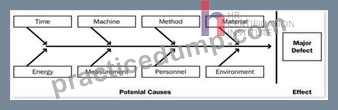
It is known as a fishbone diagram because of its shape, similar to the side view of a fish skeleton. It is considered as a basic tool of quality management.
Answer option B is incorrect. A control chart shows trend analysis by tracking the results of measurements over time.
What are control charts?
Control charts are graphical representations of different processes. These charts contain the maximum and minimum values allowed. Control charts are used to determine whether or not a process is stable or has predictable performance. A process is considered out of control when a data point exceeds a control limit or if seven consecutive points are above or below the mean.
Reference: Professional in Human Resources Certification Guide, Sybex, ISBN: 978-0-470-43096-5. Chapter
5: Human Resource Development. Official PHR and SPHR Certification Guide, HR Certification Institute, ISBN:
978-1-586-44149-4, Section III, The US Body of Knowledge.
Chapter: Human Resource Development
Objective: Organization Development
NEW QUESTION # 63
Which of the following addresses illegal immigration into the United States?
- A. Immigration and Nationality Act (INA)
- B. Black Lung Benefits Act (BLBA)
- C. Immigration Reform and Control Act (IRCA)
- D. Omnibus Budget Reconciliation Act (OBRA)
Answer: C
Explanation:
Answer option A is correct.
Chapter: Workforce Planning and Employment
Objective: Staffing Programs
NEW QUESTION # 64
......
2025 New Preparation Guide of HRCI SPHR Exam: https://certkingdom.practicedump.com/SPHR-practice-dumps.html