

Download ISC SSCP Exam Dumps to Pass Exam Easily in 2025
Get 100% Real Free ISC Certification SSCP Sample Questions
For more information, kindly read the exam references.
ISC SSCP Certification Exam Reference
NEW QUESTION # 154
Risk can be totally eliminated through planning, control, procedures, and insurance.<br>(True / False)
- A. True
- B. False
Answer: B
NEW QUESTION # 155
Which of the following protocols suite does the Internet use?
- A. TCP/IP
- B. IP/UDP/TCP
- C. IP/UDP/ICMP/TCP
- D. IMAP/SMTP/POP3
Answer: A
Explanation:
Explanation/Reference:
Transmission Control Protocol/Internet Protocol (TCP/IP) is the common name for the suite of protocols that was developed by the Department of Defense (DoD) in the 1970's to support the construction of the internet. The Internet is based on TCP/IP.
The Internet protocol suite is the networking model and a set of communications protocols used for the Internet and similar networks. It is commonly known as TCP/IP, because its most important protocols, the Transmission Control Protocol (TCP) and the Internet Protocol (IP), were the first networking protocols defined in this standard. It is occasionally known as the DoD model, because the development of the networking model was funded by DARPA, an agency of the United States Department of Defense.
TCP/IP provides end-to-end connectivity specifying how data should be formatted, addressed, transmitted, routed and received at the destination. This functionality has been organized into four abstraction layers within the DoD Model which are used to sort all related protocols according to the scope of networking involved.
From lowest to highest, the layers are:
The link layer, containing communication technologies for a single network segment (link), The internet layer, connecting independent networks, thus establishing internetworking, The transport layer handling process-to-process communication,
The application layer, which interfaces to the user and provides support services.
The TCP/IP model and related protocols are maintained by the Internet Engineering Task Force (IETF).
The following answers are incorrect:
IP/UDP/TCP. This is incorrect, all three are popular protocol and they are not considered a suite of protocols.
IP/UDP/ICMP/TCP. This is incorrect, all 4 are some of the MOST commonly used protocol but they are not called a suite of protocol.
IMAP/SMTP/POP3 . This is incorrect because they are all email protocol and consist of only a few of the protocol that would be included in the TCP/IP suite of protocol.
Reference(s) used for this question:
Hernandez CISSP, Steven (2012-12-21). Official (ISC)2 Guide to the CISSP CBK, Third Edition ((ISC)2 Press) (Kindle Locations 5267-5268). Auerbach Publications. Kindle Edition.
http://en.wikipedia.org/wiki/Internet_protocol_suite
NEW QUESTION # 156
What is the PRIMARY reason to maintain the chain of custody on evidence that has been collected?
- A. To ensure that incidents were handled with due care and due diligence.
- B. To ensure that all possible evidence is gathered.
- C. To ensure that it will be admissible in court
- D. To ensure that no evidence is lost.
Answer: C
Explanation:
Explanation/Reference:
This is the PRIMARY reason for the chain of custody of evidence. Evidence must be controlled every step of the way. If it is not, the evidence can be tampered with and ruled inadmissable. The Chain of Custody will include a detailed record of:
Who obtained the evidence
What was the evidence
Where and when the evidence was obtained
Who secured the evidence
Who had control or possession of the evidence
The following answers are incorrect because :
To ensure that no evidence is lost is incorrect as it is not the PRIMARY reason.
To ensure that all possible evidence is gathered is also incorrect as it is not the PRIMARY reason.
To ensure that incidents were handled with due care and due diligence is also incorrect as it is also not the PRIMARY reason.
The chain of custody is a history that shows how evidence was collected, analyzed, transported, and preserved in order to establish that it is sufficiently trustworthy to be presented as evidence in court.
Because electronic evidence can be easily modified, a clearly defined chain of custody demonstrates that the evidence is trustworthy which would make it admissible in court.
Reference : Shon Harris AIO v3 , Chapter-10: Law, Investigation, and Ethics , Page : 727
NEW QUESTION # 157
Preservation of confidentiality within information systems requires that the information is not disclosed to:
- A. Authorized person
- B. Unauthorized persons or processes.
- C. Unauthorized persons.
- D. Authorized persons and processes
Answer: B
Explanation:
Confidentiality assures that the information is not disclosed to unauthorized
persons or processes.
Source: KRUTZ, Ronald L. & VINES, Russel D., The CISSP Prep Guide: Mastering the
Ten Domains of Computer Security, 2001, John Wiley & Sons, Page 31.
NEW QUESTION # 158
Another name for a VPN is a:
- A. tunnel
- B. bypass
- C. one-time password
- D. pipeline
Answer: A
Explanation:
Source: TIPTON, Hal, (ISC)2, Introduction to the CISSP Exam presentation.
NEW QUESTION # 159
Because all the secret keys are held and authentication is performed on the Kerberos TGS and the authentication servers, these servers are vulnerable to:
- A. neither physical attacks nor attacks from malicious code.
- B. both physical attacks and attacks from malicious code.
- C. physical attacks only
- D. physical attacks but not attacks from malicious code.
Answer: B
Explanation:
Since all the secret keys are held and authentication is performed on the Kerberos TGS and the authentication servers, these servers are vulnerable to both physical attacks and attacks from malicious code.
Because a client's password is used in the initiation of the Kerberos request for the service protocol, password guessing can be used to impersonate a client.
NEW QUESTION # 160
Which of the following protocols is designed to send individual messages securely?
- A. Kerberos
- B. Secure Electronic Transaction (SET).
- C. Secure Sockets Layer (SSL).
- D. Secure HTTP (S-HTTP).
Answer: D
Explanation:
An early standard for encrypting HTTP documents, Secure HTTP (S-HTTP) is designed to send individual messages securely. SSL is designed to establish a secure connection between two computers. SET was originated by VISA and MasterCard as an Internet credit card protocol using digital signatures. Kerberos is an authentication system.
NEW QUESTION # 161
The primary service provided by Kerberos is which of the following?
- A. authentication
- B. non-repudiation
- C. confidentiality
- D. authorization
Answer: A
Explanation:
The answer: authentication. Kerberos is an authentication service. It can use single- factor or multi-factor authentication methods.
The following answers are incorrect:
non-repudiation. Since Kerberos deals primarily with symmetric cryptography, it does not help with non-repudiation.
confidentiality. Once the client is authenticated by Kerberos and obtains its session key and ticket, it may use them to assure confidentiality of its communication with a server; however, that is not a Kerberos service as such.
authorization. Although Kerberos tickets may include some authorization information, the meaning of the authorization fields is not standardized in the Kerberos specifications, and authorization is not a primary Kerberos service.
NEW QUESTION # 162
Which of the following issues is not addressed by digital signatures?
- A. data integrity
- B. denial-of-service
- C. nonrepudiation
- D. authentication
Answer: B
Explanation:
A digital signature directly addresses both confidentiality and integrity of the CIA triad. It does not directly address availability, which is what denial-of-service attacks.
The other answers are not correct because:
"nonrepudiation" is not correct because a digital signature can provide for nonrepudiation. "authentication" is not correct because a digital signature can be used as an authentication mechanism "data integrity" is not correct because a digital signature does verify data integrity (as part of nonrepudiation)
References:
Official ISC2 Guide page: 227 & 265 All in One Third Edition page: 648
NEW QUESTION # 163
What is the difference between Access Control Lists (ACLs) and Capability Tables?
- A. Access control lists are related/attached to an object whereas capability tables are related/attached to a subject.
- B. They are basically the same.
- C. Access control lists are related/attached to a subject whereas capability tables are related/attached to an object.
- D. Capability tables are used for objects whereas access control lists are used for users.
Answer: A
Explanation:
Capability tables are used to track, manage and apply controls based on the object and rights, or capabilities of a subject. For example, a table identifies the object, specifies access rights allowed for a subject, and permits access based on the user's posession of a capability (or ticket) for the object. It is a row within the matrix.
To put it another way, A capabiltiy table is different from an ACL because the subject is bound to the capability table, whereas the object is bound to the ACL.
CLEMENT NOTE:
If we wish to express this very simply:
Capabilities are attached to a subject and it describe what access the subject has to each of the objects on the row that matches with the subject within the matrix. It is a row within the matrix.
ACL's are attached to objects, it describe who has access to the object and what type of access they have. It is a column within the matrix.
The following are incorrect answers:
"Access control lists are subject-based whereas capability tables are object-based" is incorrect.
"Capability tables are used for objects whereas access control lists are used for users" is incorrect.
"They are basically the same" is incorrect.
NEW QUESTION # 164
What is a packet sniffer?
- A. It scans network segments for cabling faults.
- B. It tracks network connections to off-site locations.
- C. It monitors network traffic for illegal packets.
- D. It captures network traffic for later analysis.
Answer: D
Explanation:
Section: Network and Telecommunications
Explanation/Reference:
Source: TIPTON, Hal, (ISC)2, Introduction to the CISSP Exam presentation.
NEW QUESTION # 165
A proxy can control which services (FTP and so on) are used by a workstation , and also aids in protecting the network from outsiders who may be trying to get information about the:
- A. net BIOS' design
- B. user base
- C. network's design
- D. operating system design
Answer: C
Explanation:
To the untrusted host, all traffic seems to originate from the proxy server and addresses on the trusted network are not revealed.
"User base" is incorrect. The proxy hides the origin of the request from the untrusted host.
"Operating system design" is incorrect. The proxy hides the origin of the request from the untrusted host.
"Net BIOS' design" is incorrect. The proxy hides the origin of the request from the untrusted host.
References:
CBK, p. 467 AIO3, pp. 486 - 490
NEW QUESTION # 166
Who should DECIDE how a company should approach security and what security measures should be implemented?
- A. Data owner
- B. Auditor
- C. The information security specialist
- D. Senior management
Answer: D
Explanation:
They are responsible for security of the organization and the protection of its assets.
The following answers are incorrect because :
Data owner is incorrect as data owners should not decide as to what security measures should be applied.
Auditor is also incorrect as auditor cannot decide as to what security measures should be applied.
The information security specialist is also incorrect as they may have the technical knowledge of how security measures should be implemented and configured , but they should not be in a position of deciding what measures should be applied.
NEW QUESTION # 167
Which of the following would provide the BEST stress testing environment taking under consideration and avoiding possible data exposure and leaks of sensitive data?
- A. Test environment using test data.
- B. Production environment using test data.
- C. Test environment using sanitized live workloads data.
- D. Production environment using sanitized live workloads data.
Answer: C
Explanation:
The best way to properly verify an application or system during a stress test would be to expose it to "live" data that has been sanitized to avoid exposing any sensitive information or Personally Identifiable Data (PII) while in a testing environment. Fabricated test data may not be as varied, complex or computationally demanding as "live" data. A production environment should never be used to test a product, as a production environment is one where the application or system is being put to commercial or operational use. It is a best practice to perform testing in a non- production environment.
Stress testing is carried out to ensure a system can cope with production workloads, but as it may be tested to destruction, a test environment should always be used to avoid damaging the production environment. Hence, testing should never take place in a production environment.
If only test data is used, there is no certainty that the system was adequately stress tested.
NEW QUESTION # 168
This is a common security issue that is extremely hard to control in large environments. It occurs when a user has more computer rights, permissions, and access than what is required for the tasks the user needs to fulfill.
What best describes this scenario?
- A. Excessive Access
- B. Excessive Privileges
- C. Excessive Rights
- D. Excessive Permissions
Answer: B
Explanation:
Section: Access Control
Explanation/Reference:
Even thou all 4 terms are very close to each other, the best choice is Excessive Privileges which would include the other three choices presented.
Reference(s) used for this question:
HARRIS, Shon, All-In-One CISSP Certification Exam Guide, McGraw-Hill/Osborne, 2001, Page 645.
and
NEW QUESTION # 169
Failure of a contingency plan is usually:
- A. A management failure.
- B. A technical failure.
- C. Because of a lack of training.
- D. Because of a lack of awareness.
Answer: A
Explanation:
Failure of a contingency plan is usually management failure to exhibit ongoing interest and concern about the BCP/DRP effort, and to provide financial and other resources as needed. Lack of management support will result in a lack awareness and training.
NEW QUESTION # 170
Which Network Address Translation (NAT) is the most convenient and secure solution?
- A. Static Address Translation
- B. Port Address Translation
- C. Dedicated Address Translation
- D. Hiding Network Address Translation
Answer: B
Explanation:
Static network address translation offers the most flexibility, but it is not normally practical given the shortage of IP version 4 addresses. Hiding network address translation is was an interim step in the development of network address translation technology, and is seldom used because port address translation offers additional features above and beyond those present in hiding network address translation while maintaining the same basic design and engineering considerations. PAT is often the most convenient and secure solution.
Source: WACK, John et al., NIST Special publication 800-41, Guidelines on Firewalls and Firewall Policy, January 2002 (page 18).
NEW QUESTION # 171
What can be defined as an instance of two different keys generating the same ciphertext from the same plaintext?
- A. Ciphertext collision
- B. Key clustering
- C. Hashing
- D. Key collision
Answer: B
Explanation:
Section: Cryptography
Explanation/Reference:
Key clustering happens when a plaintext message generates identical ciphertext messages using the same transformation algorithm, but with different keys.
Source: KRUTZ, Ronald L. & VINES, Russel D., The CISSP Prep Guide: Mastering the Ten Domains of Computer Security, John Wiley & Sons, 2001, Chapter 4: Cryptography (page 130).
NEW QUESTION # 172
Which of the following is NOT a known type of Message Authentication Code (MAC)?
- A. DES-CBC
- B. Signature-based MAC (SMAC)
- C. Keyed-hash message authentication code (HMAC)
- D. Universal Hashing Based MAC (UMAC)
Answer: B
Explanation:
There is no such thing as a Signature-Based MAC.
Being the wrong choice in the list, it is the best answer to this question.
WHAT IS A Message Authentication Code (MAC)?
In Cryptography, a MAC (Message Authentication Code) also known as a cryptographic checksum, is a small block of data that is generated using a secret key and then appended to the message. When the message is received, the recipient can generate their own MAC using the secret key, and thereby know that the message has not changed either accidentally or intentionally in transit. Of course, this assurance is only as strong as the trust that the two parties have that no one else has access to the secret key.
A MAC is a small representation of a message and has the following characteristics:
A MAC is much smaller than the message generating it.
Given a MAC, it is impractical to compute the message that generated it. Given a MAC and the message that generated it, it is impractical to find another message generating the same MAC.
See the graphic below from Wikipedia showing the creation of a MAC value: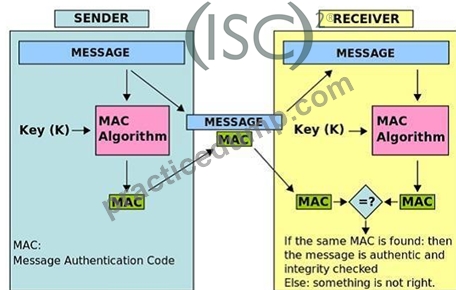
Message Authentication Code MAC HMAC
In the example above, the sender of a message runs it through a MAC algorithm to produce a MAC data tag. The message and the MAC tag are then sent to the receiver. The receiver in turn runs the message portion of the transmission through the same MAC algorithm using the same key, producing a second MAC data tag. The receiver then compares the first MAC tag received in the transmission to the second generated MAC tag. If they are identical, the receiver can safely assume that the integrity of the message was not compromised, and the message was not altered or tampered with during transmission.
However, to allow the receiver to be able to detect replay attacks, the message itself must contain data that assures that this same message can only be sent once (e.g. time stamp, sequence number or use of a one-time MAC). Otherwise an attacker could -- without even understanding its content -- record this message and play it back at a later time, producing the same result as the original sender.
NOTE: There are many ways of producing a MAC value. Below you have a short list of some implementation.
The following were incorrect answers for this question:
They were all incorrect answers because they are all real type of MAC implementation. In the case of DES-CBC, a MAC is generated using the DES algorithm in CBC mode, and the secret DES key is shared by the sender and the receiver. The MAC is actually just the last block of ciphertext generated by the algorithm. This block of data (64 bits) is attached to the unencrypted message and transmitted to the far end. All previous blocks of encrypted data are discarded to prevent any attack on the MAC itself. The receiver can just generate his own MAC using the secret DES key he shares to ensure message integrity and authentication. He knows that the message has not changed because the chaining function of CBC would significantly alter the last block of data if any bit had changed anywhere in the message. He knows the source of the message (authentication) because only one other person holds the secret key.
A Keyed-hash message authentication code (HMAC) is a specific construction for calculating a message authentication code (MAC) involving a cryptographic hash function in combination with a secret cryptographic key. As with any MAC, it may be used to simultaneously verify both the data integrity and the authentication of a message. Any cryptographic hash function, such as MD5, SHA-1, may be used in the calculation of an HMAC; the resulting MAC algorithm is termed HMAC- MD5 or HMAC-SHA1 accordingly. The cryptographic strength of the HMAC depends upon the cryptographic strength of the underlying hash function, the size of its hash output, and on the size and quality of the key.
A message authentication code based on universal hashing, or UMAC, is a type of message authentication code (MAC) calculated choosing a hash function from a class of hash functions according to some secret (random) process and applying it to the message. The resulting digest or fingerprint is then encrypted to hide the identity of the hash function used. As with any MAC, it may be used to simultaneously verify both the data integrity and the authenticity of a message.
UMAC is specified in RFC 4418, it has provable cryptographic strength and is usually a lot less computationally intensive than other MACs.
What is the MicMac (confusion) with MIC and MAC?
The term message integrity code (MIC) is frequently substituted for the term MAC, especially in communications, where the acronym MAC traditionally stands for Media Access Control when referring to Networking. However, some authors use MIC as a distinctly different term from a MAC; in their usage of the term the MIC operation does not use secret keys. This lack of security means that any MIC intended for use gauging message integrity should be encrypted or otherwise be protected against tampering. MIC algorithms are created such that a given message will always produce the same MIC assuming the same algorithm is used to generate both.
Conversely, MAC algorithms are designed to produce matching MACs only if the same message, secret key and initialization vector are input to the same algorithm. MICs do not use secret keys and, when taken on their own, are therefore a much less reliable gauge of message integrity than MACs. Because MACs use secret keys, they do not necessarily need to be encrypted to provide the same level of assurance.
NEW QUESTION # 173
......
SSCP Study Guide Realistic Verified Dumps: https://certkingdom.practicedump.com/SSCP-practice-dumps.html