

[2026] 220-1101 by A+ Actual Free Exam Practice Test
Free A+ 220-1101 Exam Question
CompTIA A+ certification is widely recognized in the IT industry, and it is a requirement for many entry-level IT positions. Employers view CompTIA A+ certification as an indication of the candidate's technical abilities, work ethic, and commitment to professional development. CompTIA A+ Certification Exam: Core 1 certification can help job seekers stand out in a crowded job market and increase their chances of landing a job in the IT industry.
CompTIA A+ Certification Exam: Core 1 is a valuable certification for entry-level IT professionals looking to start their career in the IT industry. CompTIA A+ Certification Exam: Core 1 certification covers a range of topics related to hardware, software, networking, and security, making it a comprehensive validation of the candidate's technical abilities. CompTIA A+ certification is widely recognized in the IT industry and can help job seekers stand out in a competitive job market.
NEW QUESTION # 461
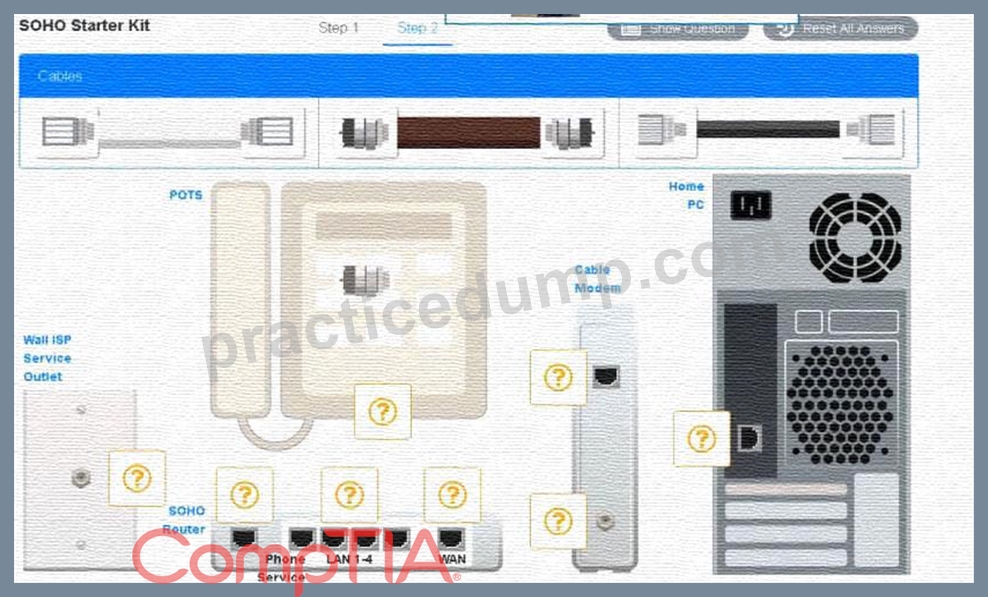
A small ISP has hired a new technician Joe, the new technician, is being trained to configure customers* home networks.
The trailing instructor gives me technician a starter kit with cables, cable ends, and other network equipment and asks mm to build a working network.
The computer should be connected to have internet connectivity and the phone should be connected to have a dial tone.
INSTRUCTIONS
Use the appropriate cables. cable ends, tools and equipment to configure the network ana connect an components accordingly.
There are 3 steps and the simulation starts on step 1.
Answer:
Explanation:
See the answer below in explanation part.
Explanation:
Answer of both steps below.

NEW QUESTION # 462
Which of the following BEST describes the main function of a web server?
- A. Hosting home pages and business portals
- B. Providing IP addresses and printing services
- C. Storing files and controlling user access
- D. Setting up personal mailboxes and calendars
Answer: A
NEW QUESTION # 463
A technician has set up a new conference room with a TV and a video soundbar. The technician wants to test the system with a conference call. During the test, the TV speaker produces sound, but the soundbar does not.
Which of the following is the MOST likely cause of the issue?
- A. An incorrect HDMI cable is being used.
- B. The volume on the TV needs to be turned up.
- C. The conference call needs to be unmuted for audio.
- D. The TV's HDMI-ARC port is not being used.
Answer: D
Explanation:
Explanation
HDMI-ARC (Audio Return Channel) is an HDMI connection that allows audio to be sent from the TV to an external sound system, such as a soundbar. If the TV's HDMI-ARC port is not being used, then the soundbar will not receive any audio from the TV and thus will not produce any sound. To resolve the issue, the technician should ensure that the TV's HDMI-ARC port is being used to connect the TV to the soundbar.
NEW QUESTION # 464
A technician is troubleshooting a wireless network issue. The users are all connected to the network, but the throughput is slow, and connections often drop. Which of the following should the technician check first?
- A. Number of connected devices
- B. Encryption cipher
- C. Antenna type
- D. Channel interference
Answer: D
Explanation:
The first thing that the technician should check when troubleshooting a wireless network issue with slow throughput and frequent connection drops is the channel interference. Channel interference is a common cause of poor Wi-Fi performance, as it occurs when multiple wireless networks or devices use the same or overlapping frequency bands, resulting in signal degradation, congestion, or collision. Channel interference can affect both 2.4 GHz and 5 GHz networks, but it is more likely to happen on the 2.4 GHz band, as it has fewer and narrower channels than the 5 GHz band.
To check for channel interference, the technician can use a Wi-Fi analyzer tool, such as the ones found in the web search results123, to scan the wireless environment and identify the best channel to use for the network.
A Wi-Fi analyzer tool can display various information, such as the network name (SSID), signal strength (RSSI), channel number, frequency, bandwidth, and security type. The technician can look for the following indicators of channel interference:
High network density: If there are many wireless networks or devices in the vicinity, they may compete for the same or adjacent channels, causing interference and congestion. The technician can look for the number of networks or devices on each channel and avoid the crowded ones.
Channel overlap: If there are wireless networks or devices that use the same or partially overlapping channels, they may interfere with each other and degrade the signal quality. The technician can look for the channel width and frequency of each network and avoid the overlapping ones. For example, on the 2.4 GHz band, the technician should use only the non-overlapping channels 1, 6, and 11, and avoid the channels in between.
Signal interference: If there are other sources of electromagnetic radiation or noise that operate on the same or similar frequency bands as the wireless network, they may interfere with the wireless signals and cause distortion or loss. The technician can look for the signal strength and quality of each network and avoid the ones that are weak or noisy. For example, some common sources of signal interference are microwave ovens, cordless phones, Bluetooth devices, or baby monitors.
To fix the channel interference issue, the technician can try the following solutions:
Change the channel of the wireless network: The technician can use the Wi-Fi analyzer tool to find the least congested and most optimal channel for the network, and then change the channel settings on the router or the access point. The technician should also consider using the 5 GHz band instead of the 2.4 GHz band, as it offers more and wider channels and less interference.
Relocate the router or the access point: The technician can move the router or the access point to a different location, away from potential sources of interference or obstacles that may block or weaken the wireless signals, such as walls, furniture, or metal objects. The technician should also place the router or the access point in a central and elevated position, to provide better coverage and signal quality for the network.
Upgrade the router or the access point: The technician can replace the router or the access point with a newer and more advanced model, that supports the latest Wi-Fi standards, such as Wi-Fi 6 (802.11ax) or Wi-Fi 5 (802.11ac). These standards offer higher data rates, lower latency, and better performance in dense and noisy environments, compared to the older standards, such as Wi-Fi 4 (802.11n) or Wi-Fi 3 (802.11g).
References:
How to Fix Wi-Fi Connection Drops - Lifewire4
How to Fix When Wi-Fi Keeps Disconnecting on Windows 115
How to Fix Wi-Fi Connection Drops - Lifewire6
How to Fix Wi-Fi Connection Drops - Lifewire7
How to Fix Wi-Fi Connection Drops - Lifewire8
NEW QUESTION # 465
A technician is replacing the power supply in a computer. Which of the following safety measures should the technician take to protect the computer?
- A. Wear an antistatic wrist strap.
- B. Wear gloves.
- C. Wear protective eyewear.
- D. Minimize the use of tools.
Answer: A
Explanation:
When replacing a power supply in a computer, wearing an antistatic wrist strap is crucial to prevent static electricity from damaging the computer components. Static electricity can easily damage sensitive electronic components within the computer; therefore, using an antistatic wrist strap helps to ground the technician, mitigating the risk of electrostatic discharge. The other options provide general safety but do not address the primary concern of electrostatic discharge in this context.
References:CompTIA A+ Core 1 (220-1101) objectives covering best practices for hardware maintenance, including electrostatic discharge prevention.
NEW QUESTION # 466
A technician receives multiple calls from users stating that documents submitted to a shared printer are not printing. The technician can ping the device to confirm it is powered on and connected to the network. The technician successfully prints a test page from the device control panel. Which of the following should the technician perform NEXT?
- A. Reinstall the print drivers
- B. Remove and reinstall the printer
- C. Restart the print spooler
- D. Reconfigure TCP/IP settings
Answer: C
NEW QUESTION # 467
A technician installed a Cat 5 UTP cable approximately 275ft (84m) from a network switch in an office to a workstation located on a factory floor The technician sees both a flashing green LED and a flashing orange LED on the workstation's NIC. Which of the following should the technician do FIRST?
- A. Upgrade the entire cable run to multimode fiber.
- B. Install a powered hub as close as possible to the halfway point in the Cat 5 UTP cable run.
- C. Replace the entire run of Cat 5 UTP cable with Cat 5 STP cable.
- D. Check for loose connections, pinched bends, and physical damage.
Answer: D
Explanation:
Explanation
The flashing green and orange LEDs on the NIC indicate connection issues. The technician should first check for loose connections, pinched bends, and physical damage, which are the most common causes of connection problems. References: CompTIA A+ Certification Exam Guide, Ninth Edition, Chapter 14
NEW QUESTION # 468
Laura, a customer, has instructed you to configure her home office wireless access point.
She plans to use the wireless network for finances and has requested that the network be setup with the highest encryption possible.
Additionally, Laura knows that her neighbors have wireless networks and wants to ensure that her network is not being interfered with by the other networks.
She requests that the default settings be changed to the following.
Wireless Name: HomeWiFi
Shared Key: CompTIA
Router Password: Secure$1
Finally, Laura wants to ensure that only her laptop and Smartphone can connect to the network.
Laptop: IP Address 192.168.1.100
Hardware Address: 00:0A:BF:03:C4:54
Smartphone: IP Address 192.168.1.101
Hardware Address: 09:2C:D0:22:3F:11
INSTRUCTIONS
Configure Laura's wireless network using the network adapter window.
If at any time you would like to bring back the initial state of the situation, please click the Reset All button.


Answer:
Explanation:
See the explanation below
Explanation:
solution as


NEW QUESTION # 469
A technician is receiving reports that the entire office sporadically loses network connectivity throughout the day. The technician determines the root cause to be EMI. Which of the following cable mediums would be the MOST cost effective without sacrificing system performance?
- A. Coaxial
- B. Shielded Cat 6
- C. Multimode fiber
- D. Plenum Cat 5e
Answer: B
Explanation:
Shielded Cat 6 cable mediums would be the MOST cost-effective without sacrificing system performance.
NEW QUESTION # 470
A technician attempts to join a Windows client to a domain but receives the following error:
An attempt to resolve the hostname has failed.
The technician generates the display shown below utilizing ipconfig /all.
Which of the following is the most likely reason for the error?
- A. Subnet mask
- B. DNS
- C. Default gateway
- D. IPv4 address
- E. Physical address
Answer: B
Explanation:
The most likely reason for the error is that the DNS server is not configured correctly. The technician should check the DNS server settings and make sure they are correct.
DNS, or Domain Name System, is a service that translates domain names, such as www.example.com, into IP addresses, such as 192.168.1.1, that computers use to communicate with each other. DNS is essential for joining a Windows client to a domain, which is a logical group of computers that share a common directory and security policy. A domain name, such as example.com, identifies the domain and its members on the network.
To join a Windows client to a domain, the client needs to resolve the hostname of the domain controller, which is the server that manages the domain and its resources. The client sends a DNS query to the DNS server, asking for the IP address of the domain controller. The DNS server responds with the IP address, and the client uses it to establish a connection with the domain controller and complete the domain join process.
However, if the DNS server is not configured correctly, the client may not be able to resolve the hostname of the domain controller, and receive the error: An attempt to resolve the hostname has failed. This can happen if the DNS server is not reachable, not authoritative, or not updated. For example, the DNS server may have an incorrect IP address, a wrong DNS suffix, a missing or outdated DNS record, or a firewall blocking the DNS traffic.
To fix the error, the technician should verify that the DNS server settings on the client and the domain controller are correct and consistent. The technician can use the ipconfig /all command to display the DNS server settings, such as the IPv4 address, the subnet mask, the default gateway, and the DNS suffix. The technician can also use the nslookup command to test the DNS resolution and the ping command to test the connectivity. The technician should make sure that the client and the domain controller are using the same DNS server, and that the DNS server can resolve the hostname of the domain controller.
References:
How to Resolve the "Temporary failure in name resolution" Error1
Strict hostname resolution configured but no hostname was set2
Error: Hostname Not Resolved to an IP Address - HostGator3
The Host Name Could Not be Resolved in DNS4
Troubleshoot DNS name resolution on the Internet - Windows Server5
NEW QUESTION # 471
A technician needs to confirm that desktop PCs can be deployed to a global, remote workforce. Which of the following specifications should the technician validate?
- A. BIOS language support
- B. Supply chain security
- C. Input voltage
- D. Power efficiency
Answer: C
Explanation:
Input voltage must be validated to ensure desktop PCs can operate in different regions with varying power standards (e.g., 110V in North America vs. 220V in Europe). Failure to verify input voltage compatibility can lead to hardware damage or operational issues.
Option B (BIOS language support): Incorrect. While language support may be helpful, it is not critical for hardware deployment across regions.
Option C (Supply chain security): Incorrect. This refers to ensuring secure sourcing of components but does not directly impact deployment.
Option D (Power efficiency): Incorrect. Power efficiency may be important for energy savings but is not relevant to regional compatibility.
Reference:
CompTIA A+ Core 1 Objectives: 3.5 (Power supply requirements)
NEW QUESTION # 472
A field technician has been dispatched to a site with an internet outage. Upon arriving, the technician discovers that the POTS lines are not working as well. Which of the following technologies is the site MOST likely using?
- A. Satellite
- B. DSL
- C. Cable
- D. Fiber
Answer: B
Explanation:
DSL (Digital Subscriber Line) uses POTS (Plain Old Telephone Service) lines to provide high-speed internet access. If the POTS lines are not working, it could cause an internet outage for DSL customers. Fiber and cable internet typically use different types of infrastructure, while satellite internet is not reliant on POTS lines. Reference: CompTIA A+ Certification Exam: Core 1 - Page 231
NEW QUESTION # 473
Which of the following is used to register inputs on a touch-screen monitor?
- A. Inverter
- B. Digitizer
- C. OLED
- D. Cathode-ray tube
Answer: B
Explanation:
The digitizer converts touch inputs into digital signals, enabling touch functionality on a monitor. This component is essential for touch screens to process user input and is covered under the CompTIA A+ Core 1 objective on display technologies for mobile devices.
NEW QUESTION # 474
A department sends in a ticket to report a printer is not working. The responding technician sees paper stuck to the fuser, which is much hotter than normal. The (user was just installed a few weeks ago. as indicated by the service history. Which of the following should the technician do NEXT?
- A. Replace the overheating fuser.
- B. Disconnect the printer power for troubleshooting.
- C. Replace the paper with thicker paper stock.
- D. Install a printer roller kit.
Answer: B
Explanation:
The first step in troubleshooting a printer issue is to disconnect the printer power to avoid electric shock or further damage to the printer. The technician can then inspect the fuser and determine if it needs to be replaced or repaired. Installing a printer roller kit or replacing the paper with thicker paper stock will not solve the problem of the overheating fuser. Replacing the fuser without disconnecting the power is dangerous and not recommended. References: https://www.comptia.org/certifications/a#examdetails
https://www.comptia.org/blog/what-is-a-fuser
NEW QUESTION # 475
A customer reports that a printer is only printing misaligned images. Which of the following should the technician do to correct the issue?
- A. Perform a calibration.
- B. Scan the document.
- C. Replace the ink cartridge.
- D. Clean the print heads.
Answer: A
Explanation:
Calibration is the process of adjusting the printer settings to ensure that the printed output matches the original document. Calibration can fix issues such as misaligned images, color accuracy, and print quality. References: [Printer Calibration]
NEW QUESTION # 476
A customer is having an issue printing documents. The customer can print a text document without any issue.
However, when the customer prints a PDF containing images, the job fails and no other jobs will run until the computer is rebooted. Which of the following is the most likely cause of the issue?
- A. The firmware is EOL.
- B. The user is sending too many documents.
- C. The print queue is moving too slowly.
- D. The printer is using a PostScript driver.
Answer: D
Explanation:
Printers that use PostScript drivers are designed to handle complex printing tasks, including detailed graphics and images in PDF files. However, if the printer's PostScript driver is outdated, incompatible, or improperly configured, it may struggle to process and print PDF files containing images. Updating or reinstalling the PostScript driver, or choosing a different driver compatible with the printer and document type, can resolve this issue.
NEW QUESTION # 477
A laser printer is making humming and grinding noises, and the printouts have ghost images on the pages.
Which of the following should be replaced?
- A. Fuser
- B. Paper
- C. Rollers
- D. Cartridge
Answer: C
Explanation:
When a laser printer produces humming and grinding noises along with ghost images on the printouts, the issue is most likely related to the printer's rollers. These symptoms suggest that the rollers, which are responsible for feeding paper through the printer, may be worn out or dirty. This can cause them to not grip the paper properly, leading to repeated imprints or "ghosting" of images on the printouts. Replacing or cleaning the rollers should resolve both the noise and the print quality issues.
References:
* CompTIA A+ Core 1 (220-1101) Exam Objectives, specifically the sections dealing with printer maintenance and troubleshooting, which would include addressing issues with internal components such as rollers.
* General knowledge of laser printer operation and common issues, highlighting the role of rollers in paper feed mechanisms and their impact on print quality.
NEW QUESTION # 478
......
The 220-1101 exam covers a wide range of topics, including hardware components, networking concepts, mobile devices, and troubleshooting techniques. 220-1101 exam is designed to test the candidate's knowledge of these topics and their ability to apply that knowledge in real-world scenarios. Candidates who pass the exam will have demonstrated a solid foundation in IT support and will be well-prepared for a career in this field.
CompTIA 220-1101 Actual Questions and Braindumps: https://certkingdom.practicedump.com/220-1101-practice-dumps.html