

Accurate & Verified 2025 New SPLK-1005 Answers As Experienced in the Actual Test!
SPLK-1005 Certification Sample Questions certification Exam
Passing the SPLK-1005 exam is a valuable credential for IT professionals who work with Splunk Cloud. Splunk Cloud Certified Admin certification demonstrates that an individual has a strong understanding of Splunk Cloud and is capable of administering and managing Splunk Cloud deployments. Splunk Cloud Certified Admin certification can help IT professionals advance their careers and increase their earning potential.
The SPLK-1005 certification exam is an industry-recognized certification that demonstrates a professional’s expertise in Splunk Cloud administration. It is ideal for IT professionals who are responsible for the management and administration of Splunk Cloud environments. Splunk Cloud Certified Admin certification exam is also suitable for IT professionals who want to enhance their knowledge of Splunk Cloud and improve their career prospects.
NEW QUESTION # 35
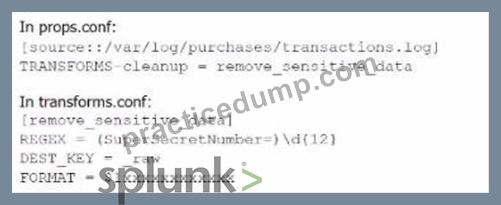
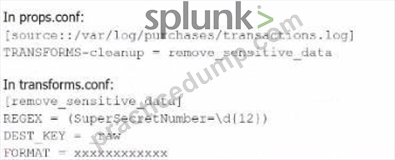
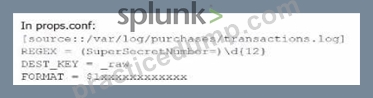
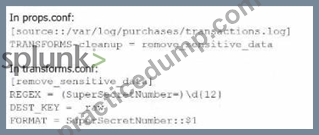
A user has been asked to mask some sensitive data without tampering with the structure of the file /var/log
/purchase/transactions. log that has the following format:
- A.
- B.
- C.
- D.
Answer: A
Explanation:
Option B is the correct approach because it properly uses a TRANSFORMS stanza in props.conf to reference the transforms.conf for removing sensitive data. The transforms stanza in transforms.conf uses a regular expression (REGEX) to locate the sensitive data (in this case, the SuperSecretNumber) and replaces it with a masked version using the FORMAT directive.
In detail:
* props.confrefers to the transforms.conf stanza remove_sensitive_data by setting TRANSFORMS- cleanup = remove_sensitive_data.
* transforms.confdefines the regular expression that matches the sensitive data and specifies how the sensitive data should be replaced in the FORMAT directive.
This approach ensures that sensitive information is masked before indexing without altering the structure of the log files.
Splunk Cloud Reference:For further reference, you can look at Splunk's documentation regarding data masking and transformation through props.conf and transforms.conf.
Source:
* Splunk Docs: Anonymize data
* Splunk Docs: Props.conf and Transforms.conf
NEW QUESTION # 36
Which feature allows a heavy forwarder to route data to different indexers based on criteria such as source, sourcetype, or host?
- A. Data filtering
- B. Data sampling
- C. Data masking
- D. Data cloning
Answer: D
NEW QUESTION # 37
When adding a directory monitor and specifying a sourcetype explicitly, it applies to all files in the directory and subdirectories. If automatic sourcetyping is used, a user can selectively override it in which file on the forwarder?
- A. outputs.cont
- B. props.conf
- C. transforms.conf
- D. inputs.conf
Answer: B
Explanation:
When a directory monitor is set up with automatic sourcetyping, a user can selectively override the sourcetype assignment by configuring the props.conf file on the forwarder. The props.conf file allows you to define how data should be parsed and processed, including assigning or overriding sourcetypes for specific data inputs.
Splunk Documentation Reference: props.conf configuration
NEW QUESTION # 38
Li was asked to create a Splunk configuration to monitor syslog files stored on Linux servers at their organization. This configuration will be pushed out to multiple systems via a Splunk app using the on-prem deployment server.
The system administrators have provided Li with a directory listing for the logging locations on three syslog hosts, which are representative of the file structure for all systems collecting this data. An example from each system is shown below: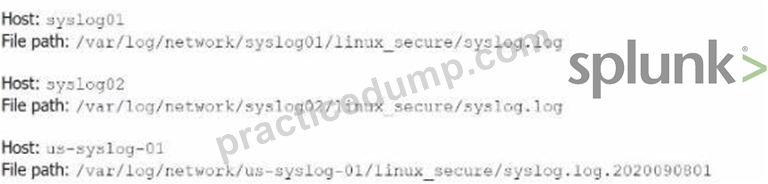
- A.

- B.

- C.

- D.

Answer: C
Explanation:
The correct monitor statement that will capture all variations of the syslog file paths across different systems is [monitor:///var/log/network/syslog*/linux_secure/*].
This configuration works because:
* syslog* matches directories that start with "syslog" (like syslog01, syslog02, etc.).
* The wildcard * after linux_secure/ will capture all files within that directory, including different filenames like syslog.log and syslog.log.2020090801.
This setup will ensure that all the necessary files from the different syslog hosts are monitored.
Splunk Documentation Reference: Monitor files and directories
NEW QUESTION # 39
By default, which of the following capabilities are granted to the sc_admin role?
- A. indexes_edit, fsh_manage, admin_all_objects can_delete
- B. indexes_edit, fsh_manage, acs_conf, list_indexesdiscovert
- C. indexes_edit, edit_token_http, admin _all objects, edit limits_conf
- D. indexes_edit, edit___token, admin_all_objects, delete_by_keyword
Answer: A
Explanation:
By default, the sc_admin role in Splunk Cloud is granted several important capabilities, including:
* indexes_edit: The ability to create, edit, and manage indexes.
* fsh_manage: Manage full-stack monitoring integrations.
* admin_all_objects: Full administrative control over all objects in Splunk.
* can_delete: The ability to delete events using the delete command.
Option C correctly lists these default capabilities for the sc_admin role.
Splunk Documentation Reference: User roles and capabilities
NEW QUESTION # 40
Which feature of forwarders can improve the network performance and reduce the bandwidth consumption?
- A. Data filtering
- B. Data compression
- C. Data sampling
- D. SSL security
Answer: B
NEW QUESTION # 41
Which of the following is the default bandwidth limit in the Splunk Universal Forwarder credentials package?
- A. 1024 KBps
- B. 512 KBps
- C. 256 KBps
- D. 0KBps
Answer: C
Explanation:
The default bandwidth limit in the Splunk Universal Forwarder is set to 256 KBps. This setting is in place to prevent the forwarder from overwhelming network resources, and it can be adjusted as necessary based on the deployment's specific needs.
Splunk Documentation Reference: Universal Forwarder Configuration
NEW QUESTION # 42
Which of the following are features of a managed Splunk Cloud environment?
- A. Availability of premium apps, SSO integration, maximum concurrent search limit of 20.
- B. 20GB daily maximum data ingestion, no SSO integration, no availability of premium apps.
- C. Availability of premium apps, no IP address whitelisting or blacklisting, deployed in US East AWS region.
- D. Availability of premium apps, SSO integration, IP address whitelisting and blacklisting.
Answer: D
Explanation:
In a managed Splunk Cloud environment, several features are available to ensure that the platform is secure, scalable, and meets enterprise requirements. The key features include:
* Availability of premium apps:Splunk Cloud supports the installation and use of premium apps such as Splunk Enterprise Security, IT Service Intelligence, etc.
* SSO Integration:Single Sign-On (SSO) integration is supported, allowing organizations to leverage their existing identity providers for authentication.
* IP address whitelisting and blacklisting:To enhance security, managed Splunk Cloud environments allow for IP address whitelisting and blacklisting to control access.
Given the options:
* Option Ccorrectly lists these features, making it the accurate choice.
* Option Aincorrectly states "no IP address whitelisting or blacklisting," which is indeed available.
* Option Bmentions "no SSO integration" and "no availability of premium apps," both of which are inaccurate.
* Option Dtalks about a "maximum concurrent search limit of 20," which does not represent the standard limit settings and may vary based on the subscription level.
Splunk Documentation References:
* Splunk Cloud Features and Capabilities
* Single Sign-On (SSO) in Splunk Cloud
* Security and Access Control in Splunk Cloud
NEW QUESTION # 43
A customer has worked with their LDAP administrator to configure an LDAP strategy in Splunk. The configuration works, and user Mia can log into Splunk using her LDAP Account. After some time, the Splunk Cloud administrator needs to move Mia from the user role to the power role. How should they accomplish this?
- A. Create a role named Power in Splunk, then map Mia's account to that role.
- B. Ask the LDAP administrator to move Mia's account to an appropriately mapped LDAP group.
- C. Have Mia log into Splunk, then update her own role in user settings.
- D. Use the Cloud Monitoring Console app as an administrator to map Mia's account to the power role.
Answer: B
Explanation:
Explanation: In Splunk Cloud, role-based access controls are managed by mapping LDAP groups to Splunk roles. Therefore, any change in roles should be managed by the LDAP administrator, who can adjust Mia's group to an LDAP group mapped to the power role. [Reference: Splunk Docs on LDAP integration in Splunk Cloud]
NEW QUESTION # 44
Which option in Splunk web can be used to access the Guided Data On-boarding feature?
- A. Data models
- B. Add data
- C. Data inputs
- D. Data summary
Answer: B
NEW QUESTION # 45
What is the main advantage of self-service Splunk Cloud over managed Splunk Cloud in terms of cost and control?
- A. Self-service Splunk Cloud costs more to get started and maintain but allows your organization total control in setup and security configurations.
- B. Self-service Splunk Cloud costs less to get started and maintain and allows your organization total control in setup and security configurations.
- C. Self-service Splunk Cloud costs less to get started and maintain but requires your organization to rely on Splunk for setup and security configurations.
- D. Self-service Splunk Cloud costs more to get started and maintain and requires your organization to rely on Splunk for setup and security configurations.
Answer: B
NEW QUESTION # 46
Windows Input types are collected in Splunk via a script which is configurable using the GUI. What is this type of input called?
- A. Scripted
- B. Front-end
- C. Batch
- D. Modular
Answer: D
Explanation:
Windows inputs in Splunk, particularly those that involve more advanced data collection capabilities beyond simple file monitoring, can utilize scripts or custom inputs. These are typically referred to asModular Inputs.
* C. Modular:This is the correct answer. Modular Inputs are designed to be configurable via the Splunk Web UI and can collect data using custom or predefined scripts, handling more complex data collection tasks. This is the type of input that is used for collecting Windows-specific data such as Event Logs, Performance Monitoring, and other similar inputs.
Splunk Documentation References:
* Modular Inputs
* Windows Data Collection
NEW QUESTION # 47
What syntax is required in inputs.conf to ingest data from files or directories?
- A. A monitor stanza, sourcetype, index, and hostis required to ingest data.
- B. Only the monitor stanza is required to ingest data.
- C. A monitor stanza, sourcetype, and Index is required to ingest data.
- D. A monitor stanza and sourcetype is required to ingest data.
Answer: C
NEW QUESTION # 48
Due to internal security policies, a Splunk Cloud administrator cannot send data directly to Splunk Cloud from certain data sources. Additional parsing and API-based data sources also need to be sent to Splunk Cloud. What forwarder type should the Splunk Cloud administrator use to satisfy these requirements within their environment?
- A. Universal forwarder as an intermediate forwarder
- B. Light forwarder as an intermediate forwarder
- C. Syslog-ng server with a universal forwarder
- D. Heavy forwarder as an intermediate forwarder
Answer: D
Explanation:
Explanation: A heavy forwarder is appropriate in this scenario because it can perform additional data parsing, filtering, and routing before forwarding data to Splunk Cloud. This is particularly useful for data that requires preprocessing or cannot be sent directly due to security policies. [Reference: Splunk Docs on forwarder types and capabilities]
NEW QUESTION # 49
What is the name of the input processor that allows you to monitor files that Windows rotates automatically on machines that run Windows Vista or Windows Server 2008 and higher?
- A. MonitorNoHandle
- B. UploadNoHandle
- C. upload
- D. monitor
Answer: A
NEW QUESTION # 50
Which input type can be used to monitor Windows Event Logs from a remote machine?
- A. WinEventLogForwarder
- B. WinEventLogRemote
- C. WinEventLogCollections
- D. WinEventLog
Answer: C
NEW QUESTION # 51
......
Certification Topics of SPLK-1005 Exam PDF Recently Updated Questions: https://certkingdom.practicedump.com/SPLK-1005-practice-dumps.html