

Free QSBA2024 Exam Files Downloaded Instantly UPDATED [2025]
100% Pass Guaranteed Free QSBA2024 Exam Dumps
Qlik QSBA2024 Exam Syllabus Topics:
| Topic | Details |
|---|---|
| Topic 1 |
|
| Topic 2 |
|
| Topic 3 |
|
| Topic 4 |
|
NEW QUESTION # 23
A banking organization needs a dashboard that shows the following:
* A KPI indicator for current year (CY) versus last year (LY) revenue
* A scatter plot that shows the cost versus revenue of product categories
* A treemap that shows average customer satisfaction rating based on regions
* A table that shows CY cost by record number, financial instrument, and bank In addition to the customer satisfaction rating, which fields should be used to create the required measures?
- A. CY Revenue, LY Revenue, Cost
- B. Revenue and Cost
- C. CY Revenue, LY Revenue, CY Cost
- D. Revenue and CY Cost
Answer: C
Explanation:
The banking dashboard requires several KPIs and visualizations based on current year (CY) and last year (LY) revenue, as well as cost and customer satisfaction. To build the required measures, the fields CY Revenue, LY Revenue, and CY Cost are necessary because they provide the comparison between the current and previous year, as well as cost-related data for the specific calculations.
Key Concepts:
KPI for CY vs LY Revenue: This requires both CY Revenue and LY Revenue fields.
Scatter Plot for Cost vs Revenue: This comparison requires both CY Revenue and CY Cost to create the necessary relationship in the scatter plot.
Treemap for Customer Satisfaction: In addition to the customer satisfaction rating, the field CY Revenue would likely be used for additional insights by region.
Table with CY Cost: The table requires CY Cost data along with other relevant fields like record number, financial instrument, and bank.
Why the Other Options Are Less Suitable:
B . CY Revenue, LY Revenue, Cost: While this covers the revenue fields, it does not specifically include CY Cost, which is needed for the table and scatter plot.
C . Revenue and Cost: This option is too general and does not distinguish between current year and last year revenue, which is essential for the KPI.
D . Revenue and CY Cost: This does not include LY Revenue, which is required for the KPI.
References for Qlik Sense Business Analyst:
Comparison Measures in Qlik Sense: In Qlik Sense, comparisons across time periods like CY and LY require specific fields to calculate accurate insights, and it's essential to ensure the appropriate fields are included for each visualization.
Thus, A provides the correct set of fields for the required dashboard, making it the verified answer.
NEW QUESTION # 24
A business analyst needs to rapidly prototype an application design for a prospective customer. The only dataset provided by the customer contains 30 fields, but has over one billion rows. It will take too long to keep loading in its entirety while the analyst develops the data model.
Which action should the business analyst complete in the Data manager?
- A. Use the Filter data option to reduce the number of rows
- B. Deselect text columns with unique data values to reduce the memory footprint
- C. Split the dataset and create a normalized star schema of associated tables
- D. Truncate text fields longer than 256 characters to create preview fields
Answer: A
Explanation:
When working with large datasets, such as the one containing over a billion rows in this scenario, loading the entire dataset can be time-consuming, especially during the development phase. Qlik Sense provides a Filter data option in the Data Manager, which allows business analysts to work with a subset of the data during development. This is particularly useful for rapidly prototyping the application design.
Key Concepts:
Filter Data Option: This feature in Qlik Sense allows the analyst to load a smaller sample of the dataset for analysis and development purposes. By filtering out unnecessary rows, the business analyst can quickly build and prototype the application without waiting for the full dataset to load. Once the design is finalized, the full dataset can be reloaded.
Prototyping with Reduced Data: It's often more efficient to work with a smaller dataset during the design phase. This allows for faster iterations and design cycles, especially when working with large datasets.
Why the Other Options Are Less Suitable:
A . Split the dataset and create a normalized star schema of associated tables: This would involve complex data modeling that is not necessarily related to the immediate need of reducing the size of the dataset for prototyping. While star schemas can optimize data models, it's not the quickest way to reduce the number of rows for initial testing.
B . Deselect text columns with unique data values to reduce the memory footprint: This may reduce the memory usage but won't necessarily address the issue of reducing the number of rows. Also, the text columns might be important for the analysis and should not be removed without careful consideration.
D . Truncate text fields longer than 256 characters to create preview fields: Truncating text fields will not significantly reduce the dataset size or the load time. It may also result in losing critical information, which is not ideal for prototyping.
References for Qlik Sense Business Analyst:
Rapid Prototyping: Qlik Sense encourages rapid development of applications by allowing business analysts to work with subsets of the data. The Filter Data option is an important tool for managing large datasets efficiently.
Data Manager Tools: The Data Manager in Qlik Sense provides several tools for reducing the dataset size, and filtering is one of the key options for improving performance during development.
Using the Filter data option allows the business analyst to focus on a smaller subset of data, enabling quicker prototyping and iteration, which makes option C the most effective solution.
NEW QUESTION # 25
A marketing team needs to display sales for a limited number of products by providing a bar chart that the user can control. The visualization has several requirements:
* Starts with the top five products
* Allows the user to change the number of products displayed
* Allows the user to scroll through all products on a mini chart
The business analyst creates a bar chat and a variable. Which steps should the business analyst complete next?
- A. * Add the slider object and use the variable to set its value
* Use the properties to set the number of bars to custom - B. * Add the slider object and use the variable to set its value
* Set the number of bars to custom and use the variable to set its value - C. * Use the variable to fix the limitation
* Add a slider object and use the variable to set its value - D. * Use the variable to fix the limitation
* Add an input box to enable the user to enter the required value
Answer: B
Explanation:
To meet the requirement of controlling the number of products displayed in the bar chart, the business analyst should use a slider object tied to a variable. The variable will store the number of products the user wants to display. In the Appearance section of the bar chart's properties, the analyst can set the number of bars to a custom value using the variable, ensuring that the user can dynamically change the number of displayed products.
Key Concepts:
Slider Object: This provides a user-friendly way for users to adjust the number of products displayed in the bar chart.
Custom Bar Limitation: By setting the number of bars displayed to a custom value controlled by the variable, the business analyst ensures that the user can dynamically adjust how many products are shown.
Why the Other Options Are Less Suitable:
B . Use the variable to fix the limitation and add an input box: While this could work, sliders provide a better, more intuitive user experience than input boxes for adjusting values dynamically.
C . Use the variable to fix the limitation and add a slider: This is almost correct, but it misses the step of setting the number of bars to a custom value using the variable.
D . Add the slider object and set its value, but without custom bar settings: While adding a slider is correct, not setting the number of bars to custom using the variable means the user wouldn't be able to dynamically control the number of displayed products.
References for Qlik Sense Business Analyst:
Dynamic Control with Variables and Sliders: Qlik Sense best practices recommend using sliders and variables to give users control over visualizations, particularly when it comes to dynamically limiting data displayed.
Thus, adding the slider object and setting the number of bars to a custom value controlled by the variable is the best solution, making A the verified answer.
NEW QUESTION # 26
A company director who spends very little time in applications needs to be informed when a threshold is breached. Which feature should the business analyst use?
- A. Alerting
- B. Weekly PDF report
- C. Bookmark
- D. Storytelling
Answer: A
Explanation:
To inform a company director when a threshold is breached, Alerting is the most appropriate feature. Qlik Sense allows users to set up automated alerts based on specific conditions or thresholds. These alerts can be configured to notify users when certain criteria are met, making it ideal for keeping the director informed without requiring them to constantly check the application.
Key Concepts:
Alerting: This feature allows users to set conditions (such as when a sales or performance threshold is breached) and automatically send notifications to the relevant individuals.
Automated Notifications: Alerting ensures that the director is notified promptly and automatically when a critical threshold is reached.
Why the Other Options Are Less Suitable:
A . Weekly PDF report: A weekly report would not provide real-time notifications, which are necessary when thresholds are breached.
B . Storytelling: Storytelling is used for presentations, not for monitoring thresholds.
D . Bookmark: A bookmark only saves a particular selection or view, and cannot send notifications when a condition is met.
References for Qlik Sense Business Analyst:
Alerting in Qlik Sense: Qlik Sense's alerting functionality is designed to notify users when specific conditions are triggered, making it ideal for scenarios where timely notifications are critical.
Thus, using Alerting is the best solution to notify the director when a threshold is breached, making C the verified answer.
NEW QUESTION # 27
A customer needs to distribute sales data to a variety of teams. The internal analyst team requires a global view of dat a. The sales team requires mobile device access.
Which solution will meet the needs of both teams?
- A. One app with a specific extension for mobile users
- B. One app with various objects
- C. A mashup with various objects
- D. Two apps: one designed for mobile and one for internal use
Answer: D
Explanation:
To meet the needs of both the internal analyst team and the sales team, the best solution is to create two separate apps: one designed specifically for mobile use and another for internal use. Mobile devices require different UI considerations, such as simpler, touch-optimized layouts, while the internal team can benefit from a more detailed app optimized for desktop use. Designing separate apps ensures that both teams have a tailored experience that suits their specific devices and use cases.
Key Concepts:
Mobile Optimization: Mobile devices require apps that are streamlined and optimized for smaller screens, while internal users on desktop computers can handle more complex layouts and detailed reports.
Separate Apps: Creating separate apps ensures that each team gets the best user experience tailored to their needs.
Why the Other Options Are Less Suitable:
A . One app with a specific extension for mobile users: While extensions can provide some mobile functionality, they don't offer the flexibility and optimization needed for a fully mobile-friendly experience.
C . A mashup with various objects: A mashup may provide flexibility, but it could be overly complex for this requirement and wouldn't necessarily offer an optimal mobile experience.
D . One app with various objects: This could complicate the user experience for both teams, as mobile users may struggle with objects that are not optimized for their devices.
References for Qlik Sense Business Analyst:
Mobile vs. Desktop App Design: Qlik Sense recommends optimizing apps for specific devices to ensure the best user experience for both desktop and mobile users.
Thus, B is the correct answer because it provides the best solution for both the mobile sales team and the internal analyst team, making it the verified answer.
NEW QUESTION # 28
Refer to the exhibit.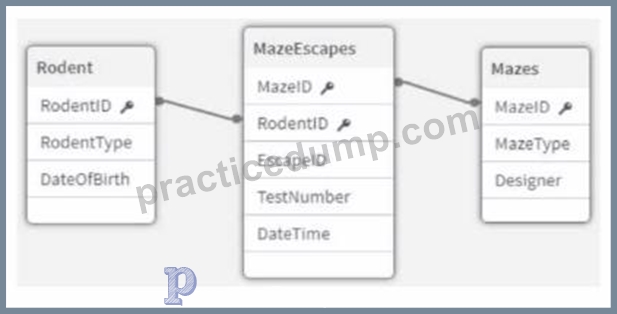
An app that will track experiments for rodents (e.g., rats and mice) that navigate mazes (labyrinths) is being developed. Individual rodents are catalogued in the Rodent table, while the Mazes table has metadata for the mazes. The MazeEscapes table holds a record of each attempt at a maze by a rodent. A business analyst needs to build a KPI that will allow users to see how many rodents have made at least one attempt at any maze.
How should the analyst construct the KPI?
- A. Create 1 AS RodentID_Counter in the MazeEscapes table.
Use Sum (RodentlD Counter) as the KPI expression. - B. * Create 1 AS RodentID_Counter in the Rodent table.
* Use Sum (RodentlD Counter) as the KPI expression. - C. * Create RodentlD AS RodentID_Counter in the MazeEscapes table.
* Use Count (Distinct RodentlD Counter) as the KPI expression. - D. * Create RodentlD AS RodentlD Counter in the Rodent table.
* Use Count (Distinct RodentID Counter) as the KPI expression.
Answer: C
Explanation:
In this case, we need to count how many unique rodents have made at least one attempt at any maze. Since the relationship between the Rodent table and the MazeEscapes table is a one-to-many relationship (each rodent may attempt several mazes), the best approach is to base the calculation on the MazeEscapes table, as it holds the actual records of rodent attempts.
By creating a new field RodentID_Counter in the MazeEscapes table, the analyst ensures that each rodent's attempt is captured. Using the Count (Distinct RodentID_Counter) as the KPI expression then accurately counts each unique rodent that has made at least one attempt, without counting multiple attempts by the same rodent.
Key Concepts:
Distinct Count: The distinct count ensures that rodents who have made multiple maze attempts are only counted once.
MazeEscapes Table: This table holds the records of each attempt, making it the correct source for this KPI.
Why the Other Options Are Less Suitable:
B . Sum (RodentID_Counter) in the Rodent table: This would incorrectly sum the number of rodents rather than counting unique attempts, leading to inaccurate results.
C . Sum (RodentID_Counter) in the MazeEscapes table: Summing the counter would not account for the distinct rodents, leading to incorrect counting.
D . RodentID_Counter in the Rodent table: This would not correctly reflect the rodents that have made an attempt, as not every rodent in the Rodent table may have attempted a maze.
References for Qlik Sense Business Analyst:
Distinct Count in KPI: It is best practice to use Count(Distinct ...) when working with KPIs that require unique counts, such as counting distinct rodents in this scenario.
Thus, A is the verified answer because it ensures that each rodent is counted once, based on their attempts in the MazeEscapes table.
NEW QUESTION # 29
A business analyst needs to create two side-by-side charts for a sales department with the following data:
* Number of orders
* Name of the customer
* Percentage of margin
* Total sales
The charts use a common dimension, but each chart has different measures. The analyst needs to create a color association between the two charts on the dimension values.
Which action should the business analyst take?
- A. Use nested IF statements to set the colors by expression for each dimension value
- B. Select 'By Dimension' and 'Persistent colors' in the Colors property panel
- C. Use the Fieldlndex function to set the colors by expression for each dimension value
- D. Define the color values in the master measures and use the color library
Answer: B
Explanation:
In Qlik Sense, the 'By Dimension' and 'Persistent colors' options in the Colors property panel ensure that the same dimension values have the same color across multiple charts. This is especially useful when you have two or more side-by-side charts sharing a common dimension, like customer names in this case. Persistent colors guarantee consistency in color assignment, helping users visually track the same dimension across different visualizations.
Key Concepts:
By Dimension: This option ensures that each unique value of a dimension (e.g., customer name) gets a distinct color across all charts that use this setting.
Persistent Colors: This feature ensures that the colors remain the same between charts, making the visual comparison across charts easier for the users.
Why the Other Options Are Less Suitable:
A . Use nested IF statements to set the colors by expression for each dimension value: While this would work, it would be unnecessarily complex to maintain and manage, especially with many dimension values.
B . Define the color values in the master measures and use the color library: This would only apply if the goal was to set colors based on measures, not dimensions. In this case, dimension consistency is required, not measure-based coloring.
D . Use the FieldIndex function to set the colors by expression for each dimension value: This would involve writing complex expressions that would not be as straightforward as using the built-in functionality of 'By Dimension' and 'Persistent colors'.
References for Qlik Sense Business Analyst:
Color Consistency Across Charts: The 'By Dimension' and 'Persistent colors' settings are recommended in Qlik Sense documentation when creating multi-chart layouts with shared dimensions, ensuring visual coherence across different charts.
The Persistent colors and By Dimension settings offer a straightforward and maintainable way to create color associations across charts, making option C the verified solution.
NEW QUESTION # 30
A business analyst is building an app to analyze virus outbreaks. They create a bar chart using a dimension of Continent, and a measure of Sum (Knowning sections). They require a secondary bar on the chart, so they create a second measure using Count (MajorCities).
The bar chart adjusts, but no bars are visible for this second measure. Which action should the business analyst take to resolve this issue?
- A. Change the Y-axis Range scale from Auto to Custom and select a suitable Max value
- B. Recreate the second measure as an alternative measure
- C. Enable Value labels within the Presentation section of the Appearance properties
- D. Convert the bar chart to a combo chart and reconfigure the second measure to be a bar
Answer: D
Explanation:
In this scenario, the second measure (Count of MajorCities) is likely not being displayed because the two measures-Sum(Knowing sections) and Count(MajorCities)-are on vastly different scales. When two measures have significantly different ranges, one of them may not be visible on the same Y-axis, causing the issue you're seeing where no bars are visible for the second measure.
By converting the bar chart to a combo chart, the business analyst can display both measures with appropriate configurations. The combo chart allows you to display different measures in different ways, such as using one axis for the first measure (e.g., bars for Sum(Knowing sections)) and another axis for the second measure (e.g., bars for Count(MajorCities)), ensuring that both are visible on the chart.
Key Concepts:
Combo Chart: This type of chart allows you to display multiple measures using different axis scales or types of visualization (e.g., bars and lines).
Scale Mismatch: When two measures differ significantly in scale, they may not be displayed properly on the same axis. A combo chart helps by allowing separate Y-axes for each measure.
Why the Other Options Are Less Suitable:
A . Enable Value labels: While value labels can help show specific data points, they won't resolve the issue of one measure being invisible due to scale differences.
B . Recreate as an alternative measure: This would allow switching between measures, but the requirement is to show both measures simultaneously.
C . Change Y-axis Range to Custom: While adjusting the Y-axis manually might help, it's not the best solution because the scale difference between the two measures might still cause issues, and it would be harder to adjust dynamically.
References for Qlik Sense Business Analyst:
Combo Charts for Multiple Measures: Combo charts are recommended in Qlik Sense when you need to display multiple measures with different scales.
Thus, converting the bar chart to a combo chart ensures both measures are properly displayed, making D the correct answer.
NEW QUESTION # 31
The VP of Sales asks a business analyst to include a KPI object on the sales dashboard that shows total sales value for the year 2022, regardless of selections. Existing fields in the data model include Sales and Year.
How should the business analyst write the measure for the KPI object?
- A. Sum( 1 { < year="(" '2022'="" )="" /> ) Sales)
- B. Sum( { < year="|" '2022,="" }="" /> } Sales)
- C. Sum( { $ < year="{" '2022*="" )="" /> } Sales)
- D. Sum( { 1 < year="{" '2022'="" )="M /> ) Sales)
Answer: D
Explanation:
In this scenario, the VP of Sales wants to see the total sales for the year 2022 regardless of selections. This requirement is best handled using Set Analysis in Qlik Sense. The key to achieving this is using the set identifier 1, which ignores the user's selections and ensures the calculation is based on the entire dataset. The expression Sum( { 1 < year = { '2022' } > } Sales) calculates the sum of sales for the year 2022, irrespective of any other selections made in the app.
Key Concepts:
Set Identifier 1: This identifier ensures that the calculation is performed on the entire dataset, ignoring any selections or filters applied by the user.
Year Filtering: The expression < year = { '2022' } > ensures that only sales from the year 2022 are included in the calculation.
Why the Other Options Are Less Suitable:
A . Sum( { < year = '2022' > } Sales): This is incorrectly formatted, and the pipe (|) symbol should not be used in this context.
B . Sum( { $ < year = { '2022' } > } Sales): The $ set identifier respects the current selections, which is not what is needed in this case, as the VP wants the value to be shown regardless of selections.
D . Sum( 1 { < year = { '2022' } > } Sales): The placement of 1 is incorrect in this expression.
References for Qlik Sense Business Analyst:
Set Analysis: Qlik Sense's Set Analysis allows analysts to control what data is used in a calculation, regardless of user selections. The set identifier 1 ensures that selections are ignored, which is essential for showing fixed data such as total sales for a specific year.
Thus, the correct expression to show the total sales for 2022, regardless of user selections, is C.
NEW QUESTION # 32
A customer is developing over 100 apps, each with several sheets that contain multiple visualizations and text objects. The customer wants to standardize all colors used every object across every app. The customer also needs to be able to change these colors quickly, as required.
Which steps should the business analyst take to make sure the color palette is easily maintained in every app?
- A. * Store color definitions within a .qvd file
* Have each app load this file as a data island in the model
* Have every object select its required color property from the rows within the data island - B. * Develop the first app with every variation of object and visualization that will be required
* Duplicate this app to create every other app
* Remove the variations that are not required and adjust the ones needed - C. * Design all base objects as master visualizations
* Link each object in each app to the relevant master visualization
* Adjust the data properties as required - D. * Create all color expressions as variables in a text file
* Load it in each app with an include statement
* Use these variables in the color property of all objects
Answer: D
Explanation:
In scenarios where a customer needs to standardize colors across multiple apps and be able to update them quickly, using variables in combination with an include statement is the most flexible and maintainable approach.
A . Design all base objects as master visualizations and link each object in each app to the relevant master visualization.
While master visualizations help with consistency within a single app, they don't offer an easy way to update all apps globally. You would need to manually update the colors in every master visualization in each app, which is not efficient for large-scale management.
B . Develop the first app with every variation of object and visualization and duplicate this app.
Duplicating apps will create maintenance challenges. Each app would need to be updated individually if colors or other settings change, which is not scalable for over 100 apps.
C . Create all color expressions as variables in a text file, load it in each app with an include statement, and use these variables in the color property of all objects.
This is the most efficient solution. By storing color definitions in a text file and loading them with an include statement, the business analyst can update the colors in one place, and these updates will be reflected across all apps that use the file. This method ensures easy maintenance and flexibility.
D . Store color definitions within a .qvd file and load it as a data island.
While using a .qvd file is possible, it's not as straightforward as using variables and an include statement. Data islands are typically used for selection purposes, and this method would introduce unnecessary complexity in managing colors.
Key Qlik Sense Business Analyst References:
Variables are widely used in Qlik Sense for managing repeated expressions or values like colors. They can be defined once and reused throughout the app.
Include statements allow external files (like text files containing variables) to be loaded into apps, ensuring that updates made to the text file are automatically reflected in all apps that use it. This creates a flexible and scalable solution for managing standardization across multiple apps.
Thus, the best way to maintain a standardized color palette across all apps is to create all color expressions as variables in a text file and load them into each app using an include statement.
NEW QUESTION # 33
A business analyst is working with a customer to refine the end user experience. The customer has the following requirements:
* Ability to provide these charts to a specific user group
* Minimize the number of navigation clicks between charts
* Achieve fastest screen response time when switching between charts
* Maximize the chart size in terms of screen real estate
Which action should the business analyst take to meet the requirements?
- A. Use Conditional show on all charts and overlay the charts in the same location
- B. Create a single sheet with every required chart on this single sheet
- C. Create several sheets (one sheet per client) and use buttons to navigate between sheets
- D. Use a container object to host the required visualizations
Answer: D
Explanation:
The best solution for minimizing navigation clicks, maximizing screen real estate, and ensuring fast response times is to use a container object. A container object allows the business analyst to house multiple charts within a single visualization, making it easy for users to switch between them with minimal navigation. This also ensures that only one chart is rendered at a time, which improves screen response time.
Key Concepts:
Container Object: This feature allows multiple charts to be placed in one object, minimizing navigation clicks and maximizing screen real estate, as users can switch between charts within the same view.
Fast Response Time: Since only one chart is visible at a time, rendering performance is optimized, ensuring fast responses when switching between visualizations.
Why the Other Options Are Less Suitable:
A . Conditional show: This could lead to performance issues, as multiple charts would be rendered simultaneously, slowing down response time.
B . Single sheet with all charts: This would clutter the screen and reduce chart size, making it less optimal for user experience.
D . Several sheets with buttons for navigation: This increases the number of navigation clicks, which contradicts the requirement of minimizing navigation.
References for Qlik Sense Business Analyst:
Container Object for Multiple Visualizations: Qlik Sense recommends container objects when you need to show multiple charts with minimal navigation and maximum screen real estate.
Thus, using a container object to host the required visualizations is the best solution, making C the verified answer.
NEW QUESTION # 34
A dashboard developer finishes creating a supply chain analysis app and is presenting it to leadership for review. The landing page shows four visualizations including:
* Bar chart showing available supply by product category
* Line chart showing total cost of deliveries to the warehouse by month-year
* Scatter plot showing cost of delivery and time-to-deliver by product
* A map that shows the volume of delivery from suppliers to warehouses using a line layer Leadership asks the developer how they can see the total cost of delivery overall. How can the analyst show this information to leadership?
- A. Use the line chart to add up each month-year to get to the number required
- B. Adjust the line layer on the map to reflect cost of delivery
- C. Select all products in the scatter plot to see the total delivery cost
- D. Create a KPI object that shows the total cost of delivery
Answer: D
Explanation:
In Qlik Sense, when leadership requests a high-level summary such as the total cost of delivery overall, the most efficient way to present this information is by using a KPI object. The KPI object is specifically designed to display a single, important metric in a simple and clear format.
A . Use the line chart to add up each month-year to get to the number required.
This option is not efficient because it requires manual effort to add up the values from the line chart for each period. Additionally, this method is prone to human error and would be time-consuming during a presentation.
B . Create a KPI object that shows the total cost of delivery.
The most appropriate action here is to use a KPI object to display the overall total cost of delivery. A KPI in Qlik Sense is specifically designed to display single, aggregate measures in a clean and concise way, making it the perfect choice for presenting high-level summaries to leadership.
C . Adjust the line layer on the map to reflect the cost of delivery.
While it is possible to adjust the map, the map is primarily used for spatial analysis. Modifying it to reflect the overall cost of delivery would not be as intuitive or effective as using a KPI object. Additionally, it could lead to unnecessary clutter and confusion for the audience.
D . Select all products in the scatter plot to see the total delivery cost.
Selecting all products in the scatter plot would not give the desired result because the scatter plot is designed to show relationships between variables (cost of delivery and time-to-deliver). It's not ideal for displaying aggregate values like total cost.
Key Qlik Sense Business Analyst References:
KPI objects are ideal for presenting single, key metrics such as the total cost of delivery. They provide a straightforward, visually clear representation of high-level performance indicators.
Best practices in dashboard development emphasize the importance of creating specific visualizations that address both granular and high-level data needs. KPI objects fulfill the need for high-level summaries, particularly in leadership presentations.
Thus, the best way to show the total cost of delivery to leadership is to create a KPI object.
NEW QUESTION # 35
A business analyst designs a visualization to analyze a count of products by fixed price ranges. The customer now wants the price ranges to be dynamically modified so they are configurable by the application users. The business analyst modified the dimension axis on the visualization.
Which step should the business analyst complete next?
- A. Create a calculated field in Data manager, using the Class() function
- B. Load an independent source file to contain the user-defined boundary values
- C. Create the price range dimension using the Buckets feature in Data manager
- D. Define a variable and use it in a variable input object on the sheet
Answer: D
Explanation:
To make the price ranges dynamically adjustable by the application users, a variable input object is the best approach. The business analyst can define a variable that stores the range value, which users can modify directly through a variable input control. This method allows users to change the price ranges interactively, giving them control over the ranges used in the analysis.
Key Concepts:
Variable Input Object: This object allows users to interact with and modify the values of predefined variables directly within a Qlik Sense sheet, which can then be used to adjust calculations dynamically, such as defining custom ranges.
Configurable by Users: This approach gives end-users the flexibility to modify the visualization based on their specific needs without requiring backend changes or reloading the app.
Why the Other Options Are Less Suitable:
B . Create a calculated field in Data manager, using the Class() function: The Class() function is useful for creating static price ranges, but it does not allow for user interaction or dynamic updates to the ranges.
C . Load an independent source file to contain the user-defined boundary values: While this could provide configurable ranges, it's unnecessarily complex and would require more management, and it's not as user-friendly as using a variable.
D . Create the price range dimension using the Buckets feature in Data manager: Similar to the Class() function, this would create static groupings, which wouldn't be dynamically adjustable by the user.
References for Qlik Sense Business Analyst:
Dynamic Controls with Variables: Qlik Sense provides the ability to create variable input objects that allow users to control how visualizations behave dynamically. This feature is highlighted in Qlik Sense's Business Analyst best practices when making interactive applications.
By using a variable and a variable input object, the business analyst enables user interactivity and customization, making A the correct choice.
NEW QUESTION # 36
In the 'Sales By Product' bar chart, a customer wants to highlight a specific product bar that includes a dynamic label. The label will only be visible when conditions are met. Which feature should the business analyst add to the bar chart?
- A. A Color By Expression property under Appearance
- B. A Dimension reference line add-on
- C. An Alternative dimension with a calculation
- D. A reference line add-on under Properties
Answer: A
Explanation:
To dynamically highlight a specific product bar in a bar chart based on conditions, the best approach is to use the Color By Expression feature under the Appearance settings in Qlik Sense. This feature allows you to apply conditional formatting to bars, changing their color dynamically based on expression logic.
A . A Color By Expression property under Appearance
This is the correct answer. The Color By Expression property allows the business analyst to dynamically color bars in the chart based on specific conditions. The expression can be set to highlight a specific product bar only when certain conditions are met, and the color can be customized to make it stand out.
B . A Dimension reference line add-on
Dimension reference lines are used to show thresholds or important values along the axes, but they do not dynamically color the bars or add conditional labels to them. This would not achieve the desired effect.
C . An Alternative dimension with a calculation
Alternative dimensions allow users to switch between different dimensions in the same chart, but they do not provide dynamic highlighting or conditional visibility for labels.
D . A reference line add-on under Properties
Reference lines are used to mark specific values or thresholds in a chart, but they do not interact with the dynamic coloring or visibility of labels on individual bars.
Key Qlik Sense Business Analyst References:
Color By Expression is a powerful feature in Qlik Sense that allows dynamic customization of chart colors based on expressions, making it ideal for highlighting specific data points or conditions.
This feature provides great flexibility in creating visually engaging and interactive charts that respond to changes in the underlying data or user selections.
Thus, the correct way to highlight a specific product bar with a dynamic label is to use Color By Expression under Appearance.
NEW QUESTION # 37
Two customers in an organization want to use an app that contains a finance data set. With different analysis objectives, each customer will only use a subset of that data. Which procedure should the business analyst follow?
- A. Apply Section Access to manage the data for each customer
- B. Unpivot, then re-associate the data tables for each customer
- C. Create multiple visualizations using set analysis
- D. Duplicate and rename the apps for each customer
Answer: C
Explanation:
In Qlik Sense, Set Analysis is one of the most powerful tools available to a Business Analyst for managing different subsets of data within the same app. Since both customers are working with the same finance dataset but have different objectives, creating multiple visualizations using set analysis allows the analyst to tailor the data views for each customer without duplicating the app or creating complex data models.
Key Concepts:
Set Analysis: This feature enables the creation of expressions that define subsets of data, allowing you to filter data within specific visualizations. This is ideal when multiple users need different insights from the same underlying dataset.
Flexibility: Using set analysis, you can specify conditions within individual visualizations so that each user can focus on their own segment of the data without impacting others.
Efficiency: This method avoids redundancy by ensuring you only need one app and one data model, instead of duplicating and maintaining multiple apps or applying complex logic such as Section Access.
Why the Other Options Are Less Suitable:
A . Apply Section Access: While Section Access is useful for managing security and limiting what users can see in the entire dataset, it is primarily designed to restrict data access based on user roles. In this case, both users need access to the same dataset but will conduct different analyses. Section Access would be an overly restrictive and complex solution for this scenario.
C . Duplicate and rename the apps: This is inefficient because it leads to redundancy and makes maintenance harder (e.g., any changes to the dataset or visualizations would need to be applied to both apps). It also increases the risk of inconsistencies across versions of the app.
D . Unpivot and re-associate the data tables: This option is not relevant to the problem, as unpivoting is more appropriate for transforming datasets rather than tailoring views for different users within the same app. It does not address the need for customer-specific analysis objectives.
References for Qlik Sense Business Analyst:
Set Analysis: In the Qlik Sense Business Analyst's toolkit, Set Analysis is covered as a method to manage diverse data subsets within single apps, providing the flexibility needed in multi-user environments without duplicating content.
Efficient Application Design: Best practices suggest maintaining a single app where possible to ensure consistency and ease of maintenance, which aligns with the approach of using Set Analysis.
By using Set Analysis, you provide both customers with tailored data views that are easily managed and updated within a single app. This is why option B is the most effective and verified solution.
NEW QUESTION # 38
The sales manager is investigating the relationship between Sales and Margin to determine if this relationship is linear when choosing the dimension Customer or Product Category.
The sales manager wants to have the potential percentage Sales for each Stage (Initial to Won) of the sales process.
Which visualizations will meet these requirements?
- A. Scatter plot: Measures X-axis Sales and Y-axis Margin, Alternative dimensions Customer or Product category Funnel chart: Segments Stage, Width Sales
- B. Combo chart: Measures Sales and Margin, Dimensions Customer or Product category Pie chart: Dimension Stage, Measure Sales
- C. Distribution plot: Alternative measures Sales and Margin, Alternatives dimensions Customer or Product category Bar chart: Dimension Stage, Measure Sales
- D. Scatter plot: Measures X-axis Sales and Y-axis Margin, Dimensions Customer or Product category Bar chart: Dimension Stage, Measure Sales
Answer: A
Explanation:
For analyzing the relationship between Sales and Margin, a scatter plot is ideal, as it allows you to visualize the relationship between two measures (Sales and Margin) across various dimensions such as Customer or Product Category. The funnel chart is perfect for visualizing stages in a sales process, as it shows how sales progress from the initial stage to the final (Won) stage, with the width of each segment representing the total sales for each stage.
Key Concepts:
Scatter Plot: This type of chart is specifically designed to visualize the correlation or relationship between two measures, making it ideal for analyzing Sales versus Margin across different dimensions.
Funnel Chart: This chart is particularly suited for visualizing the sales stages, as it visually demonstrates the proportion of sales moving through each stage of the sales funnel.
Why the Other Options Are Less Suitable:
A . Scatter plot and Bar chart: While a scatter plot is correct for analyzing Sales and Margin, a bar chart won't adequately represent the different stages of the sales process as effectively as a funnel chart.
C . Combo chart and Pie chart: A combo chart could potentially work, but it would not show the relationship between Sales and Margin as clearly as a scatter plot. A pie chart is also less effective for representing stages in a sales funnel.
D . Distribution plot and Bar chart: A distribution plot does not effectively show the relationship between two measures, and a bar chart isn't the best choice for visualizing the stages of a sales process.
References for Qlik Sense Business Analyst:
Scatter Plot for Relationships: This chart type is highly recommended when exploring relationships between two continuous variables, such as Sales and Margin.
Funnel Charts: These are ideal for visualizing how data moves through various stages of a process, such as sales stages, from initial engagement to final sale.
Therefore, the combination of a scatter plot and a funnel chart provides the best solution, making B the correct answer.
NEW QUESTION # 39
A business analyst is building an app to analyze virus outbreaks. They create a bar chart using a dimension of Continent, and a measure of Sum (Knowning sections). They require a secondary bar on the chart, so they create a second measure using Count (MajorCities).
The bar chart adjusts, but no bars are visible for this second measure. Which action should the business analyst take to resolve this issue?
- A. Change the Y-axis Range scale from Auto to Custom and select a suitable Max value
- B. Recreate the second measure as an alternative measure
- C. Enable Value labels within the Presentation section of the Appearance properties
- D. Convert the bar chart to a combo chart and reconfigure the second measure to be a bar
Answer: D
NEW QUESTION # 40
A business analyst receives an image of a dashboard from the HR Director and is asked to recreate the image in Qlik Sense. The image shows charts for:
* Company employee structure
* Average employee salary by region
* Geographical representation of office capacity
* Company retention over time
Which charts will meet these analysis requirements?
- A. Line chart, network chart, bar chart, map chart
- B. Map chart, grid chart, line chart, KPI chart
- C. Map chart, org chart, line chart, bar chart
- D. Line chart, sankey chart, map chart, bar chart
Answer: C
Explanation:
To recreate the dashboard image provided by the HR Director, the following charts are needed:
Map chart: To show the geographical representation of office capacity.
Org chart: To show the company employee structure.
Line chart: To show company retention over time.
Bar chart: To show average employee salary by region.
Key Concepts:
Map Chart: Used to visualize geographical data, such as office capacity across different locations.
Org Chart: Ideal for displaying hierarchical structures, such as the employee structure of a company.
Line Chart: Best suited for showing trends over time, such as employee retention.
Bar Chart: A good choice for comparing salaries across regions.
Why the Other Options Are Less Suitable:
A . Sankey chart: This chart is used for flow or process analysis, not employee structure.
B . Network chart: Network charts show relationships but are not ideal for hierarchical structures like an org chart.
C . Grid chart and KPI chart: These charts are not well-suited for the types of data required in this scenario.
References for Qlik Sense Business Analyst:
Chart Selection for HR Dashboards: Qlik Sense provides various visualization options, and selecting the correct chart for each type of data is essential for accurate and clear representation.
Thus, the correct combination of charts is D-Map chart, org chart, line chart, and bar chart-making it the verified answer.
NEW QUESTION # 41
A project management team uses an app to monitor different projects.
* Projects may have co-dependent tasks and processes
* Some projects include subtasks
The business analyst needs to use a diagram similar to a workflow with the processes and the sub tasks represented as boxes with lines to relate them to each other. The color of the boxes could also be determined by the status of each project or task.
Which visualization should be used?
- A. Org chart
- B. Network chart
- C. Grid chart
- D. Sankey chart
Answer: B
Explanation:
A Network chart is the most suitable visualization for representing processes and tasks that have dependencies, such as projects with co-dependent tasks and subtasks. The network chart allows you to visualize relationships between nodes (in this case, tasks and subtasks) and can display them in a structured manner with lines connecting them based on their relationships. The colors of the boxes (or nodes) can be determined by the status of each project or task, which matches the requirements.
Key Concepts:
Network Chart: It's designed for showing interconnections or relationships between various elements. It is ideal when tasks or processes have dependencies or subtasks that need to be visually represented with links between them.
Color Representation: In a Network Chart, you can easily apply colors to nodes based on specific criteria, such as the status of the task, making it easier for users to track project progress at a glance.
Why the Other Options Are Less Suitable:
A . Sankey chart: While Sankey charts are used to show flow and relationships between categories, they are better suited for representing flows of data or values between stages, not hierarchical or task-related dependencies.
B . Grid chart: A grid chart is used to display values in a matrix but does not provide the relational and hierarchical representation needed for tasks and subtasks.
C . Org chart: Org charts are useful for showing hierarchies but are more structured for organization personnel or roles rather than co-dependent tasks and workflows.
References for Qlik Sense Business Analyst:
Network Diagram: Network charts are widely used for visualizing complex relationships between entities, which aligns with the need to visualize tasks and subtasks in project management.
Thus, a Network chart provides the best solution for visualizing tasks and subtasks with their dependencies, making D the correct answer.
NEW QUESTION # 42
A business analyst is creating an app for the sales team. The app must meet several requirements:
* Compare 10 top-performing sales representatives and the amount of sales for each
* Investigate margin percentage and total sales by each product category
* View distribution of sales amount
Which visualizations should be used for this app?
- A. A bar chart, line chart, and scatter plot
- B. A treemap, box plot, and histogram
- C. A bar chart, scatter plot, and histogram
- D. A treemap, container, and distribution plot
Answer: C
Explanation:
For this scenario, using a bar chart, scatter plot, and histogram provides the best coverage of the requirements. The bar chart is ideal for comparing the sales performance of the top 10 sales representatives. The scatter plot is used to analyze the relationship between margin percentage and total sales by product category. The histogram is excellent for visualizing the distribution of sales amounts.
Key Concepts:
Bar Chart: Perfect for comparing categorical data, such as sales amounts across different sales representatives.
Scatter Plot: Ideal for exploring relationships between two variables, such as margin percentage and total sales.
Histogram: Provides a clear visualization of the distribution of a continuous variable, such as sales amounts.
Why the Other Options Are Less Suitable:
B . Treemap, Container, and Distribution plot: A treemap is less effective for comparing individual sales reps, and a container does not provide a clear visualization on its own.
C . Bar chart, Line chart, and Scatter plot: A line chart is not needed in this case, as it is best for showing trends over time, which is not required here.
D . Treemap, Box plot, and Histogram: A box plot is more suited for showing statistical distributions (e.g., quartiles), which is unnecessary in this case.
References for Qlik Sense Business Analyst:
Data Exploration: Bar charts, scatter plots, and histograms are among the most commonly recommended visualizations for comparing performance, analyzing relationships, and viewing distributions in Qlik Sense.
Thus, the combination of a bar chart, scatter plot, and histogram offers the most comprehensive solution, making A the correct answer.
NEW QUESTION # 43
A customer needs to demonstrate the value of sales for each month of the year with a rolling 3-month summary. Which visualization should the business analyst recommend to meet the customer's needs?
- A. Combo chart
- B. Pie chart
- C. Mekko chart
- D. Scatter plot
Answer: A
Explanation:
A combo chart is the most suitable visualization to show the value of sales for each month along with a rolling 3-month summary. The combo chart allows you to combine different types of visualizations, such as bars for monthly sales values and a line for the rolling 3-month summary. This provides a clear comparison and tracking of sales trends over time.
Key Concepts:
Rolling Summary: In this case, a 3-month rolling summary can be shown as a line measure in the combo chart, while the sales values for each month can be shown as bars.
Combo Chart: This visualization is ideal for comparing multiple measures on the same axis, such as individual sales values and aggregated rolling summaries.
Why the Other Options Are Less Suitable:
A . Scatter plot: A scatter plot is used to display the relationship between two variables, not to show time-based trends or rolling summaries.
B . Mekko chart: Mekko charts are used for categorical data and comparisons across categories, not for time-based analysis.
D . Pie chart: Pie charts are best suited for showing parts of a whole and are not appropriate for visualizing time-based data or rolling summaries.
References for Qlik Sense Business Analyst:
Combo Charts for Time Series Data: Combo charts are highly recommended when there is a need to compare different types of measures (like individual sales vs. rolling averages) over time in Qlik Sense.
Thus, a combo chart provides the most effective solution for showing both monthly sales values and the rolling 3-month summary, making C the correct answer.
NEW QUESTION # 44
......
Latest QSBA2024 dumps - Instant Download PDF: https://certkingdom.practicedump.com/QSBA2024-practice-dumps.html