

Pass Your Exam Easily! ISO-IEC-27001-Lead-Auditor-CN Real Question Answers Updated on Dec 13, 2025
Actual Questions Answers Pass With Real ISO-IEC-27001-Lead-Auditor-CN Exam Dumps
NEW QUESTION # 208
下列哪一個選項存在輕微不符合項?
- A. 風險評估方法阻礙了資訊安全風險的評估
- B. 資料的備份每月進行一次,而公司的流程則要求每天備份一次
- C. 公司與其供應商的合約沒有適當的文件版本控制
Answer: B
Explanation:
This is a minor nonconformity. The backup frequency not adhering to the company's procedure of daily backups but occurring once a month represents a deviation from established processes, yet it might not immediately impact the effectiveness of the information security management system.
References: ISO/IEC 27001:2013, Clause A.12.3 (Backup)
NEW QUESTION # 209
以下是資訊的定義,但以下情況除外:
- A. 成熟且可衡量的數據
- B. 用於特定目的的特定且有組織的數據
- C. 準確及時的數據
- D. 可以促進理解並減少不確定性
Answer: A
Explanation:
The definition of information that is not correct is C: mature and measurable data. This is not a valid definition of information, as information does not have to be mature or measurable to be considered as such.
Information can be any data that has meaning or value for someone or something in a certain context.
Information can be subjective, qualitative, incomplete or uncertain, depending on how it is interpreted or used. Mature and measurable data are characteristics that may apply to some types of information, but not all.
The other definitions of information are correct, as they describe different aspects of information, such as accuracy and timeliness (A), specificity and organization (B), and understanding and uncertainty reduction (D). ISO/IEC 27001:2022 defines information as "any data that has meaning" (see clause
3.25). References: CQI & IRCA Certified ISO/IEC 27001:2022 Lead Auditor Training Course, ISO/IEC
27001:2022 Information technology - Security techniques - Information security management systems - Requirements, What is Information?
NEW QUESTION # 210
您正在國際物流組織的出貨部門進行 ISMS 審核,該組織為當地醫院和政府辦公室等大型組織提供運輸服務。包裹通常包含藥品、生物樣本以及護照和駕駛執照等文件。您注意到公司記錄顯示大量退貨,原因包括標籤地址錯誤,以及在 15% 的情況下,一個包裹的不同地址有兩個或多個標籤。您正在面試運輸經理 (SM)。
您:出貨前檢查過嗎?
SM:任何明顯損壞的物品都會在出貨前由值班人員移除,但利潤微薄,因此實施正式檢查流程並不經濟。
您:退貨後會採取什麼措施?
SM:這些合約大多價值相對較低,因此我們認為,簡單地重新列印標籤並重新發送單一包裹比實施調查更容易、更方便。
您提出不符合項。參考該場景,您希望受審核方在進行後續審核時實施下列哪三項附件 A 控制措施?
- A. 5.32 智慧財產權
- B. 5.3 職責分離
- C. 5.34 隱私與個人識別資訊 (PII) 的保護
- D. 6.3 資訊安全意識、教育與培訓
- E. 5.13 資訊標籤
- F. 5.6 與特殊利益團體的聯繫
- G. 5.11 資產返還
- H. 6.4 紀律程序
Answer: C,D,E
Explanation:
The three Annex A controls that you would expect the auditee to have implemented when you conduct the follow-up audit are:
* B. 5.13 Labelling of information
* E. 5.34 Privacy and protection of personal identifiable information (PII)
* G. 6.3 Information security awareness, education, and training
* B. This control requires the organisation to label information assets in accordance with the information classification scheme, and to handle them accordingly12. This control is relevant for the auditee because it could help them to avoid misaddressing labels and sending parcels to wrong destinations, which could compromise the confidentiality, integrity, and availability of the information assets. By labelling the information assets correctly, the auditee could also ensure that they are delivered to the intended recipients and that they are protected from unauthorized access, use, or disclosure.
* E. This control requires the organisation to protect the privacy and the rights of individuals whose personal identifiable information (PII) is processed by the organisation, and to comply with the applicable legal and contractual obligations13. This control is relevant for the auditee because it could help them to prevent the unauthorized use of residents' personal data by a supplier, which could violate the privacy and the rights of the residents and their family members, and expose the auditee to legal and reputational risks. By protecting the PII of the residents and their family members, the auditee could also enhance their trust and satisfaction, and avoid complaints and disputes.
* G. This control requires the organisation to ensure that all employees and contractors are aware of the information security policy, their roles and responsibilities, and the relevant information security procedures and controls14. This control is relevant for the auditee because it could help them to improve the information security culture and behaviour of their staff, and to reduce the human errors and negligence that could lead to information security incidents. By providing information security awareness, education, and training to their staff, the auditee could also increase their competence and performance, and ensure the effectiveness and efficiency of the information security processes and controls.
References:
1: ISO/IEC 27001:2022 - Information technology - Security techniques - Information security management systems - Requirements, Annex A 2: ISO/IEC 27002:2022 - Information technology - Security techniques - Code of practice for information security controls, clause 8.2.1 3: ISO/IEC 27002:
2022 - Information technology - Security techniques - Code of practice for information security controls, clause 18.1.4 4: ISO/IEC 27002:2022 - Information technology - Security techniques - Code of practice for information security controls, clause 7.2.2
NEW QUESTION # 211
您正在一家提供醫療保健服務的住宅療養院進行 ISMS 審核。審核計畫的下一步是驗證資訊安全事件管理流程。 IT 安全經理介紹了資訊安全事件管理程序,並解釋該流程基於 ISO/IEC 27035-1:2016。
您查看該文件並注意到一條聲明「任何資訊安全弱點、事件和事故應在識別後 1 小時內報告給聯絡人 (PoC)」。在訪問員工時,您發現大家對「弱點、事件、事件」意義的理解有差異。
您從事件追蹤系統中抽取過去 6 個月的事件報告記錄樣本,總結結果如下表所示。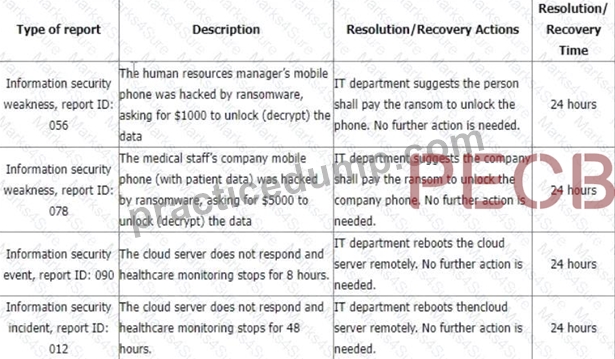
您想進一步調查其他領域以收集更多審計證據。選擇兩個不會出現在您的審核追蹤中的選項。
- A. 收集更多有關事件恢復程序的證據。 (與控制措施 A.5.26 相關)
- B. 收集更多有關組織如何確定事件恢復時間的證據。 (與控制措施 A.5.27 相關)
- C. 透過訪問更多員工了解他們對報告流程的理解來收集更多證據。
(與控制措施 A.6.8 相關) - D. 收集更多關於公司如何以及何時支付贖金以解鎖公司手機和資料(即信用卡和銀行轉帳)的證據。 (與控制措施 A.5.26 相關)
- E. 收集更多有關醫療保健監測服務要求的證據。 (與第4.2條相關)
- F. 收集更多證據,說明組織如何確定事件發生後無需採取進一步行動。 (與控制措施 A.5.26 相關)
- G. 收集有關人力資源經理如何以及何時支付贖金以解鎖個人行動資料(即信用卡和銀行轉帳)的更多證據。 (與控制措施 A.5.26 相關)
Answer: D,E
Explanation:
According to ISO/IEC 27001:2022, which specifies the requirements for establishing, implementing, maintaining and continually improving an information security management system (ISMS), clause 4.2 requires an organization to determine the needs and expectations of interested parties that are relevant to its ISMS1. This includes identifying the legal, regulatory, contractual and other requirements that apply to its information security activities1. Therefore, collecting more evidence on what the service requirements of healthcare monitoring are may not be relevant to verifying the information security incident management process, as it is not directly related to the audit objective or criteria. This option will not be in the audit trail.
NEW QUESTION # 212
目標、標準和範圍是第三方 ISMS 審核的關鍵特徵。哪兩個問題是審計目標?
- A. 確定 ISMS 的範圍
- B. 完成審核計劃
- C. 檢討組織效率
- D. 評估是否符合 ISO/IEC 27001 要求
- E. 確認執行 ISMS 的站點
- F. 評估客戶流程與功能
Answer: D,E
Explanation:
Audit objectives are the specific purposes or goals that the customer or the certification body wants to achieve through the audit. They define what the audit intends to accomplish and provide the basis for planning and conducting the audit. Audit objectives may vary depending on the type, scope, and criteria of the audit, but they should be clear, measurable, and achievable.
Some examples of audit objectives for a third-party ISMS audit are:
Assess conformity with ISO/IEC 27001 requirements: This objective means that the audit aims to verify that the organisation's ISMS meets the requirements of the ISO/IEC 27001 standard, which specifies the best practices for establishing, implementing, maintaining, and improving an information security management system. The audit will evaluate the organisation's ISMS documentation, processes, controls, and performance against the standard's clauses and annex A controls.
Confirm sites operating the ISMS: This objective means that the audit aims to confirm that the organisation's ISMS covers all the relevant sites or locations where the organisation operates or provides its services. The audit will verify that the scope of the ISMS is accurate and consistent with the organisation's context, objectives, and risks.
The other phrases are not audit objectives, but rather:
Evaluate customer processes and functions: This is not an audit objective, but rather a possible audit criterion or a requirement that the organisation's processes and functions should meet. The audit criterion is the reference against which the audit evidence is compared to determine conformity or nonconformity. The audit criterion may include ISO/IEC 27001 requirements, customer requirements, or other applicable standards or regulations.
Fulfil the audit plan: This is not an audit objective, but rather a task or an activity that the auditor performs during the audit. The audit plan is a document that describes the arrangements and details of the audit, such as the objectives, scope, criteria, schedule, roles, and responsibilities. The auditor should follow and fulfil the audit plan to ensure that the audit is conducted effectively and efficiently.
Determine the scope of the ISMS: This is not an audit objective, but rather a prerequisite or an input for conducting the audit. The scope of the ISMS is the extent and boundaries of the information security management system within the organisation. It defines what processes, activities, locations, assets, and stakeholders are included or excluded from the ISMS. The scope of the ISMS should be determined by the organisation before applying for certification or undergoing an audit.
Review organisation efficiency: This is not an audit objective, but rather a possible outcome or a result of conducting an audit. The organisation efficiency is a measure of how well the organisation uses its resources to achieve its goals and objectives. The audit may help review and improve the organisation efficiency by identifying strengths, weaknesses, opportunities, and threats in its information security management system.
Reference:
ISO/IEC 27001:2022 Lead Auditor (Information Security Management Systems) objectives and content from Quality.org and PECB ISO 19011:2018 Guidelines for auditing management systems [Section 5.3.1]
NEW QUESTION # 213
下列哪兩個短語適用於與業務流程的計劃-執行-檢查-行動週期相關的「計劃」?
- A. 設定目標
- B. 訓練人員
- C. 提供ICT資產
- D. 保留文檔
- E. 組織變更
- F. 保留文檔
Answer: A,B
Explanation:
The Plan-Do-Check-Act (PDCA) cycle is a four-step method for implementing and improving processes, products, or services. The "plan" phase involves establishing the objectives and processes necessary to deliver the desired results. This may include setting SMART goals, identifying resources, defining roles and responsibilities, conducting risk assessments, and developing plans for training, communication, and monitoring.
Reference:
ISO/IEC 27001:2022 Lead Auditor (Information Security Management Systems) objectives and content from Quality.org and PECB ISO 19011:2018 Guidelines for auditing management systems [Section 5.3.1]
NEW QUESTION # 214
選擇最能完成下面句子的字詞來描述審計資源:
Answer:
Explanation:
Explanation:
According to ISO 19011:2018, clause 5.3, the person responsible for managing the audit programme should determine the resources necessary for the audit programme, such as the audit team members, the budget, the time, the tools, etc. The audit resources should be sufficient and appropriate to ensure the quality and effectiveness of the audit programme and the audit results. The audit resources include the following elements12:
* Essential resources: These are the resources that are required to conduct the audit programme and the individual audits, such as the audit documents, the audit methods, the audit tools, the audit schedule, the audit budget, etc. The essential resources should be identified and allocated based on the audit objectives, scope, and criteria, and the availability and cooperation of the auditee. The essential resources should also be reviewed and updated as necessary to reflect any changes or deviations in the audit programme or the individual audits.
* Competent personnel: These are the audit team members who have the appropriate knowledge, skills, and experience to conduct the audit effectively and efficiently, and to provide credible and reliable audit results and recommendations. The competent personnel should include the audit team leader, the auditors, and any technical experts or observers who support the audit team. The competent personnel should be selected and appointed based on the audit objectives, scope, and criteria, and the specific competence requirements for the audit programme and the individual audits. The competent personnel should also be independent and impartial, and avoid any conflicts of interest or self-interest that may affect the audit results or the audit decisions.
References:
* ISO 19011:2018 - Guidelines for auditing management systems, clause 5.3
* PECB Candidate Handbook ISO 27001 Lead Auditor, page 19
NEW QUESTION # 215
場景 1:Fintive 是一家傑出的線上支付和保護解決方案安全提供者。 Fintive 於 1999 年由 Thomas Fin 在加州聖荷西創立,為線上營運、希望提高資訊安全、防止詐欺並保護 PII 等用戶資訊的公司提供服務。 Fintive的決策和營運流程以以往的案例為中心。他們收集客戶數據,根據情況進行分類並進行分析。該公司需要大量員工才能進行如此複雜的分析。然而,幾年後,協助進行此類分析的技術也取得了進展。現在,Fintive 正計劃使用現代工具聊天機器人來實現模式分析,以即時防止詐騙。該工具也將用於幫助改善客戶服務。
這個最初的想法已傳達給軟體開發團隊,他們支持該想法並被分配從事該專案。他們開始將聊天機器人整合到現有系統中。此外,團隊也為聊天機器人設定了一個目標,即回答 85% 的聊天查詢。
聊天機器人成功整合後,該公司立即將其發布給客戶使用。
然而,聊天機器人似乎存在一些問題。
由於測試不足,並且在訓練階段缺乏向聊天機器人提供的樣本(在訓練階段,聊天機器人本應「學習」查詢模式),因此聊天機器人無法解決用戶查詢並提供正確的答案。此外,當聊天機器人收到無效輸入(例如奇怪的點圖案和特殊字元)時,它會向使用者發送隨機檔案。因此,聊天機器人無法正確回答客戶的查詢,而傳統的客戶支援因聊天查詢而不堪重負,因此無法幫助客戶解決他們的請求。
因此,Fintive 制定了軟體開發政策。該政策規定,無論軟體是內部開發還是外包,在作業系統上實施之前都將經過黑盒測試。
根據該場景,回答以下問題:
聊天機器人應該「學習」查詢模式來解決用戶查詢並提供正確的答案。
什麼類型的技術可以實現
這?
- A. 人工智慧
- B. 雲端運算
- C. 機器學習
Answer: C
NEW QUESTION # 216
您正在一家名為 ABC 的歐洲住宿療養院執行 ISMS 審核,該療養院提供醫療保健服務。審核計畫的下一步是驗證持續改善流程的有效性。
審計中了解到,大部分居民家庭成員(90%)每週都會透過農行的醫療保健行動應用程式透過電子郵件和簡訊收到WeCare醫療器材促銷廣告一次。他們均不同意將收集的個人資料用於行銷或與ABC簽訂的服務協議中護理和醫療以外的任何其他目的。他們有充分的理由相信ABC正在向不相關的第三方洩露居民和家庭成員的個人信息,並提出了投訴。
服務經理表示,經調查,所有這些投訴均被視為不合格問題。
已根據不合格和糾正管理程序(文件參考 ID:ISMS_L2_10.1,版本 1)規劃和實施糾正措施。
您寫下不合格項,稍後再跟進。選出最能完成句子的單字: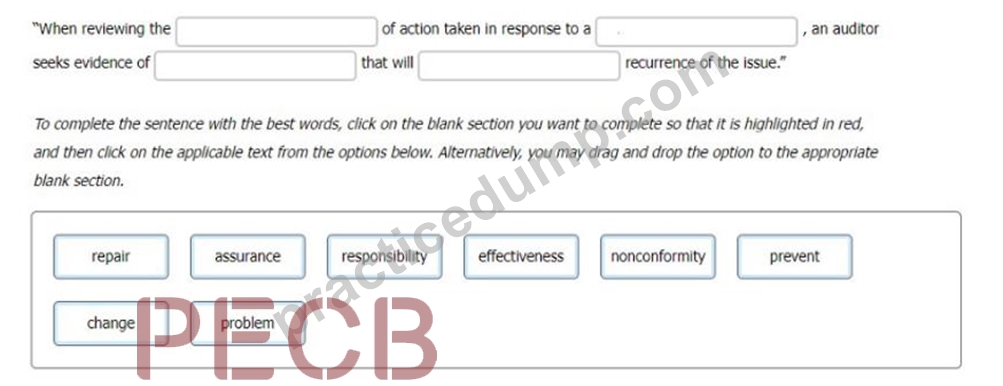
Answer:
Explanation: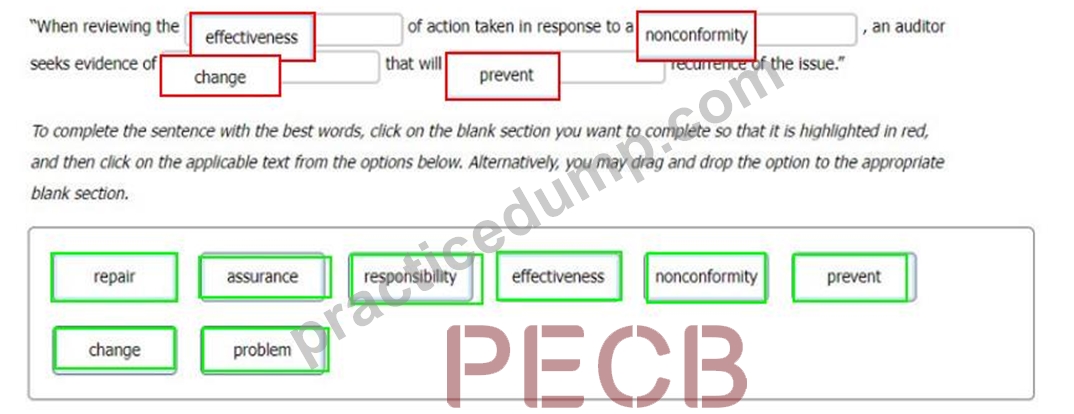
NEW QUESTION # 217
您必須進行第三方虛擬審核。在開始進行審核之前,您需要告知受審核方以下哪兩個問題?
- A. 您將要求查看螢幕上的人的身分證。
- B. 您將要求受訪的人事先說明他們的姓名和職位。
- C. 您將要求取得正在進行審核的房間的 360 度視圖。
- D. 您希望受審核方已評估與線上活動相關的所有風險。
- E. 除非允許,否則您不得記錄審核的任何部分。
- F. 您將為採訪的每個人拍照。
Answer: B,C
Explanation:
A third-party virtual audit is an external audit conducted by an independent certification body using remote technology such as video conferencing, screen sharing, and electronic document exchange. The purpose of a third-party virtual audit is to verify the conformity and effectiveness of the information security management system (ISMS) and to issue a certificate of compliance12 Before you start conducting the audit, you would need to inform the auditee about the following issues: 12
* You will ask those being interviewed to state their name and position beforehand, i.e., to confirm their identity and role in the ISMS. This is to ensure that you are interviewing the relevant personnel and that they are authorized to provide information and evidence for the audit.
* You will ask for a 360-degree view of the room where the audit is being carried out, i.e., to verify the physical and environmental security of the audit location. This is to ensure that there are no unauthorized persons or devices in the vicinity that could compromise the confidentiality, integrity, or availability of the information being audited.
The other issues are not relevant or appropriate for a third-party virtual audit, because:
* You will ask to see the ID card of the person that is on the screen, i.e., to verify their identity. This is not necessary if you have already asked them to state their name and position beforehand, and if you have access to the auditee's organizational chart or staff directory. Asking to see the ID card could also be seen as intrusive or disrespectful by the auditee.
* You will take photos of every person you interview, i.e., to document the audit process. This is not advisable as it could violate the privacy or consent of the auditee and the interviewees. Taking photos could also be seen as unprofessional or suspicious by the auditee. You should rely on the audit records and evidence provided by the auditee and the audit tool instead.
* You will not record any part of the audit, unless permitted, i.e., to respect the auditee's preferences and rights. This is not a valid issue to inform the auditee about, as you should always record the audit for quality assurance and verification purposes. Recording the audit is also a requirement of the ISO/IEC
27001 standard and the certification body. You should inform the auditee that you will record the audit and obtain their consent before the audit begins.
* You expect the auditee to have assessed all risks associated with online activities, i.e., to ensure the security of the audit process. This is not an issue to inform the auditee about, as it is part of the auditee' s responsibility and obligation to have a risk assessment and treatment process for their ISMS. You should assess the auditee's risk management practices and controls during the audit, not before it.
References:
1: ISO/IEC 27001:2022 Lead Auditor (Information Security Management Systems) Course by CQI and IRCA Certified Training 1 2: ISO/IEC 27001 Lead Auditor Training Course by PECB 2
NEW QUESTION # 218
進行外部審核後,審核員決定內部審核員將追蹤糾正措施的實施情況,直到下一次監督審核。這是可以接受的嗎?
- A. 是的,如果外部稽核師無法完成,內部稽核師可以驗證糾正措施的實施情況
- B. 否,只有外部審核員應在審核完成後跟進糾正措施的實施情況
- C. 是的,內部稽核師可以追蹤糾正措施的實施情況,直到外部審計師在監督審計期間進行驗證為止
Answer: C
Explanation:
Yes, it is acceptable for the internal auditor to follow-up on the implementation of corrective actions until verified by the external auditor during the next surveillance audit. This practice supports continuous improvement and ensures that corrective actions are effectively implemented and maintained over time.
References: PECB ISO/IEC 27001 Lead Auditor Course Material; ISO/IEC 27001:2013, Clause 9.2 (Internal audit)
NEW QUESTION # 219
您是經驗豐富的審核團隊領導,指導審核員進行培訓。
您的團隊目前正在對代表外部客戶儲存資料的組織進行第三方監督審核。接受培訓的審核員的任務是審查適用性聲明 (SoA) 中列出的並在現場實施的技術控制措施。
從以下內容中選擇您希望接受培訓的審核員審查的四項控制措施。
- A. 組織的業務連續性安排
- B. 如何實施針對惡意軟體的防護
- C. 資訊安全意識、教育與培訓
- D. 電源線和資料線如何進入建築物
- E. 如何管理對原始程式碼和開發工具的訪問
- F. 機構對資訊刪除的安排
- G. 保密與保密協議
- H. 組織如何評估其技術漏洞的暴露程度
Answer: B,E,F,H
Explanation:
The four controls from the list that the auditor in training should review are:
*B. How access to source code and development tools are managed: This control requires the organisation to restrict and monitor the access to the source code and development tools that are used to create, modify, or maintain the software applications and systems that process or store the data of external clients. This is important for ensuring the integrity, confidentiality, and availability of the software and the data, as well as for preventing unauthorized changes, errors, or malicious code injection.
*D. How protection against malware is implemented: This control requires the organisation to implement appropriate measures to detect, prevent, and remove malware from the IT systems and devices that process or store the data of external clients. This includes using antivirus software, firewalls, email filtering, web filtering, and other tools to protect against viruses, worms, ransomware, spyware, and other malicious software. This is essential for safeguarding the data and the systems from corruption, theft, or damage caused by malware.
*E. How the organisation evaluates its exposure to technical vulnerabilities: This control requires the organisation to identify and assess the technical vulnerabilities that may affect the IT systems and devices that process or store the data of external clients. This includes using vulnerability scanning tools, penetration testing tools, threat intelligence sources, and other methods to discover and evaluate the weaknesses and gaps in the security of the systems and the devices. This is necessary for prioritizing and implementing the appropriate corrective actions and controls to mitigate the risks posed by the vulnerabilities.
*G. The organisation's arrangements for information deletion: This control requires the organisation to establish and implement policies and procedures for deleting the data of external clients from the IT systems and devices when it is no longer needed or required. This includes defining the criteria and methods for data deletion, such as secure erasure, encryption, or physical destruction. This is important for complying with the contractual obligations and the legal and regulatory requirements regarding the retention and disposal of the data, as well as for protecting the confidentiality and integrity of the data.
References: = ISO/IEC 27001:2022, Annex A, clauses A.8.9, A.8.10, A.8.11, and A.8.28; Understanding ISO
27001:2022: People, process, and technology, pages 6-7; What are the 11 new security controls in ISO 27001:
2022? - Advisera.
NEW QUESTION # 220
下列哪一項是利害關係方的定義?
- A. 當第三人認為自己受到決策或活動的影響時,可以向組織提出申訴
- B. 可以乾擾管理決策或認為自己受到管理決策幹擾的團體或組織
- C. 可以影響決策或活動、受決策或活動影響或認為自己受決策或活動影響的個人或組織
- D. 可以控制決策或活動、被決策或活動控製或認為自己被決策或活動控制的個人或組織
Answer: C
Explanation:
This is the definition of an interested party according to ISO 27001:2013, clause 3.16. An interested party is essentially a stakeholder, i.e., a person or organization that can influence or be influenced by the information security management system (ISMS) or its activities. Interested parties can have different needs and expectations regarding the ISMS, and these should be identified and addressed by the organization.
References:
* ISO/IEC 27001:2013, Information technology - Security techniques - Information security management systems - Requirements, clause 3.16
* PECB Candidate Handbook ISO 27001 Lead Auditor, page 10
* Identifying interested parties and their expectations for an ISO 27001 ISMS
* Examples of ISO 27001 interested parties
NEW QUESTION # 221
您正在一家提供醫療保健服務的住宅療養院進行 ISMS 審核。審核計畫的下一步是驗證資訊安全事件管理流程。 IT 安全經理介紹了資訊安全事件管理程序(文件參考 ID:ISMS_L2_16,版本 4),並解釋此流程基於 ISO/IEC 27035-1:2016。
您查看該文件並注意到一條聲明「任何資訊安全弱點、事件和事故應在識別後 1 小時內報告給聯絡人 (PoC)」。在訪問員工時,您發現大家對「弱點、事件、事件」意義的理解有差異。
IT安全經理解釋說,6個月前舉辦了一次線上「資訊安全應對」培訓研討會。所有受訪者均參與並通過了報告練習和課程評估。
您正在準備審計結果。選擇兩個正確的選項。
- A. 沒有不合格項。資訊安全處置訓練卓有成效。這符合第 7.2 條和控制措施 A.6.3。
- B. 沒有不合格項。報告資訊安全弱點、事件和事故。
這符合第 9.1 條和控制措施 A.5.24。 - C. 還有改進的機會 (OFI)。提高資訊安全事件訓練效果。這與第 7.2 條和控制措施 A.6.3 相關。
- D. 存在不合格項 (NC)。事件管理報告流程的術語不明確,員工對「弱點、事件和事件」意義的誤解證明了這一點。這不符合第 9.1 條和控制措施 A.5.24。
- E. 存在不合格項 (NC)。資訊安全事件培訓失敗。這不符合第 7.2 條和控制措施 A.6.3。
- F. 有改進的機會 (OFI)。報告資訊安全弱點、事件和事件。這與第 9.1 條和控制措施 A.5.24 有關。
Answer: C,D
Explanation:
According to ISO/IEC 27001:2022 clause 7.2, the organization must ensure that the persons doing work under its control are aware of the information security policy, their contribution to the effectiveness of the ISMS, the implications of not conforming to the ISMS requirements, and the benefits of improved information security performance. The organization must also provide information security awareness education and training to its personnel and relevant interested parties. According to control A.6.3, the organization must ensure that all employees and contractors are made aware of the information security incident management procedures and their expected roles and responsibilities. Therefore, an opportunity for improvement (OFI) can be identified if the information security incident training effectiveness can be improved, as evidenced by the differences in the understanding of the meaning of "weakness, event, and incident" among the staff.
According to ISO/IEC 27001:2022 clause 9.1, the organization must monitor, measure, analyze and evaluate the information security performance and the effectiveness of the ISMS. The organization must also retain appropriate documented information as evidence of the monitoring and measurement results. According to control A.5.24, the organization must establish and maintain an information security incident management process that includes the following activities:
* reporting information security events and weaknesses;
* assessing and deciding on information security events;
* responding to information security incidents;
* learning from information security incidents;
* collecting evidence and disclosing information.
Therefore, a nonconformity (NC) can be identified if the terminology of the incident management reporting process is unclear, as evidenced by the staff misunderstanding of the meaning of "weakness, event, and incident". This could lead to inconsistent or inaccurate reporting, assessment, response, learning, and disclosure of information security incidents, which could affect the information security performance and the effectiveness of the ISMS.
Reference:
* ISO/IEC 27001:2022, clauses 7.2, 9.1, and Annex A controls A.5.24 and A.6.3
* [PECB Candidate Handbook ISO/IEC 27001 Lead Auditor], pages 15-16, 18-19, 22-23
* ISO/IEC 27035-1:2016, clauses 4, 5, 6, 7, and 8
* ISO 27001 - Annex A.16: Information Security Incident Management
* ISO 27001:2022 Annex A Control 5.24 - What's New?
NEW QUESTION # 222
情境 5:Data Grid Inc. 是一家知名公司,為整個資訊科技基礎設施提供安全服務。它提供網路安全軟體,包括端點安全、防火牆和防毒軟體。二十年來,Data Grid Inc. 透過先進的產品和服務幫助多家公司保護其網路安全。 Data Grid Inc. 在資訊和網路安全領域享有盛譽,決定獲得 ISO/IEC 27001 認證,以更好地保護其內部和客戶資產並獲得競爭優勢。
Data Grid Inc. 任命了審計團隊,該團隊同意審計任務的條款。此外,Data Grid Inc.明確了審核範圍,明確了審核標準,並建議在五天內結束審核。由於Data Grid Inc.員工人數眾多,流程複雜,審計小組拒絕了Data Grid Inc.在五天內進行審計的提議。 Data Grid Inc.堅稱他們計劃在五天內完成審核,因此雙方同意在規定的時間內進行審核。審計小組遵循基於風險的審計方法。
為了獲得主要業務流程和控制的概述,審計團隊存取了流程描述和組織圖表。他們無法對 IT 風險和控制進行更深入的分析,因為他們對 IT 基礎架構和應用程式的存取受到限制。然而,審計小組表示,Data Grid Inc. 的 ISMS 出現重大缺陷的風險很低,因為該公司的大部分流程都是自動化的。因此,他們透過詢問 Data Grid Inc. 的代表以下問題來評估 ISMS 整體上符合標準要求:
*如何定義和指派 IT 和 IT 控制的職責?
*Data Grid Inc. 如何評估控制措施是否達到了預期效果?
*Data Grid Inc. 採取了哪些控制措施來保護操作環境和資料免受惡意軟體的侵害?
*是否實施了與防火牆相關的控制?
Data Grid Inc. 的代表提供了充分且適當的證據來解決所有這些問題。
審計組長起草審計結論並向Data Grid Inc. 的最高管理階層報告。
儘管審核員推薦Data Grid Inc.進行認證,但Data Grid Inc.與認證機構之間在審核目標方面產生了誤解。 Data Grid Inc. 表示,儘管審計目標包括確定潛在改進的領域,但審計團隊並未提供此類資訊。
根據該場景,回答以下問題:
哪種類型的審計風險被審計團隊定義為「低*」?
- A. 控制
- B. 固有的
- C. 檢測
Answer: A
Explanation:
The audit team stated that the risk of a significant defect occurring in Data Grid Inc.'s ISMS was low. This refers to "Control Risk," which is the risk that a misstatement could occur in any relevant assertion related to an ISMS and that the risk could not be prevented or detected on a timely basis by the organization's internal control systems.
NEW QUESTION # 223
您是審核小組組長,對電信服務供應商進行第三方監督審核。您已將審核組織的資訊安全目標的責任分配給審核團隊的初級成員。在他們開始評估之前,您可以問他們以下問題來檢查他們對 ISO 要求的理解
/IEC 27001:2022。
資訊安全目標必須符合下列哪四項標準?
- A. 必須始終對其進行測量
- B. 它們必須清晰明確
- C. 它們必須作為記錄資訊提供
- D. 必須適當地溝通
- E. 必須始終對其進行監控
- F. 它們必須是可實現的
- G. 它們必須符合 IS 政策
- H. 必須每年進行審核
Answer: C,D,F,G
Explanation:
According to ISO/IEC 27001:2022, clause 6.2, information security objectives are the specific results that an organisation intends to achieve with its information security management system (ISMS). The standard specifies that information security objectives must fulfil the following criteria:
They must be communicated appropriately (A): The organisation must ensure that the relevant internal and external parties are informed about the information security objectives and their roles and responsibilities in achieving them. This can help to create awareness, commitment, and accountability for information security. This criterion is related to clause 6.2.2 of ISO/IEC 27001:2022.
They must be available as documented information (B): The organisation must maintain and retain documented information on the information security objectives, including their scope, level, indicators, and time frame. This can help to provide evidence, traceability, and consistency for information security. This criterion is related to clause 6.2.1 of ISO/IEC 27001:2022.
They must be consistent with the IS Policy (G): The organisation must ensure that the information security objectives are aligned with the information security policy, which is the top-level statement of the organisation's intentions and direction for information security. This can help to support the strategic objectives and the context of the organisation. This criterion is related to clause 5.2 of ISO/IEC 27001:2022.
They must be achievable (H): The organisation must ensure that the information security objectives are realistic and attainable, considering the available resources, capabilities, and constraints. This can help to avoid setting unrealistic or unfeasible expectations and to monitor and measure the progress and performance of information security. This criterion is related to clause 6.2.1 of ISO/IEC 27001:2022.
Reference:
ISO/IEC 27001:2022, Information technology - Security techniques - Information security management systems - Requirements1 PECB Candidate Handbook ISO/IEC 27001 Lead Auditor2 ISO 27001:2022 Lead Auditor - PECB3 ISO 27001:2022 certified ISMS lead auditor - Jisc4 ISO/IEC 27001:2022 Lead Auditor Transition Training Course5 ISO 27001 - Information Security Lead Auditor Course - PwC Training Academy6
NEW QUESTION # 224
您是 ISMS 審計團隊負責人,負責在客戶的資料中心進行後續審計。
現場兩天后,您得出結論,在促使進行後續審核的最初 12 項輕微不符合項和 1 項重大不符合項中,只有 1 項輕微不符合項仍未解決。
選擇您可以採取的動作的四個選項。
- A. 建議下次監督審核時處理未解決的輕微不符合項
- B. 告知受審核方您將安排下一次審核為線上審核,以處理突出的不合格項
- C. 在一項未通知的輕微不符合項被清除後,進行現場後續審核以對其進行審查
- D. 建議暫停組織的認證,因為組織未能在商定的時間內實施商定的糾正措施和糾正措施
- E. 記錄所取得的進展,但保持審核開放,直到所有糾正措施均已清除
- F. 結束後續審核,因為組織已證明其致力於清除提出的不合格項
- G. 與受審核方/審核客戶同意如何清除剩餘的不合格項、何時以及如何驗證其清除
- H. 建議管理審核計畫的個人就突出的不合格項所做的任何決定
Answer: E,F,G,H
Explanation:
The four options for the actions you could take are A, C, F, and G. These options are consistent with the guidance and requirements of ISO 19011:2018, Clause 6.712. You could agree with the auditee/audit client how the remaining nonconformity will be cleared, by when, and how its clearance will be verified (A), and document the agreement in the audit report1. You could close the follow-up audit as the organisation has demonstrated it is committed to clearing the nonconformities raised , and report the outcome to the audit client and other relevant parties1. You could note the progress made but hold the audit open until all corrective action has been cleared (F), and determine the need for another follow-up audit or other actions1.
You could also advise the individual managing the audit programme of any decision taken regarding the outstanding nonconformity (G), as they are responsible for the overall management and coordination of the audit programme3. The other options are either not appropriate or not necessary for the situation. You should not recommend that the outstanding minor nonconformity is dealt with at the next surveillance audit (B), as this may compromise the audit objectives and the audit programme1. You should not recommend suspension of the organisation's certification as they have failed to implement the agreed corrections and corrective actions within the agreed timescale (D), as this is not within your role or authority as an ISMS auditor4. You should not advise the auditee that you will arrange for the next audit to be an online audit to deal with the outstanding nonconformity (E), as this may not be feasible or effective depending on the nature and complexity of the nonconformity1. You should not conduct an unannounced follow-up audit on-site to review the one outstanding minor nonconformity once it has been cleared (H), as this may not be in accordance with the audit agreement or the audit programme1. References: 1: ISO 19011:2018, Guidelines for auditing management systems, Clause 6.7 \n2: PECB Certified ISO/IEC 27001 Lead Auditor Exam Preparation Guide, Domain 6: Closing an ISO/IEC 27001 audit \n3: ISO 19011:2018, Guidelines for auditing management systems, Clause 5.3 \n4: ISO/IEC 27006:2022, Information technology - Security techniques - Requirements for bodies providing audit and certification of information security management systems, Clause 9.6
NEW QUESTION # 225
下列哪一項不屬於資訊安全攻擊類型?
- A. 法律事件
- B. 車輛事故
- C. 技術漏洞
- D. 隱私權事件
Answer: B
Explanation:
Vehicular incidents are not a type of information security attack. A vehicular incident is an event that involves a vehicle or its driver causing damage or injury to people or property. A vehicular incident may have an impact on information security if it affects the availability or integrity of information or systems that are transported or accessed by vehicles, but it is not an intentional or malicious attack on information security. Legal incidents are a type of information security attack that involve legal actions or disputes that may compromise the confidentiality or integrity of information or systems. Technical vulnerabilities are a type of information security attack that exploit weaknesses or flaws in software or hardware that may compromise the confidentiality, integrity, or availability of information or systems. Privacy incidents are a type of information security attack that involve unauthorized access or disclosure of personal or sensitive information that may compromise the confidentiality or integrity of information or systems. Reference: : CQI & IRCA ISO 27001:2022 Lead Auditor Course Handbook, page 25. : [ISO/IEC 27001 LEAD AUDITOR - PECB], page 13.
NEW QUESTION # 226
您是一位經驗豐富的審核團隊負責人,負責為其客戶設計網站的組織進行第三方監督審核。您目前正在審查該組織的適用性聲明。
根據 ISO/IEC 27001 的要求,以下關於適用性聲明的觀察哪兩項是正確的?
- A. 尋求 ISO/IEC 27001 合規性的組織必須出具適用性聲明
- B. 需要說明在適用性聲明中包含和排除附件 A 控制措施的理由
- C. 適用性聲明必須至少每年檢討一次
- D. 適用性聲明由組織的最高管理階層擁有和修改
- E. 適用性聲明必須在管理審查中進行審查
- F. 僅需要對組織選擇排除的任何控制進行說明
Answer: A,B
NEW QUESTION # 227
......
New ISO-IEC-27001-Lead-Auditor-CN Dumps - Real PECB Exam Questions: https://certkingdom.practicedump.com/ISO-IEC-27001-Lead-Auditor-CN-practice-dumps.html