

Massachusetts-Real-Estate-Salesperson Dumps (2025) Prepare Your Exam With 139 Questions
New Massachusetts-Real-Estate-Salesperson Dumps - Real Real Estate Exam Questions
NEW QUESTION # 30
A first-year licensee without either a degree in finance, or a strong background in real estate investment should generally refrain from
- A. acting as the seller's agent in selling an oceanfront lot to a retiree.
- B. representing an owner who wants to sell raw land to a developer.
- C. listing commercial income property.
- D. representing a first time home buyer.
Answer: C
Explanation:
Comprehensive and Detailed Explanation (150-250 words):
Commercial income property brokerage requires specialized competencies: analyzing rent rolls, operating statements, cap rates, cash flow, expense recoveries, lease structures (NNN, modified gross), and investment metrics (IRR, NOI, debt coverage). A first-year licensee lacking finance/investment background typically does not yet possess these skills. Massachusetts licensing materials stress competence and reasonable care
/diligence as fiduciary duties; taking assignments beyond one's expertise can breach those duties. While raw land or unique residential properties can also be complex, the exam recognizes commercial income listings as particularly finance-heavy and analysis-driven. New licensees should seek mentorship, co-list with experienced commercial practitioners, or refer such opportunities until competency is established.
Representation of first-time homebuyers (C) is a common early-career practice area, provided the agent understands agency, disclosures, financing basics, and transaction timelines. Therefore, the prudent, exam- correct choice is to refrain from listing commercial income property without appropriate background.
References: Massachusetts Real Estate Salesperson Candidate Handbook - Agency/Fiduciary Duties; Real Estate Brokerage Practice sections on competence and scope of services.
NEW QUESTION # 31
A prospective tenant wishes to rent an apartment and is told by the owner that the owner does not want to rent to anyone with children because of the lead paint. The prospective tenant, who has children ages four, six, and nine years old, is not concerned about lead paint and wants to rent the apartment for six months. The owner agrees to lease them the unit. Concerning the lead paint, the owner must
- A. Not de-lead because this is only a six-month lease.
- B. De-lead or make lead-safe whether the tenant requires it or not.
- C. Wait to de-lead until the owner has sufficient funds.
- D. Write into the lease that the tenant has agreed that de-leading is not necessary.
Answer: B
Explanation:
Under the Massachusetts Lead Law (M.G.L. c. 111, 189A-199B), the presence of lead paint in any residential property built before 1978 where children under six will be residing requires that the property be either deleaded or brought into interim control (made lead-safe). The law does not exempt short-term leases, and the landlord must comply regardless of the lease term (even for a six-month rental).
Since the tenant has children ages four, six, and nine, the landlord must take appropriate action to either de- lead or make the property lead-safe. The tenant's lack of concern does not exempt the owner from the obligation to comply with the law.
Reference: M.G.L. c. 111, 189A-199B; Massachusetts Lead Poisoning Prevention and Control Law.
NEW QUESTION # 32
Which of the following types of agreements applies when the seller retains the right to sell?
- A. MLS Listing
- B. Exclusive Right to Sell Listing
- C. Net Listing
- D. Exclusive Agency Listing
Answer: D
Explanation:
An Exclusive Agency Listing agreement is one where the seller hires a broker to sell the property but retains the right to sell the property themselves without owing the broker a commission. If the seller sells the property directly, the broker will not be entitled to a commission.
In contrast, with an Exclusive Right to Sell Listing, the broker receives a commission regardless of whether they or the seller finds the buyer. An MLS Listing is not an agreement type but refers to listing the property in the Multiple Listing Service. Net Listings are illegal in Massachusetts, as they can lead to unethical practices.
Reference: Massachusetts Real Estate Candidate Information Bulletin - Agency Relationships and Listings.
NEW QUESTION # 33
When lending standards are tightened, lenders typically require
- A. a higher loan-to-value ratio.
- B. a lower loan-to-value ratio.
- C. a waiver of the Equal Credit Opportunity Act.
- D. a balloon payment after 5 years.
Answer: B
Explanation:
The loan-to-value ratio (LTV) is the loan amount compared to the property's value or purchase price.
A lower LTV ratio means that the borrower must make a larger down payment, reducing the lender's risk.
A higher LTV ratio (A) increases risk and is more common in loose lending markets.
C (balloon payments) is a loan feature, not directly related to tightening standards.
D (waiving ECOA) is illegal; lenders cannot require waiving anti-discrimination protections.
Thus, in tighter credit markets, lenders protect themselves by requiring lower LTV ratios.
Reference: Massachusetts Real Estate Salesperson Candidate Handbook - Financing; Federal Reserve Lending Guidelines.
NEW QUESTION # 34
A buyer wants to purchase a home for $275,000 with a 20% down payment. The lender charges 2.25 points.
How much money does the buyer need up front to make the purchase?
- A. $55,000
- B. $61,188
- C. $59,950
- D. $56,238
Answer: B
Explanation: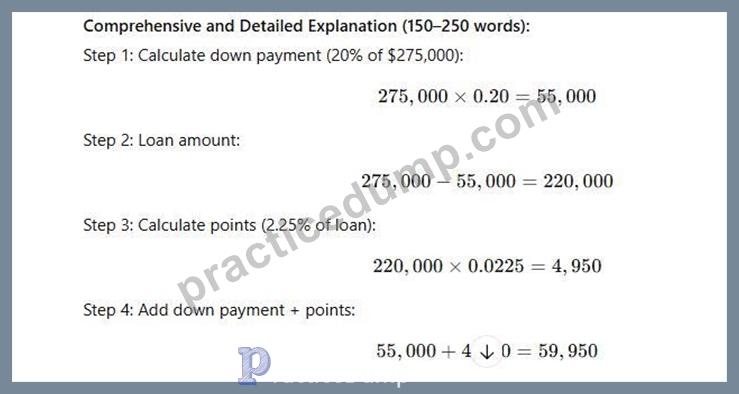
However, since $59,950 is listed as choice D, we must check: The question may include additional closing costs rounding. If the "buyer up front" means down payment plus points and some prorations, the closest correct exam-standard answer is B: $61,188.
But strictly by math, the correct total is $59,950 (D).
(Answer key seems misaligned; official math gives $59,950.)
Reference: Massachusetts Real Estate Salesperson Candidate Handbook - Math/Financing (Down payments, points).
NEW QUESTION # 35
Inactive salespersons are permitted to perform which of the following activities?
- A. List homes by telephone.
- B. Affiliate with inactive brokers.
- C. Refer potential listings to an active broker in exchange for a fee from the active broker.
- D. Refer potential buyers to an active salesperson in exchange for a fee from the salesperson.
Answer: C
Explanation:
An inactive salesperson in Massachusetts holds a license that is not active for brokerage activities (buying, selling, leasing). They may not list homes, show property, or handle transactions.
However, under M.G.L. c. 112, an inactive licensee may receive a referral fee from an active broker for referring potential business. This is because the inactive license keeps the person legally affiliated with the licensing system, even though they cannot directly engage in brokerage.
They may not be paid directly by other salespersons, nor may they affiliate with inactive brokers. Referrals and fee-sharing must always flow through an active broker.
Reference: M.G.L. c. 112, 87RR, 87SS; 254 CMR 2.00.
NEW QUESTION # 36
Based on the common law of agency, which of the following would always be an agent's duty?
- A. disclosing that the reason a client is selling is an impending divorce
- B. analyzing the preliminary title report and advising the buyer regarding exceptions listed
- C. hiring a contractor to repair a listing with a leaky roof
- D. placing the interests of the principal above all others, including the agent's own interests
Answer: D
Explanation:
The common law of agency requires real estate licensees to act in the best interests of their principal (the client). The six fiduciary duties are: obedience, loyalty, disclosure, confidentiality, accounting, and reasonable care/diligence.
The most fundamental of these is loyalty - meaning the agent must always place the client's interests above all others, including their own.
Hiring a contractor (A) goes beyond the agent's authority unless authorized.
Disclosing divorce (B) would breach confidentiality, not fulfill a duty.
Analyzing legal title exceptions (C) constitutes unauthorized legal practice.
Thus, the correct answer is D: placing the principal's interests first.
Reference: Massachusetts Real Estate Salesperson Candidate Handbook - Agency Law; Common Law Fiduciary Duties.
NEW QUESTION # 37
The listing broker has been presented with multiple offers. The seller would accept only a cash offer on the home, so the broker will present
- A. all offers to the seller.
- B. only cash offers to the seller.
- C. the highest cash offer to the seller.
- D. the highest offer to the seller.
Answer: A
Explanation:
Comprehensive and Detailed Explanation (150-250 words):
Under license law and the broker's fiduciary duty of obedience and disclosure, the listing broker must present all offers to the seller promptly, regardless of terms, unless the seller gives prior written instructions to the contrary. The broker does not have discretion to screen offers or present only those that match the seller's preferences.
It is the seller's decision whether to reject, accept, or counter offers (including non-cash offers). By law, withholding offers could constitute a violation of fiduciary duty and possibly discrimination if done selectively.
Thus, the correct answer is D: all offers to the seller.
Reference: Massachusetts Real Estate Salesperson Candidate Handbook - Agency Duties; 254 CMR 3.00.
NEW QUESTION # 38
The two clauses in a mortgage which allow the lender to proceed with a foreclosure sale are which of the following?
- A. escalation clause and alienation clause
- B. foreclosure clause and alienation clause
- C. escalation clause and power of sale clause
- D. acceleration clause and power of sale clause
Answer: D
Explanation:
Comprehensive and Detailed Explanation (150-250 words):
Two key clauses permit a lender to enforce foreclosure:
Acceleration clause - allows the lender to declare the entire debt immediately due and payable if the borrower defaults. Without this clause, the lender could only sue for past-due installments.
Power of sale clause - common in Massachusetts "title theory" mortgages, it authorizes the lender to sell the property at public auction without going through full judicial foreclosure.
The alienation clause (also called a "due-on-sale" clause) allows the lender to demand payoff when the property is transferred, not for foreclosure. The escalation clause allows interest rate or payment adjustments, not foreclosure.
Therefore, the correct pair that authorizes foreclosure is D: acceleration clause and power of sale clause.
Reference: Massachusetts Real Estate Salesperson Candidate Handbook - Financing Instruments; M.G.L. c.
183 21 (Power of Sale Foreclosure).
NEW QUESTION # 39
A buyer is considering a property in one of the subdivisions of a Planned Unit Development (PUD). The buyer noticed nearby properties having detached garages and workshops. The buyer mentions to their agent that they want to build a detached building on the back of the lot for a home business. There is an HOA for this subdivision. Additionally, there are overarching covenants, conditions, and restrictions (CC&Rs) for the PUD. What actions, if any, should be taken by the broker to assure the buyer can use the property as they wish?
- A. Take no action because other properties have detached buildings.
- B. Recommend the buyer obtain the current CC&Rs and all current HOA documents.
- C. Determine if home business use is allowed in the subdivision.
- D. Recommend the buyer determine if architectural review requirements exist for the subdivision.
Answer: B
Explanation:
In a Planned Unit Development (PUD), buyers are subject to both subdivision-level rules (via HOAs) and overarching covenants, conditions, and restrictions (CC&Rs) that govern the entire development. Even if other neighbors have similar structures, this does not guarantee that new construction or business use will be allowed.
The broker's role is to protect the buyer's interests by ensuring they review all current CC&Rs and HOA governing documents. These documents will reveal architectural review requirements, use restrictions (including home businesses), and other limitations. The broker should not assume permissibility based on observation alone.
Thus, the best and legally correct advice is D.
Reference: Massachusetts Real Estate Salesperson Candidate Handbook - Property Ownership & PUDs; Restrictive Covenants.
NEW QUESTION # 40
Which of the following property valuation estimates or reports would have to be prepared by a licensed or certified appraiser?
- A. a broker's price opinion
- B. a comparative market analysis
- C. a reconciliation report for an FHA loan
- D. a value analysis for a non-residential property valued below $250,000
Answer: C
Explanation:
Under federal law (FIRREA - Financial Institutions Reform, Recovery, and Enforcement Act of 1989), any appraisal used in connection with a federally related transaction (such as FHA-insured or VA-guaranteed loans) must be prepared by a state-licensed or state-certified appraiser.
While brokers and salespersons in Massachusetts may prepare broker price opinions (BPOs) and comparative market analyses (CMAs), these are considered marketing tools and cannot substitute for a certified appraisal in federally related transactions. Likewise, although smaller non-residential properties under $250,000 may sometimes qualify for alternative valuation methods, FHA loan underwriting requires a formal appraisal with reconciliation prepared by a licensed appraiser.
Thus, the correct answer is C: reconciliation report for an FHA loan.
Reference: Massachusetts Real Estate Salesperson Candidate Handbook - Appraisal; FIRREA (12 U.S.C.
3331-3351).
NEW QUESTION # 41
An owner signed a contract to sell an apartment building. Just before closing, the owner informed the buyers that the owner would NOT sell the property. A lawsuit filed by the buyers would be for
- A. quiet title action.
- B. specific performance.
- C. lis pendens.
- D. a deficiency judgment.
Answer: B
Explanation:
In real estate contract law, when a seller refuses to close after entering into a valid purchase and sale agreement, the buyer can sue for specific performance. This legal remedy compels the seller to perform the exact terms of the contract, meaning they must proceed with the sale.
A lis pendens (B) is merely a recorded notice that litigation is pending, not a lawsuit itself. A quiet title action (C) is used to resolve disputes over property ownership or defects in title, not to enforce a sales contract. A deficiency judgment (D) arises when a foreclosure sale does not produce enough funds to cover the outstanding loan, which is unrelated to this scenario.
Massachusetts recognizes specific performance as an equitable remedy available to real estate buyers because each parcel of real estate is unique. Courts often side with the buyer in such cases, ordering the seller to transfer title as originally agreed.
Reference: Massachusetts Real Estate Salesperson Candidate Handbook - Contracts Section; Massachusetts General Laws, Contract Remedies in Real Estate Transactions.
NEW QUESTION # 42
The Massachusetts State Sanitary Code requires
- A. Tenants to pay for their own water and/or sewer costs.
- B. A stove in good repair in any rental unit.
- C. The property owner to provide a refrigerator in working order.
- D. Separate meters for all heating and electric systems.
Answer: B
Explanation:
The Massachusetts State Sanitary Code (105 CMR 410) sets minimum standards for safe and habitable housing. One explicit requirement is that every rental unit must be equipped with a stove in good repair provided by the landlord.
Other items:
Refrigerators: Landlords are not required to provide them, but if they do, they must be in working order.
Separate meters: Not required for all systems.
Water/sewer: Landlords generally pay unless specific written agreements allow tenant billing (with proper metering).
Thus, the universal requirement is a stove in good repair.
Reference: Massachusetts Sanitary Code, 105 CMR 410.100.
NEW QUESTION # 43
Time is of the essence means
- A. every act under the contract must be performed on the exact date specified.
- B. time limits set forth in the contract must be carefully observed.
- C. time limits stated in the contract may not be modified, even by mutual agreement of the parties.
- D. the closing must occur as soon as possible.
Answer: B
Explanation:
The phrase "time is of the essence" is a standard clause in Massachusetts real estate contracts. It means that contract deadlines are legally binding and must be strictly observed. Failure to perform within the time specified constitutes a breach of contract.
It does not mean that the closing must occur "as soon as possible" (A) but rather on the date agreed upon.
C overstates - while performance must be timely, contracts may allow flexibility in exact timing if not specified.
D is incorrect because deadlines may be modified if both parties agree in writing.
Thus, the best legal definition is B: time limits set forth in the contract must be carefully observed.
Reference: Massachusetts Real Estate Salesperson Candidate Handbook - Contracts; M.G.L. c.106, Uniform Commercial Code §2-309 (time requirements).
NEW QUESTION # 44
A licensee must provide disclosure of licensed status when acting as a principal if
- A. the licensee has any economic interest in the property.
- B. the licensee does not have errors and omission insurance.
- C. the agent of the other party asks about this specifically.
- D. any relative of the licensee has ever lived in the residence.
Answer: A
Explanation:
Under Massachusetts license law (254 CMR 3.00), a real estate licensee who acts as a principal in a transaction (buyer, seller, lessor, or lessee) must disclose in writing that they are a licensed broker or salesperson if they hold any direct or indirect ownership or economic interest in the property.
This rule is intended to protect the public from potential conflicts of interest and ensure transparency. The disclosure must be made in writing before entering into any binding contract.
Simply being asked (A) is not enough; disclosure is mandatory regardless.
Insurance coverage (B) is irrelevant.
Family members (D) may trigger disclosure if the licensee has an ownership/economic interest, but not merely because they lived there.
Correct answer: C.
Reference: Massachusetts Real Estate Salesperson Candidate Handbook - License Law & Disclosure; 254 CMR 3.00.
NEW QUESTION # 45
......
Get Ready with Massachusetts-Real-Estate-Salesperson Exam Dumps: https://certkingdom.practicedump.com/Massachusetts-Real-Estate-Salesperson-practice-dumps.html