

Free 2025 New Jersey Real Estate New-Jersey-Real-Estate-Salesperson dumps are available on Google Drive shared by PracticeDump
Welcome to download the newest PracticeDump New-Jersey-Real-Estate-Salesperson PDF dumps: https://certkingdom.practicedump.com/New-Jersey-Real-Estate-Salesperson-practice-dumps.html ( 122 Q&As)
NEW QUESTION # 61
Which of the following actions is NOT a cause for suspension or revocation of a New Jersey real estate license?
- A. payment of a referral fee by a licensed New Jersey broker to a broker licensed in another state
- B. delivering a consumer information statement to a seller after having made a listing presentation
- C. collecting a commission as a broker from both parties to a transaction while representing both parties as their agent
- D. failing to provide a client with a copy of the signed exclusive listing contract
Answer: A
Explanation:
The New Jersey Real Estate Licensing Law (N.J.S.A. 45:15-17) lists specific causes for suspension or revocation, including:
Failing to provide a signed document copy to a client.
Failure to properly deliver a Consumer Information Statement before discussing motivation or making a presentation.
Collecting compensation from both parties without full disclosure and written consent.
However, paying a referral fee to an out-of-state broker is expressly permitted, provided the other broker is properly licensed in their jurisdiction. This is not grounds for discipline.
Reference: NJ Real Estate Licensing Law, N.J.S.A. 45:15-17; NJREC Rules on Referral Fees.
NEW QUESTION # 62
An applicant for a real estate salesperson's license must apply for the issuance of the license within:
- A. one year from the date of passing the state licensing examination
- B. 30 days after accepting an offer of employment from a licensed real estate broker
- C. one year from the date of completion of the prelicensure education course
- D. one year from the date of beginning the prelicensure education course
Answer: C
Explanation:
Under the New Jersey Real Estate Licensing Law, an applicant must:
Complete the 75-hour prelicensure education course.
Pass the state examination.
Apply for licensure within one year from the date of completing the prelicensure course.
If application is not made within one year of course completion, the course must be retaken.
Reference: N.J.S.A. 45:15-9; NJ Real Estate Salesperson Pre-Licensure Course Guide, Licensing Requirements section.
NEW QUESTION # 63
A listing agent presents a signed offer to a seller who then changes the amount of the down payment. Before presenting the counteroffer to the buyer, the New Jersey Real Estate License Law requires the listing agent to
- A. verbally inform any buyer's agent of the proposed revision.
- B. prepare a separate addendum that reflects the revision.
- C. secure the seller's initials confirming the revision.
- D. obtain the consent of the listing broker.
Answer: C
Explanation:
Under NJ Real Estate License Law and Commission regulations (NJAC 11:5-6.2), all material changes to a written offer must be acknowledged in writing by the party making the change before it can be treated as a counteroffer. This is typically done by having the seller initial and date the change on the offer form. Without the seller's written confirmation (initials), the revision is not valid or binding.
A is unnecessary; broker consent is not required for counteroffers.
C is not required unless the parties specifically use an addendum, but initials are the minimum legal requirement.
D is insufficient; oral notice is not valid without written confirmation.
Therefore, the correct answer is B.
(Reference: NJ Real Estate Salesperson Pre-Licensure Course Study Guide, Contracts & License Law- Handling Offers and Counteroffers; NJAC 11:5-6.2.)
NEW QUESTION # 64
A national company desires a parcel of land which must be 4 times the size of its proposed building. If the building design includes 20,000 square feet, then which of the following minimum sized lots should be purchased?
- A. 1 acre
- B. 4 acres
- C. 8 acres
- D. 2 acres
Answer: C
Explanation: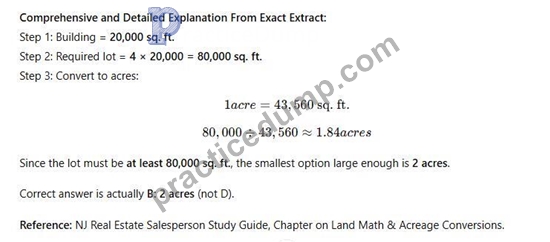
NEW QUESTION # 65
A CORRECT statement about transaction brokers is that they:
- A. may conduct transactions without an active real estate license
- B. represent both the buyer and the seller
- C. are required to disclose confidential information
- D. represent neither the buyer nor the seller
Answer: D
Explanation:
A transaction broker facilitates a real estate transaction without representing either party as an agent.
They owe both parties honesty and fairness but do not owe fiduciary duties such as loyalty or confidentiality.
They do not require client-level agency agreements.
They must still be licensed.
Correct answer = B.
Reference: NJ Real Estate Salesperson Study Guide, Chapter on Agency and Non-Agency Relationships.
NEW QUESTION # 66
The Multiple Listing Service (MLS) board members decided that the population of each area of the city would be best served by the brokerages who have offices actually located within those areas. The board established boundaries dividing the city into six districts and voted to limit listings for each district to only those brokerages with offices within the district. Brokerages who tried to advertise beyond their own district would be prohibited from listing properties in the MLS. This action violates what Real Estate Law?
- A. Sherman Anti-trust Act
- B. Civil Rights Act
- C. Diversity Jurisdiction
- D. Housing and Community Development Act of 1974
Answer: A
Explanation:
Restricting brokers to certain areas and dividing territories constitutes market allocation, which is a violation of the Sherman Antitrust Act.
Antitrust laws prohibit price-fixing, group boycotts, and territorial/market allocation among competitors.
Correct answer = C.
Reference: Sherman Antitrust Act (1890); NJ Real Estate Salesperson Study Guide, Chapter on Antitrust Laws.
NEW QUESTION # 67
A ranch house with a double garage is being valued. The house next door, which is similar except that it lacks a garage and has an outside deck, was sold last month for $138,000. Experience in that area shows that a two- car garage is probably worth $10,000 to buyers, while in general, they will pay only $500 extra for a deck.
The ranch house is most likely to sell for around:
- A. $147,500
- B. $128,500
- C. $123,500
- D. $148,500
Answer: A
Explanation: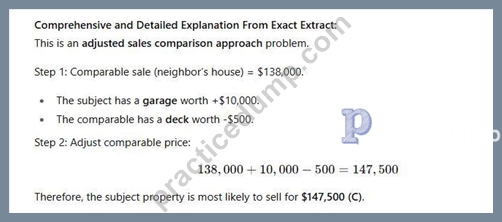
Therefore, the subject property is most likely to sell for $147,500 (C).
Reference: NJ Real Estate Salesperson Study Guide, Chapter on Appraisal Methods (Sales Comparison Approach).
NEW QUESTION # 68
The following statement was found in a real estate sales contract: "In the event of a default by the purchaser, the forfeiture of the earnest money to the seller will be the only compensation to which the seller will be entitled." This statement most likely describes a:
- A. broker protection clause
- B. indemnification clause
- C. default delivery clause
- D. liquidated damages clause
Answer: D
Explanation:
A liquidated damages clause specifies in advance the amount of money or type of damages one party will receive if the other party defaults.
In this case, the earnest money deposit forfeiture is the seller's only compensation in the event of buyer default.
A broker protection clause protects a broker's commission rights.
Indemnification clauses shift liability to another party.
A default delivery clause is not a standard real estate term.
Thus, the correct clause is B: liquidated damages clause.
Reference: NJ Real Estate Salesperson Study Guide, Chapter on Contracts and Contract Clauses.
NEW QUESTION # 69
A purchase money note need NOT contain the:
- A. loan-to-value ratio.
- B. time and method of payment.
- C. principal amount of the loan.
- D. rate of interest.
Answer: A
Explanation:
A promissory note (purchase money note) is the borrower's written promise to repay a loan. It must include:
The principal amount of the loan.
The interest rate.
The time and method of repayment.
The loan-to-value ratio (LTV) is a lender's underwriting guideline but is not a required element of the promissory note.
Correct answer = C.
Reference: NJ Real Estate Salesperson Study Guide, Chapter on Financing Instruments (Promissory Notes & Mortgages)
NEW QUESTION # 70
Under the New Jersey Real Estate Licensing Law, which of the following is an unlicensed assistant or secretary NOT permitted to do?
- A. Place signs on properties
- B. Type contracts for approval
- C. Follow up on loan applications with lenders
- D. Make telephone calls to request rent payments
Answer: D
Explanation:
Per NJREC rules, unlicensed assistants may:
Perform clerical tasks (typing, filing, placing signs).
Follow up on routine administrative matters with lenders or clients.
They may NOT:
Engage in any activity requiring a license, including solicitation of business, discussing terms, or making calls to request rent payments.
Correct answer = B.
Reference: NJREC Rules, N.J.A.C. 11:5-3.2; NJ Real Estate Salesperson Study Guide, Chapter on Licensing and Activities Requiring a License.
NEW QUESTION # 71
According to the New Jersey Real Estate Time Share Act, if a licensee is selling a timeshare located within the state of New Jersey, all of the following are true EXCEPT that the:
- A. timeshare must be approved by the Real Estate Commission.
- B. licensee must hold a timeshare sales license.
- C. licensee must provide the buyer with a copy of the Public Offering Statement.
- D. contract of sale must provide notice of a seven calendar day rescission period.
Answer: B
Explanation:
Under the NJ Real Estate Time Share Act (N.J.S.A. 45:15-16.50 et seq.), timeshares sold in New Jersey must be registered with the NJ Real Estate Commission.
Buyers must be given a Public Offering Statement.
Buyers are entitled to a 7-calendar-day rescission period.
There is no separate "timeshare sales license" - a standard NJ real estate license is sufficient.
Thus, the false statement is A.
Reference: New Jersey Real Estate Time Share Act; NJ Real Estate Salesperson Study Guide, Chapter on Timeshares and Condominiums.
NEW QUESTION # 72
The Freshwater Wetlands Protection Act of 1987 is a New Jersey law that:
- A. requires the registration of residential development projects with the New Jersey Department of Community Affairs
- B. requires environmental impact statements to be filed with the New Jersey Department of Environmental Protection before title to developed real estate can be transferred
- C. empowers the New Jersey Department of Environmental Protection to acquire title to certain real estate for less than its fair market value through condemnation
- D. restricts development of real estate in certain designated areas
Answer: D
Explanation:
The Freshwater Wetlands Protection Act (1987) gives the New Jersey Department of Environmental Protection (NJDEP) the authority to regulate activities in freshwater wetlands and transition areas (buffer zones). Its primary purpose is to restrict development in wetlands and certain protected areas to preserve environmental resources.
It does not require environmental impact statements prior to transfer of title, does not authorize below-market condemnation, and is unrelated to DCA residential project registration.
Reference: New Jersey Real Estate Salesperson Pre-Licensure Course Guide, Chapter on Environmental Issues; Freshwater Wetlands Protection Act, N.J.S.A. 13:9B-1 et seq.
NEW QUESTION # 73
Which of the following items would be prorated at closing with the credit going to the seller?
- A. earnest money
- B. prepaid property taxes
- C. accrued interest on an assumed mortgage
- D. unearned rent collected in advance
Answer: B
Explanation:
Prepaid items (like property taxes already paid by seller) are prorated at closing, with the buyer reimbursing the seller for the period after closing. The credit therefore goes to the seller.
Accrued interest is typically credited to the buyer (since the seller owes it).
Earnest money is applied to buyer's costs, not prorated.
Unearned rent collected in advance is credited to the buyer, since the seller must pass future rent benefit to the buyer.
Correct answer = B.
Reference: NJ Real Estate Salesperson Study Guide, Chapter on Closings and Prorations.
NEW QUESTION # 74
A seller refuses to honor a sales agreement. The buyer could seek specific performance, which is a legal request to:
- A. force the seller to complete the sales agreement.
- B. receive monetary damages for losses suffered.
- C. cancel all contractual obligations.
- D. collect punitive damages from the seller.
Answer: A
Explanation:
Specific performance is a legal remedy requiring a party to perform as agreed in the contract, rather than just pay damages.
In real estate, because every parcel of land is unique, buyers often sue for specific performance to force the seller to transfer the property.
Options A and B describe rescission and compensatory damages.
Punitive damages are rare in contract law.
Correct answer = C.
Reference: NJ Real Estate Salesperson Study Guide, Chapter on Contracts and Remedies.
NEW QUESTION # 75
A prospective buyer calls a licensed New Jersey salesperson to inquire about a property listed with that salesperson's brokerage. During the first substantive discussion about the property's price and terms, the salesperson must
- A. only provide the CIS if the buyer asks for agency representation.
- B. immediately provide the Consumer Information Statement (CIS).
- C. provide the CIS at closing when all agency relationships are finalized.
- D. wait until the buyer is ready to make an offer before presenting the CIS.
Answer: B
Explanation:
Under New Jersey Real Estate Commission (NJREC) Regulations, licensed brokers and salespersons are required to provide the Consumer Information Statement (CIS) to clients and customers at the first substantive discussion about the price, terms, or motivation regarding a specific property.
The purpose of the CIS is to disclose to the consumer the various types of business relationships available in New Jersey (seller's agent, buyer's agent, disclosed dual agent, and transaction broker) and to clarify how the licensee intends to work with them.
Important rules from N.J.A.C. 11:5-6.9:
* The CIS must be given before any confidential information is disclosed or before an offer is written
, whichever occurs first.
* A "first substantive contact" means when a buyer or seller begins discussing financial or personal motivation about the transaction.
* Failing to provide the CIS at the proper time is considered a violation of agency disclosure requirements and can subject the licensee to disciplinary action by NJREC.
Therefore, the correct answer is A, because the CIS must be provided immediately at the first substantive discussion.
Reference: New Jersey Real Estate Commission, Rules and Regulations, N.J.A.C. 11:5-6.9 (Agency Disclosure / Consumer Information Statement); New Jersey Real Estate Salesperson Pre-Licensure Course Study Guide, Chapter on Agency and Business Relationships.
NEW QUESTION # 76
A private integrated club refused to rent one of its condos to a minority family. The club explained that it did not rent the condos to the public since the condos were for members only. Is the club in violation of the federal Fair Housing Act, and if so, how?
- A. Yes, because when race is involved, no exceptions to the federal Fair Housing Act exist.
- B. Yes, because the club had minority members, and therefore was not eligible for exemptions from the federal Fair Housing Act.
- C. No, because as an integrated club, they could discriminate on the basis of race in renting facilities.
- D. No, because a private club may restrict the rental of its own lodgings to its members as long as the lodgings are not operated commercially.
Answer: D
Explanation:
Under the Federal Fair Housing Act of 1968 (as amended), there are limited exemptions. One is the private club exemption: a bona fide private club that is not operated commercially may restrict the rental or occupancy of lodgings that it owns to members only.
However, even though exemptions exist, race-based discrimination is never permitted in the sale or rental of housing to the public. Here, since the club restricts rentals to members only and does not rent to the general public, it is not in violation of the Act.
Reference: Federal Fair Housing Act, 42 U.S.C. §3607 (Exemptions); NJ Real Estate Salesperson Study Guide, Chapter on Fair Housing and Civil Rights.
NEW QUESTION # 77
Rules for Truth in Lending and RESPA call for disclosure documents to borrowers. How can a managing broker best prepare associated licensees to manage these disclosures?
- A. Because the listing broker will be primarily responsible for completing the Loan Estimate to send to the lender, the broker should train associated licensees to collect all the necessary information in a timely fashion.
- B. The buyer's broker can provide samples so that when the licensee and the borrower prepare the forms they are following a good example.
- C. Because the lender has primary responsibility to provide these forms, the broker and licensees should be aware of the items required for the lender to comply.
- D. The managing broker should train licensees to advise borrowers to accept the Loan Estimate right away.
Answer: C
Explanation:
Under TILA-RESPA Integrated Disclosure (TRID) rules, the lender is primarily responsible for preparing and delivering the Loan Estimate and Closing Disclosure.
Brokers and licensees do not prepare these forms.
However, licensees must be knowledgeable about the disclosures so they can help clients understand the process and provide necessary information for lender compliance.
Thus, the best practice is B: brokers should ensure licensees are aware of what the lender requires.
Reference: Truth in Lending Act (Regulation Z); RESPA (Regulation X); NJ Real Estate Salesperson Study Guide, Chapter on Federal Lending Laws.
NEW QUESTION # 78
A contract of sale prepared by a licensee MUST include an attorney review clause if it pertains to which of the following types of properties?
- A. Subdivision of fifteen or more lots
- B. Six-family dwelling unit, a portion of which is used for non-residential purposes
- C. Commercial building that does not exceed 10,000 square feet
- D. Single family residential vacant lot
Answer: D
Explanation:
According to the New Jersey Supreme Court Mandated Attorney Review Clause (as adopted by NJREC, N.J.
A).C. 11:5-6.2(g)), all contracts prepared by licensees for the sale of one-to-four family residential properties and residential vacant lots must contain the three-day attorney review clause.
The purpose is to protect consumers in residential transactions by giving them the right to have their attorney review and potentially cancel or modify the contract within three business days.
Therefore, the correct answer is D, because the attorney review clause is mandatory for contracts involving a single-family residential vacant lot.
Reference: NJREC Rules and Regulations, N.J.A.C. 11:5-6.2(g); NJ Attorney Review Clause Requirement, New Jersey Real Estate Salesperson Pre-Licensure Course Guide.
NEW QUESTION # 79
A property was listed for $110,000. It sold for $106,000. A 6.5% fee was split equally between the listing and selling real estate firms. The listing licensee received 55% of the listing office share. How much did the listing licensee receive?
- A. $1,894.75
- B. $3,575.00
- C. $1,966.25
- D. $3,789.50
Answer: A
Explanation: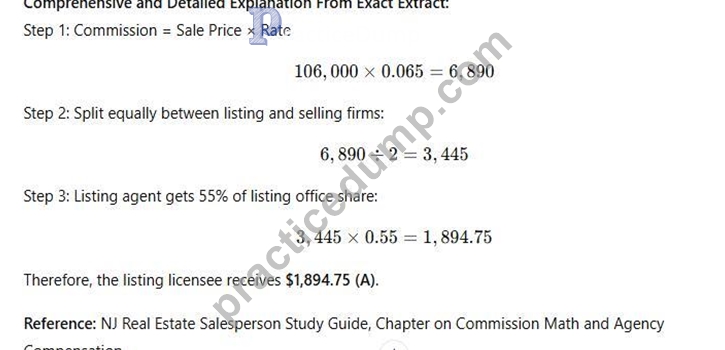
NEW QUESTION # 80
According to the Real Estate Licensing Law, a real estate licensee can provide a rebate of the commission to a buyer
- A. provided it does not exceed 50% of the total commission.
- B. if a writing confirming the terms of the rebate is provided to the buyer at closing.
- C. if the licensee is the broker.
- D. if notated on the contract of sale.
Answer: B
Explanation:
New Jersey law (P.L. 2009, c. 273; NJ Real Estate Licensing Law) permits brokers to rebate a portion of their commission to a buyer provided that:
The rebate does not constitute a violation of RESPA or other federal laws.
The terms of the rebate are disclosed in writing to the buyer prior to closing.
The rebate must be documented in the transaction records maintained by the broker.
There is no statutory 50% cap, and it does not have to be written directly into the contract of sale. It is also not limited to the broker personally-salespersons may provide a rebate under the broker's supervision.
Reference: New Jersey Real Estate Commission - Licensing Law, Commission Rebates to Buyers, N.J.S.A.
45:15-17; NJREC Bulletins on Commission Rebates.
NEW QUESTION # 81
......
Tested Material Used To New-Jersey-Real-Estate-Salesperson: https://certkingdom.practicedump.com/New-Jersey-Real-Estate-Salesperson-practice-dumps.html