

CCBA 100% Pass Guaranteed Download Certification of Capability in Business Analysis Exam PDF Q&A
CCBA Practice Test Dumps with 100% Passing Guarantee
The CCBA exam is computer-based and consists of 130 multiple-choice questions. Candidates are given three hours to complete the exam, which is offered in English, Spanish, Portuguese, German, French, and Chinese. To be eligible for the exam, candidates must have at least 3750 hours of business analysis work experience in the last seven years, as well as 900 hours of experience in two of the five CCBA knowledge areas. They must also have at least 21 hours of professional development in the last four years.
The Certification of Capability in Business Analysis (CCBA) certification of capability in business analysis (CCBA) exam tests the candidate's knowledge and skills in various areas of business analysis, including requirements analysis, business architecture, stakeholder engagement, and strategy analysis. CCBA exam consists of 130 multiple-choice questions and has a time limit of 3.5 hours. The passing score for the CCBA exam is 70%.
NEW QUESTION # 233
A business analyst (BA) is verifying a set of requirements. One of the requirements is "After the customer has received an email confirmation, the customer is likely to access the order status in the order history which is available upon order submission." Which one of the following requirements quality characteristic is breached?
- A. Understandable
- B. Prioritized
- C. Atomic
- D. Concise
Answer: D
Explanation:
Explanation
Concise is a requirement is considered concise when it uses just enough information to describe itself. It doesn't contain unnecessary explanations or content.
NEW QUESTION # 234
A finance manager wants to begin a new project to replace the existing expenses processing system. The finance manager feels that the current expense submission-to-reimbursement process takes too long and is substantiated by 50% more complaints regarding incorrect reimbursement amounts than the same time last year. What should the business analyst (BA) investigate first?
- A. Business process to uncover inefficiencies and falling control points
- B. Finance solution vendors for inclusion in a Request for information
- C. Enterprise information model to ensure definitions are still valid
- D. Submission processes to determine which activities can be fully automated
Answer: A
Explanation:
The BA should investigate the business process to uncover inefficiencies and failing control points first. This is because the problem statement given by the finance manager indicates that there are issues with the current process that need to be resolved before replacing the system. The BA should analyze the current state of the process, identify the root causes of the problems, and recommend improvements that can address them. The other options are not relevant at this stage of the project. References:
BABOK Guide, section 5.1: Plan Business Analysis Approach
CCBA Practice Test, question 98
NEW QUESTION # 235
What type of analysis can a business analyst perform to understand the functions of stakeholders, the location of stakeholders, the tasks stakeholders complete, and the stakeholders' concerns about the solution?
- A. Operational analysis
- B. Organizational assessment
- C. Stakeholder impact analysis
- D. Technical assessment
Answer: C
NEW QUESTION # 236
You are the business analyst for your organization. You are identifying new opportunities to improve upon your existing web services. Management is open to new opportunities as long as the changes do not take more than 60 days to implement. What type of a factor does the 60-day implementation represent?
- A. Technical constraint
- B. Business constraint
- C. Assumption
- D. Schedule constraint
Answer: B
Explanation:
Explanation/Reference:
A time limit, budget limit, limit on the number of resources, and other organizational restrictions are business constraints.
C is incorrect. A technical constraint describes the architectural decisions concerning hardware,
software, platforms, and interoperability with the enterprise architecture.
D is incorrect. An assumption is something that's believed to be true, but it hasn't yet been proven
to be true.
A is incorrect. A schedule constraint is tempting, but this is not a valid term for business analysis.
Constraints on the time limit are just part of the business constraint.
NEW QUESTION # 237
Which approach is best to take when a business analyst is assessing the solution options for a business need when there are relatively few criteria involved?
- A. Focus on the commonalities of the solutions.
- B. Focus on the differences of the solutions.
- C. Focus on the life cycle costs of the solutions.
- D. Focus on the implementation cost of the solutions.
Answer: B
Explanation:
Explanation/Reference:
When there are only few criteria involved, it's often easiest and most direct to focus on the differences of the solutions.
B is incorrect. The commonalities of the solutions won't expose the weaknesses, strengths, and
values between the solutions.
A is incorrect. The life cycle costs may be considered, but there are other elements that can be
considered too.
D is incorrect. The implementation cost of the solution is usually considered, but it's the business
value of the solutions that the business analyst should actually focus on.
NEW QUESTION # 238
You are a business analyst for your organization and you're working with Mary. Mary wants to know what you need to complete the process of planning the business analysis approach if you're already the business analyst for your organization. Which of the following statements is true regarding the plan business analysis approach?
- A. The plan business analysis approach describes the processes the business analyst will or will not do, based on the time and budget available.
- B. The plan business analysis approach describes the amount of time needed for the business analysis approach.
- C. The plan business analysis approach is required to select an approach that will perform business analysis.
- D. The plan business analysis approach describes the amount of budget needed for the requirements elicitation.
Answer: C
Explanation:
Explanation
The plan business analysis approach is required to select an approach that will perform business analysis. This approach helps to find out the following:
Which stakeholders need to be involved in the decision?
Who will be consulted regarding and informed of the approach?
What is the rationale for using it?
Answer D, A, and C are incorrect. These statements are not true regarding the plan business analysis approach.
NEW QUESTION # 239
You are the business analyst for your organization. Management has asked you to create a plan that will define the proposed structure and schedule for communicating the business analysis activities to the appropriate stakeholders. What plan does management want you to create?
- A. Communications management plan
- B. Stakeholder Management Plan
- C. Business Analysis Communications Plan
- D. Business Analysis Plan
Answer: C
Explanation:
Explanation/Reference:
Management is asking you to create the business analysis communication plan.
C is incorrect. This is a specific question asking for the BABOK definition of the business analysis
communication plan.
B is incorrect. The business analysis plan defines the activities and scope of work.
A is incorrect. The stakeholder management plan defines how the business analyst will manage
the fears, threats, requirements, and demands of the stakeholders.
NEW QUESTION # 240
Which technique consists of review meetings to determine if the stakeholders agree that their needs are being met with the identified requirements?
- A. Structured walkthrough
- B. Risk analysis
- C. Stakeholder management
- D. Prototyping
Answer: A
Explanation:
Explanation
Structured walkthroughs are meetings that help determine if the stakeholders agree that their needs are being met with the identified requirements.
Answer A is incorrect. Risk analysis reviews identified risks in the requirements to determine the probability and impact of the risk event.
Answer B is incorrect. Prototyping is used to gain user agreement with the proposed solution and requirements for the solution.
Answer C is incorrect. Stakeholder management is not a technique that is used as part of validating requirements.
NEW QUESTION # 241
A project's business requirements require that the new solution reduce the labor costs currently attributed to performing end of month accounting procedures. Currently the company routinely must pay overtime to meet the deadline. The business analyst (BA) has been documenting the process and wants to ensure that the approach to the process design is feasible for the staff who perform the end of month procedures. Which of the following stakeholders will provide this verification?
- A. Project sponsor
- B. Operational support
- C. Implementation subject matter expert
- D. Domain subject matter expert
Answer: D
Explanation:
The domain subject matter expert will provide the verification that the approach to the process design is feasible for the staff who perform the end of month accounting procedures. According to the BABOK Guide, a domain subject matter expert is "a stakeholder who has specialized knowledge of a business domain or area of expertise that is relevant to the change or the solution" 4. The domain subject matter expert can provide the business analyst (BA) with the necessary information, feedback, and validation regarding the current and desired state of the accounting process and the impact of the new solution on the staff. The implementation subject matter expert, the operational support, and the project sponsor are also important stakeholders, but they do not have the same level of expertise or authority as the domain subject matter expert in this case. References: 4: BABOK Guide, Version 3, Section 2.4.2 Domain Subject Matter Expert
NEW QUESTION # 242
Beth is a business analyst for her organization and she's discussing the solution with her key stakeholders.
Beth is considering that moving to a new operating system, new office software, and new customized applications will be too much for the end users to learn and to manage their ongoing responsibilities. What task is Beth completing in this scenario?
- A. Manage the stakeholders.
- B. Assess organizational readiness.
- C. Define transition requirements.
- D. Evaluate solution performance.
Answer: B
Explanation:
Explanation
Beth is performing the assessment of organizational readiness. This task reviews the organization's ability to accept and use the solution.
Answer A is incorrect. Stakeholder management is not an applicable business analysis task for this scenario.
Answer C is incorrect. The task of defining transition requirements describes the process of moving from one solution to another.
Answer B is incorrect. Evaluation of solution performance is the task of reviewing current solutions for improvement.
NEW QUESTION # 243
Which stakeholder analysis technique shows stakeholders that fall outside the scope of the solution but still interact with it in some way?
- A. Risk analysis
- B. Scope modeling
- C. Process modeling
- D. Interview
Answer: B
Explanation:
Explanation
Scope modeling shows stakeholders that fall outside the scope of the solution but still interact with it in some way. Scope models are used to describe the scope of analysis or the scope of a solution. It serves as a basis for defining and delimiting the scope of business analysis and project work.
Answer D is incorrect. Process modeling can be a source for identifying additional stakeholders, since related
processes may be affected.
Answer A is incorrect. Risk analysis is the study of the probability, impact, and scoring of identified risk
events. Risk analysis is the science of risks and their probability and evaluation in a business or a process. It is an important factor in security enhancement and prevention in a system. Risk analysis should be performed as part of the risk management process for each project. The outcome of the risk analysis would be the creation or review of the risk register to identify and quantify risk elements to the project and their potential impact.
Answer B is incorrect. Interviews are useful for collecting requirements and for identifying other
stakeholders. An interview is a systematic approach. It is used for eliciting information from a person or a group of people in an informal or formal setting by talking to an interviewee, asking relevant questions, and documenting the responses. Interviewees are also able to identify other stakeholders.
NEW QUESTION # 244
A business analyst (BA) creates the following diagram as part of current state analysis activities.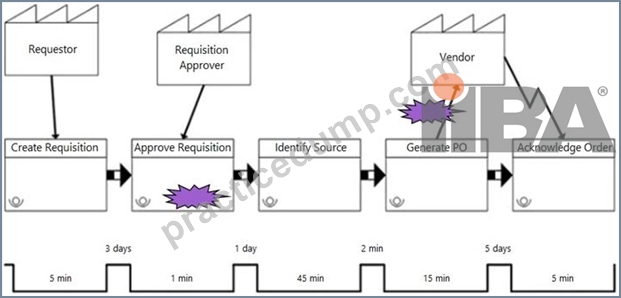
What does a diagram of this type help users to understand?
- A. Business capability
- B. Regulatory compliance
- C. Process improvement
- D. Decision-making
Answer: B
NEW QUESTION # 245
As a business analyst, you must identify activities in your business analysis approach. Which one of the following is useful for identifying activities?
- A. Project management input
- B. WBS
- C. A list of deliverables
- D. BABOK
Answer: C
Explanation:
Explanation
One of the best elements available for identifying project activities is a list of deliverables. By understanding what the endeavor is to create, the business analyst can better understand what activities are needed.
Answer B is incorrect. BABOK, A Guide to the Business Analysis Body of Knowledge, isn't a valid selection for this QUESTION.
Answer A is incorrect. You won't use project management input, other than expert judgment in some instances, to help identify activities.
Answer D is incorrect. The work breakdown structure (WBS) isn't a valid input for identifying activities.
NEW QUESTION # 246
What type of a business analysis approach focuses on the rapid delivery of business value in short iterations?
- A. Change-driven
- B. Risk-driven
- C. Risk-laden
- D. Profit-driven
Answer: A
Explanation:
The change-driven approach looks to create business value in short iterations. The downside of this approach, however, is that there is more risk and uncertainty in the overall direction. The change-driven approach relies on team interaction to define requirements and gather feedback on the solution.
Answer D is incorrect. This is not a valid term to describe the change-driven business analysis approach.
Answer A is incorrect. This is not a valid term to describe the change-driven business analysis approach.
Answer B is incorrect. This is not a valid term to describe the change-driven business analysis approach.
NEW QUESTION # 247
A business analyst (BA) creates the following diagram as part of current state analysis activities.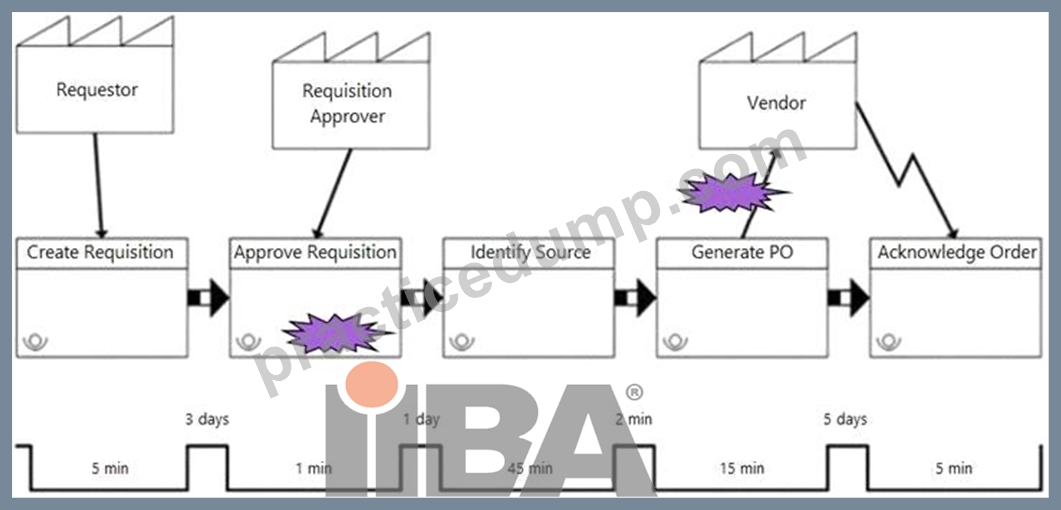
What does a diagram of this type help users to understand?
- A. Business capability
- B. Decision-making
- C. Regulatory compliance
- D. Process improvement
Answer: D
Explanation:
The diagram that the BA created is a flowchart diagram of a procurement process. A flowchart diagram is a graphical representation of a process that shows the steps, decisions, inputs, outputs, and roles involved. A diagram of this type can help users to understand process improvement by identifying the current state of the process, highlighting the pain points, bottlenecks, delays, or inefficiencies, and suggesting ways to optimize or streamline the process. References: Flowchart Diagram, Process Improvement
NEW QUESTION # 248
Fred is the business analyst for his organization. His current initiative is quite large, so Fred decides to create a high-level plan for the business analysis approach, and then to create a detailed plan for the most imminent activities. What type of business analysis planning is Fred using in this scenario?
- A. Cyclic planning
- B. Rolling wave planning
- C. Iterative planning
- D. Step planning
Answer: B
Explanation:
This is an example of rolling wave planning. This approach to planning is ideal for larger business analysis initiatives and allows the business analyst to plan the entire initiative and approach at the high-level and the most imminent activities at the detailed level.
Answer B is incorrect. Iterative planning is not a valid choice; planning does happen in iterations with the rolling wave planning approach, but it's not the correct name for the approach.
Answer A is incorrect. Step planning is not a valid term for business analysis processes.
Answer C is incorrect. Cyclic planning isn't a valid term for the described rolling wave planning.
NEW QUESTION # 249
During a lessons learned session, stakeholders had a heated discussion on the performance measures being employed and why they are necessary. The business analyst (BA) explained that performance measures are required to:
- A. verify that organizational resources were spent wisely.
- B. evaluate whether the required return on investment is met.
- C. gather insights into the value provided by a solution.
- D. decide if similar projects should be taken up again.
Answer: C
Explanation:
Explanation
Process performance measures are parameters that are used to identify process improvement opportunities.
Process performance measures are defined and deployed to ensure that processes are aligned to the business needs and strategic objectives of the organization. Process performance measures can address many aspects of a process including quality, time, cost, agility, efficiency, effectiveness, responsiveness, adaptability, flexibility, customer satisfaction, velocity, variability, visibility, variety, rework, and volume. Many of the process performance measures seek to measure the effectiveness and efficiency of the process as well as the degree to which the process goals are achieved.
NEW QUESTION # 250
You need to identify assumptions as part of the assessment of capability gaps. Which of the following is an example of an assumption?
- A. All vendors must have security clearance.
- B. The project manager believes that her project team members can program in COBOL.
- C. The software must be compatible with the current operating system.
- D. The risk in the project must be quantified.
Answer: B
NEW QUESTION # 251
Consider a business analyst who is completing the business analysis tasks of specifying and modeling requirements for an organization. This task can help an organization achieve all of the following objectives except for which one?
- A. Increasing revenue and/or reducing costs within an organization
- B. Supporting training activities and knowledge management
- C. Facilitating communication among stakeholders
- D. Compliance with contracts and regulations
Answer: A
Explanation:
Explanation
The task of specifying and modeling requirements does not ensure that revenues will increase or that costs will be reduced. However, the task does allow for some insight into operational improvements.
Answer C is incorrect. The task of specifying and modeling requirements does help with compliance to
contracts and regulations.
Answer B is incorrect. The task of specifying and modeling requirements does help the stakeholders
communicate better.
Answer A is incorrect. The task of specifying and modeling requirements can help with training and
knowledge management.
NEW QUESTION # 252
You are the business analyst for your organization. You've believed that your solution can actually be purchased from outside vendor rather than trying to create the solution internally. You decide to ask the vendor to provide a fee for their services based on the statement of work. What document will you give the vendor along with the statement of work?
- A. Request for quote
- B. Purchase order
- C. Contract terms
- D. Request for proposal
Answer: A
Explanation:
Explanation/Reference:
When an organization wants just the cost of the service or product, request for quote is used. Quotes, provided by vendors to buyers, don't present any ideas or direction, but provide just the cost of the solution.
C is incorrect. Request for proposal asks the vendor to provide detail on a proposed solution and
the cost of the solution.
D is incorrect. Purchase order tells the vendor that your organization will be purchasing the goods
or services.
B is incorrect. Contract terms aren't feasible, as the business analyst doesn't know how much the
solution will cost. Contract terms come later in the procurement process.
NEW QUESTION # 253
When a business analyst wants to present requirements for review, she must consider the requirements, audience, and what other factor to determine the level of formality in the presentation?
- A. Regulations
- B. Organizational process assets
- C. Standards
- D. Governance
Answer: B
Explanation:
The best answer is organizational process assets. These include the organization's preference for presenting requirements, forms, processes, and internal requirements.
Answer D is incorrect. Regulations don't represent the best answer for this QUESTION.
Answer A is incorrect. Standards are guidelines and don't represent the best answer for this QUESTION.
Answer C is incorrect. While governance is tempting, the best answer is organizational process assets, as it represents the rules and policies of the organization.
NEW QUESTION # 254
A business analyst (BA) is planning how to present a set of requirements for a project with financial constraints. Which requirements attribute should the BA assign to allow cost implications to be assessed?
- A. Ownership
- B. Source
- C. Complexity
- D. Status
Answer: C
Explanation:
The requirements attribute that the BA should assign to allow cost implications to be assessed is complexity.
This is because complexity is a measure of how difficult, intricate, or involved a requirement or a solution is.
Complexity can have an impact on the cost of implementing or maintaining a requirement or a solution by affecting the effort, time, resources, or skills needed. Assigning complexity to the requirements can help to estimate and compare the cost implications of different requirements or solutions, especially for a project with financial constraints. The other options are not as relevant or useful as complexity. References:
BABOK Guide, section 4.2.4: Structure Requirements
CCBA Practice Test, question 109
NEW QUESTION # 255
You work as a project manager for SoftTech Inc. You are working with the project stakeholders to begin the qualitative risk analysis process. You will need all of the following as inputs to the qualitative risk analysis process except for which one?
- A. Risk management plan
- B. Stakeholder register
- C. Risk register
- D. Project scope statement
Answer: B
Explanation:
You would not need the stakeholder register to perform qualitative risk analysis. Qualitative Risk Analysis uses the likelihood and impact of the identified risks in a fast and cost-effective manner. Qualitative Risk Analysis establishes a basis for a focused quantitative analysis or Risk Response Plan by evaluating the precedence of risks with a concern to impact on the project's scope, cost, schedule, and quality objectives.
The qualitative risk analysis is conducted at any point in a project life cycle. The primary goal of qualitative risk analysis is to determine proportion of effect and theoretical response. The inputs to the Qualitative Risk Analysis process are:
Organizational process assets Project Scope Statement
Risk Management Plan Risk Register
NEW QUESTION # 256
......
CCBA PDF Dumps Are Helpful To produce Your Dreams Correct QA's: https://certkingdom.practicedump.com/CCBA-practice-dumps.html