

2025 Realistic 4A0-100 Dumps Latest Alcatel-Lucent Practice Tests Dumps
4A0-100 Dumps PDF - 4A0-100 Real Exam Questions Answers
Alcatel-Lucent 4A0-100 certification exam is an ideal choice for individuals who want to enhance their career prospects in the field of network engineering. Nokia IP Networksand Services Fundamentals certification validates the candidate's expertise in designing, implementing, and troubleshooting IP networks of various sizes and complexities. 4A0-100 exam is also suitable for professionals who are already working in the networking industry and want to expand their knowledge and skills in this area.
NEW QUESTION # 153
Which of the following is TRUE regarding routers R2 and R3 in the pictured MPLS network?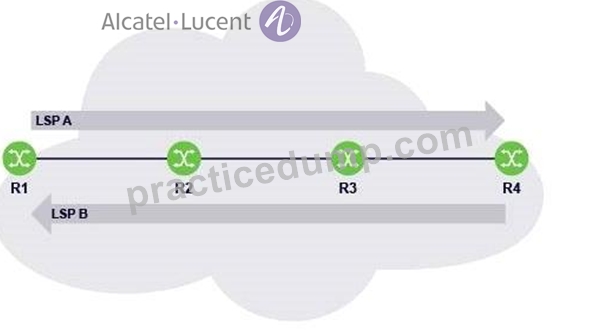
- A. Router R2 and R3 push labels for LSP A and LSP B, respectively.
- B. Router R2 swaps labels for LSP A, and R3 pops labels for LSP A.
- C. Router R2 and R3 swap labels for LSP A and LSP B.
- D. Router R2 pushes labels for LSP A, and R3 swaps labels for LSP A.
Answer: A
NEW QUESTION # 154
Which of the following statements is TRUE regarding the development of the OSI Reference Model?
- A. OSI model is maintained exclusively by the IETF.
- B. OSI protocols were no longer used after TCP/IP was developed.
- C. OSI was developed as an alternative, open standard to IBMs SNA model.
- D. OSI model is much simpler than TCP/IP.
Answer: C
NEW QUESTION # 155
The statement below describes which of the following activities?
"A set of tasks that moves a packet from its entry into an IP network to its exit from the IP network."
- A. IP tunneling
- B. IP forwarding
- C. IP decapsulation
- D. IP encapsulation
Answer: B
Explanation:
Section: Volume B
NEW QUESTION # 156
How does the Transport Layer identify which application is to receive the data?
- A. Using the MAC address of the frame.
- B. Using the IP address of the packet.
- C. Using Connection Identifier Numbers (CIN).
- D. Using port numbers.
Answer: D
Explanation:
Section: Volume B
NEW QUESTION # 157
Which of the following statements is FALSE when describing a Virtual Private LAN Service?
- A. A VPLS emulates a virtual switch or bridge.
- B. MAC addresses are maintained in a MAC address forwarding database (FDB).
- C. The VPLS performs MAC learning on MAC addresses seen from SAPs and SDPs.
- D. When a VPLS receives a frame with an unknown MAC destination, the frame will be dropped.
Answer: D
NEW QUESTION # 158
You are working from a particular Command Line Interface (CLI) context, and want to see the commands available from your current context. What command can you issue to view this information?
- A. info detail
- B. info
- C. view tree
- D. tree
Answer: D
NEW QUESTION # 159
On the Nokia 7750 SR, which key displays all command options and their descriptions?
- A. ?
- B. Return
- C. Space bar
- D. Tab
Answer: A
Explanation:
Comprehensive and Detailed Explanation From Exact Extract:
In theNokia SR OS CLI, specifically in bothclassic CLIandMD-CLI, the"?" keyis used to display a list of all possible command options at a given point in the CLI, along with a brief description of each option.
* This functionality helps the user in command discovery and reduces the chances of syntactical errors by showing only valid options.
* The"Tab"key, while helpful, is primarily used forauto-completionand not for displaying detailed descriptions.
* "Space bar"is used for command continuation, and"Return"executes the command or moves to the next line.
Correct usage example in classic CLI:
*A:SR1>config>router>interface# ?
- Shows all the valid commands and parameters under interface
Reference:
Nokia SRA Study Guide - Chapter: "CLI Fundamentals"
Nokia SR OS Fundamentals Guide - Section: "Using the CLI Help System"
NEW QUESTION # 160
Which of the following best describes the function of the service label?
- A. Customer traffic is encapsulated with a service label by the ingress PE. The service label identifies which transport tunnel to use.
- B. Customer traffic is encapsulated with a service label by the egress PE. The service label identifies which transport tunnel to use.
- C. Customer traffic is encapsulated with a service label by the ingress PE. The service label identifies the specific service the data belongs to.
- D. Customer traffic is encapsulated with a service label by the egress PE. The service label identifies the specific service the data belongs to.
Answer: C
Explanation:
Section: Volume B
NEW QUESTION # 161
What is the sequence of messages sent by a host when it attempts to ping a destination for which it has no Address Resolution Protocol (ARP) cache entry?
- A. ICMP echo request, ARP request, ARP reply, ICMP echo reply.
- B. ICMP echo request, ARP reply, ARP request, ICMP echo reply.
- C. ARP request, ARP reply, ICMP echo request, ICMP echo reply.
- D. ICMP echo request, ICMP echo reply, ARP request, ARP reply.
Answer: C
NEW QUESTION # 162
Which compact flash on a Control/Switch processor of an Alcatel-Lucent 7750 router stores the runtime image and running configuration?
- A. CF 2
- B. CF 1
- C. Both A and B
- D. CF 3
Answer: D
NEW QUESTION # 163
Which of the following protocols can be used to force traffic from router R2 to use the direct link to router R4?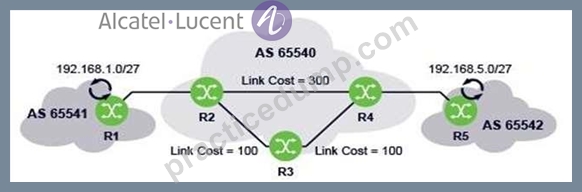
- A. IS-IS
- B. Static routing
- C. eBGP
- D. OSPF
Answer: B
Explanation:
Section: Volume B
NEW QUESTION # 164
What capability of TCP/IP allows two hosts to have multiple TCP sessions to each other simultaneously?
- A. The combination of IP source and destination address and the IP protocol field uniquely identifies each session.
- B. The hosts can identify the sessions using each others MAC addresses.
- C. Two hosts can not have multiple TCP sessions simultaneously.
- D. The combination of IP source and destination address and TCP source and destination port uniquely identifies each session.
Answer: D
NEW QUESTION # 165
A set of tasks that move a packet from its entry into an IP network to its exit from the IP network. This describes:
- A. IP encapsulation.
- B. IP routing.
- C. IP protocol.
- D. IP tunneling.
Answer: B
Explanation:
Section: Volume A
NEW QUESTION # 166
Which of the following is a characteristic of the IP layer?
- A. Provides a mechanism for flow control.
- B. Provides an unreliable, connectionless data transmission service.
- C. Provides services equivalent to the OSI data link layer.
- D. Verifies the integrity of all received datagrams.
Answer: B
NEW QUESTION # 167
Which of the following describes a static default route?
- A. An entry selected based on the route that has the least cost to the destination (path with the most physical bandwidth)
- B. An entry used by the routing protocol when it is unable to calculate the best route to the destination.
- C. An entry included in the default configuration of the router that is used if no dynamic routing protocols or static routes are configured.
- D. A wildcard entry used when the destination network is not specifically defined in the routing table.
Answer: D
NEW QUESTION # 168
Kahn solved the problem of interconnecting different networks using different protocols by pioneering a new protocol called TCP that was capable of:
- A. Secure transmission of information.
- B. Providing host to host connectivity with global addressing.
- C. Enforcing a constant packet size to avoid discards.
- D. Allowing remote logins.
Answer: B
NEW QUESTION # 169
In the diagram, R3 receives an LSA with the sequence number 111 from R7 and then receives another copy of the LSA with a sequence number 112 from R1. What does R3 do with the LSA from R1?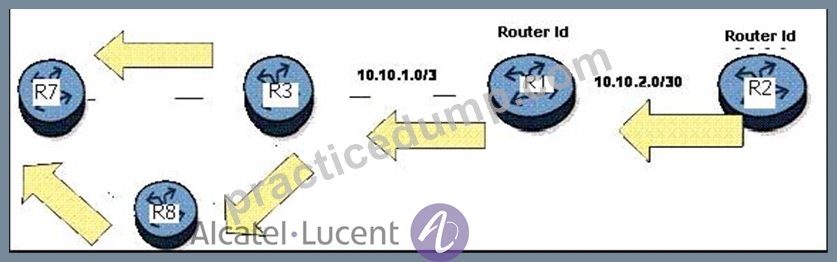
- A. R3 discards the LSA received from R1 and sends an ACK to R1.
- B. R3 discards the LSA received from R1 and sends a copy of the LSA from its link state base to R1.
- C. R3 installs the LSA received from R1 in its link state database and floods a copy to its neighbors.
- D. R3 installs the LSA received from R1 in its link state database, sends an ACK to R1 and floods a copy to its neighbors.
Answer: D
NEW QUESTION # 170
What is the purpose of the Data Link Layer in the OSI model?
- A. The Data Link Layer is responsible for encapsulating the packet into an IP header and routing the packet.
- B. The Data Link Layer is responsible for encapsulating the packet into a frame for transmission on the transmission media.
- C. The Data Link Layer is responsible for timing of the signals on the transmission media
- D. The Data Link Layer is responsible for formatting the packet for applications such as JPEG format.
Answer: B
NEW QUESTION # 171
Which of the following is a characteristic of the IP layer?
- A. Provides a mechanism for flow control.
- B. Provides an unreliable, connectionless data transmission service.
- C. Provides services equivalent to the OSI data link layer.
- D. Verifies the integrity of all received datagrams.
Answer: B
Explanation:
Section: Volume A
NEW QUESTION # 172
A Class C network is defined by a:
- A. 8-bit network.
- B. 24-bit network prefix.
- C. 32-bit network prefix.
- D. 16-bit network.
Answer: B
NEW QUESTION # 173
What happens next after an incoming packet is de-encapsulated from the Layer 2 frame in an Alcatel-
Lucent 7750 router?
- A. The IP datagram is passed to the IOM.
- B. A lookup is performed in the FIB to determine the egress interface.
- C. The IP datagram is encapsulated in the appropriate Layer 2 frame by the MDA.
- D. The IP datagram passes through the switch fabric to reach the egress IOM.
Answer: A
NEW QUESTION # 174
......
4A0-100 Premium Exam Engine pdf Download: https://certkingdom.practicedump.com/4A0-100-practice-dumps.html