

100% Pass Guaranteed Accurate FCP_ZCS_AD-7.4 Answers 365 Days Free Updates
FCP_ZCS_AD-7.4 DUMPS Q&As with Explanations Verified & Correct Answers
Fortinet FCP_ZCS_AD-7.4 Exam Syllabus Topics:
| Topic | Details |
|---|---|
| Topic 1 |
|
| Topic 2 |
|
| Topic 3 |
|
| Topic 4 |
|
| Topic 5 |
|
| Topic 6 |
|
NEW QUESTION # 37
Which Azure service provides distributed denial of service (DDoS) protection by monitoring and mitigating potential threats?
Response:
- A. Azure Sentinel
- B. Azure Application Gateway
- C. Azure Firewall
- D. Azure DDoS Protection
Answer: D
NEW QUESTION # 38
Azure public cloud offers which of the following benefits over traditional data center deployments?
Response:
- A. Longer deployment cycles
- B. Scalability on demand
- C. Reduced operational flexibility
- D. Higher initial capital costs
Answer: B
NEW QUESTION # 39
Refer to the exhibits.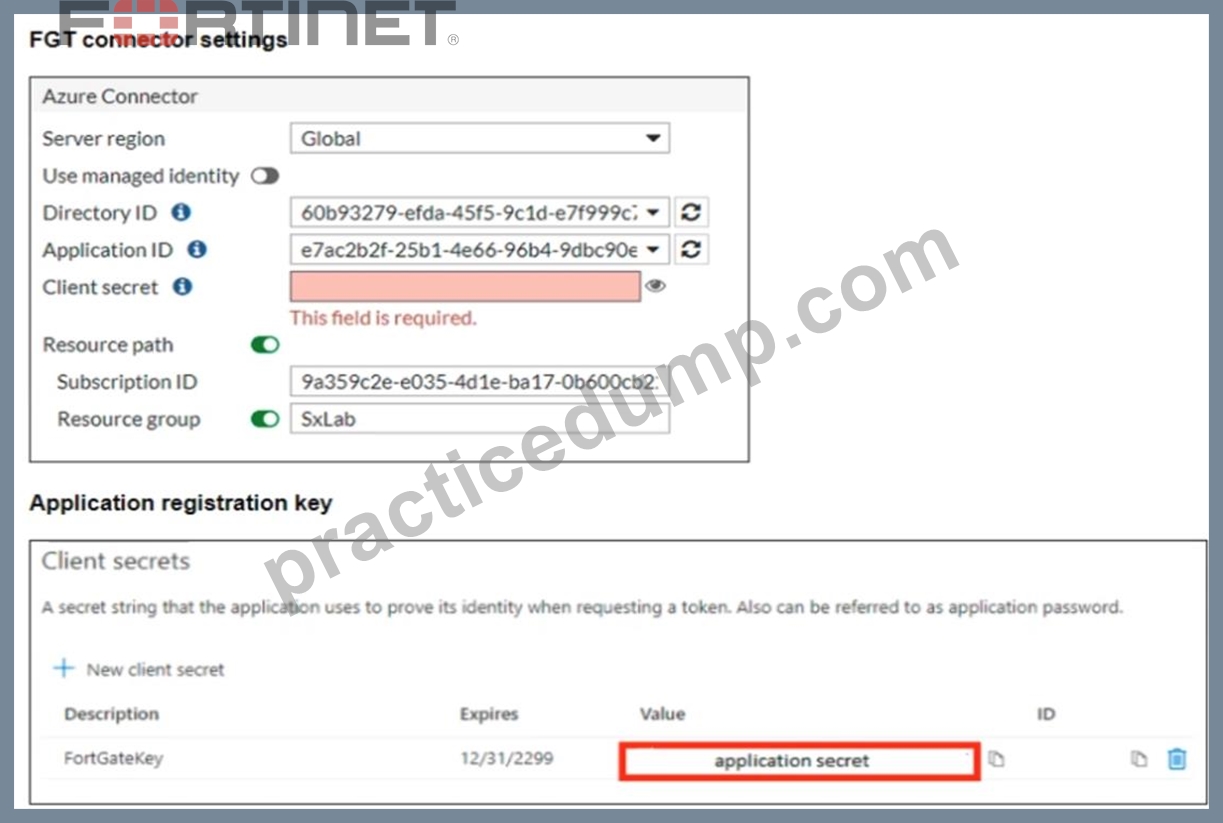
You are configuring an SDN connector for Azure on a FortiGate device You completed all the required steps on the Azure side. While configuring the FortiGate side, you notice that you did not save the client secret used in the Azure App Registration.
What is the quickest way to obtain the value of the client secret?
- A. Create a new app registration
- B. Create a new resource group
- C. Create a new client secret
- D. Create a new external connector for Azure
Answer: C
Explanation:
Azure does not allow you to view an existing client secret's value after creation for security reasons. If you did not save the client secret when it was first generated, the quickest and only option is to create a new client secret under the existing app registration and use the new value in your FortiGate configuration.
NEW QUESTION # 40
Which Fortinet Software-as-a-Service (SaaS) portal provides management and analytics capabilities to a diverse array of Fortinet solutions?
Response:
- A. FortiLAN Cloud
- B. FortiDevSec
- C. FortiNDR
- D. FortiCloud
Answer: D
NEW QUESTION # 41
Which feature of Azure supports real-time scalability and high availability of applications?
Response:
- A. Azure Logic Apps
- B. Azure Functions
- C. Azure Load Balancer
- D. Azure Blob Storage
Answer: C
NEW QUESTION # 42
What role does Azure Resource Manager play in Azure?
Response:
- A. Handles on-premises server integrations
- B. Provides software updates across different subscriptions
- C. Manages hardware lifecycle
- D. Acts as a deployment and management service
Answer: D
NEW QUESTION # 43
In Microsoft Entra ID, what is the primary administrative unit that represents an organization and its relationship with Microsoft's cloud services?
- A. Microsoft Entra organization
- B. Microsoft Entra domain
- C. Microsoft Entra subscription
- D. Microsoft Entra tenant
Answer: D
Explanation:
A Microsoft Entra tenant is the primary administrative unit that represents an organization within Microsoft's identity platform. It defines the boundary for identity management, access control, and resource governance, and serves as the core entity that connects the organization to Microsoft's cloud services such as Azure and Microsoft 365.
NEW QUESTION # 44
Which load balancing method should be used in Azure to ensure optimal distribution of traffic across multiple servers?
Response:
- A. Geographic
- B. IP Hash
- C. Least Connections
- D. Round Robin
Answer: C
NEW QUESTION # 45
What type of Azure networking element enables you to securely connect Azure virtual networks to each other?
Response:
- A. Azure VPN Gateway
- B. Azure Virtual Network
- C. Azure ExpressRoute
- D. Network Security Groups (NSGs)
Answer: A
NEW QUESTION # 46
Which scenario best utilizes the Azure Route Server for enhanced functionality?
Response:
- A. Integrating with virtual appliances for dynamic routing
- B. Archiving data
- C. Hosting static websites
- D. Managing user access controls
Answer: A
NEW QUESTION # 47
Which operational capability does FortiWeb provide when deployed in an Azure cloud environment?
Response:
- A. Wireless access management
- B. Physical network monitoring
- C. VPN connectivity enhancement
- D. Distributed Denial of Service (DDoS) mitigation
Answer: D
NEW QUESTION # 48
What impact does autoscaling have on load balancing within an Azure environment?
Response:
- A. It increases the complexity of network configuration
- B. It decreases the total cost of ownership
- C. It enhances load balancing effectiveness by dynamically adjusting resource allocation
- D. It limits the number of usable IP addresses
Answer: C
NEW QUESTION # 49
Refer to the exhibit.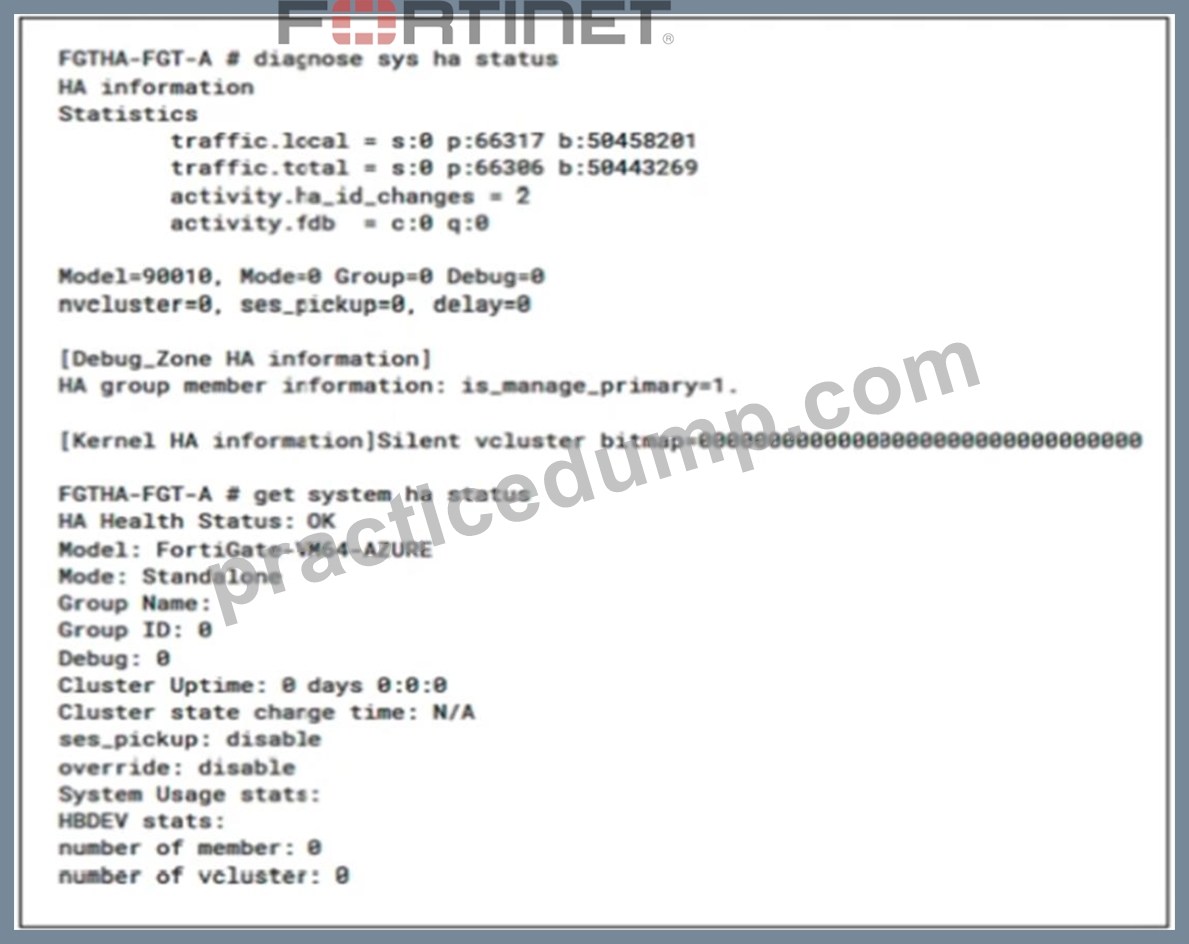
A high availability, active-active FortiGate with Elastic Load Balancing (ELB) and Internal Load Balancing (ILB) was deployed in your Azure environment.
Which tools can you use to configure synchronization? (Choose two.)
- A. Autoscale
- B. Software-defined network (SDN) Fabric Connector
- C. FortiManager
- D. Heartbeat interfaces
- E. FortiGate Clustering Protocol (FGCP)
Answer: D,E
Explanation:
In a FortiGate active-active HA deployment in Azure, synchronization between instances is achieved using:
NEW QUESTION # 50
What capabilities does Azure Virtual WAN offer?
(Choose Three)
Response:
- A. Direct on-premises connection via private links
- B. Reduced latency for Azure services
- C. Integrated security with native firewalls and security controls
- D. Centralized network and policy management
- E. Automated route management across VPN, ExpressRoute, and Azure connections
Answer: C,D,E
NEW QUESTION # 51
Refer to the exhibit.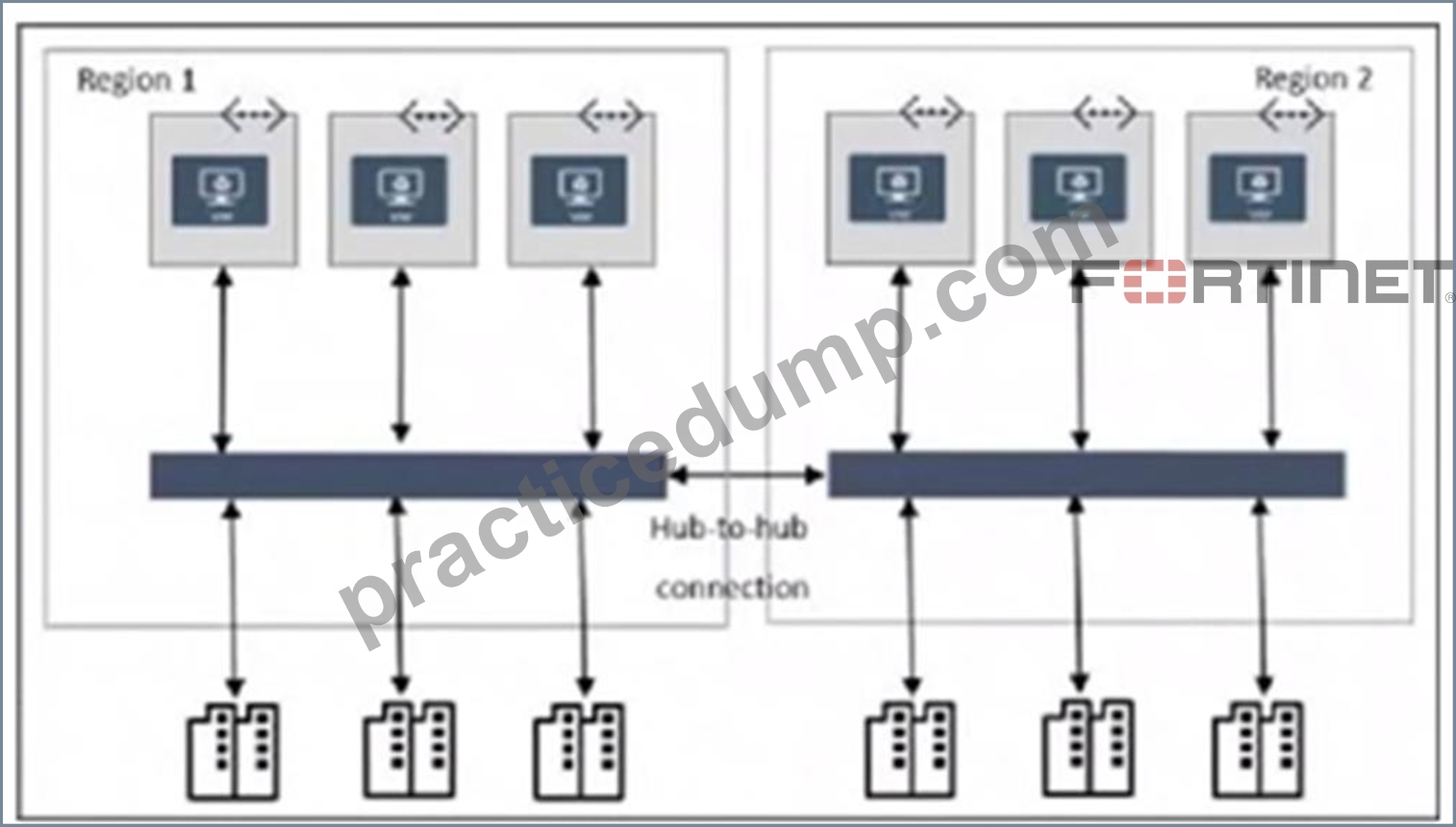
Your organization is planning the implementation of a complex hub-to-spoke solution to meet automated large-scale branch connectivity with multiple regions, offering a diverse range of connectivity options.
Which Azure networking service can deliver a solution?
- A. Azure Firewall Manager
- B. Azure VPN Gateway
- C. Azure SD-WAN
- D. Azure Virtual WAN
Answer: D
Explanation:
Azure Virtual WAN is designed for large-scale, automated, and global branch connectivity, supporting hub-and-spoke architectures across multiple regions. It enables centralized routing, hub-to-hub connectivity, and integrates with VPN, ExpressRoute, and SD-WAN solutions, making it ideal for complex, multi-region deployments as shown in the diagram.
NEW QUESTION # 52
What Fortinet solution can be utilized in Azure to secure web applications?
Response:
- A. FortiSandbox
- B. FortiAnalyzer
- C. FortiManager
- D. FortiWeb
Answer: D
NEW QUESTION # 53
Which VPN protocol is used when configuring a FortiGate device to connect to an Azure VPN gateway?
Response:
- A. PPTP
- B. IPsec
- C. SSTP
- D. L2TP
Answer: B
NEW QUESTION # 54
You deployed a FortiGate active-active with ELB/ILB solution using the template from Azure Marketplace.
What is the purpose of the inbound NAT rules configured in the external load balancer in this deployment?
- A. To filter inbound traffic before it reaches the FortiGate instances
- B. To allow administrative access to the FortiGate VMs
- C. To load balance the incoming traffic between both FortiGate VMs
- D. To forward the health probes to both FortiGate VMs
Answer: B
Explanation:
In an active-active FortiGate ELB/ILB deployment, the inbound NAT rules configured on the external load balancer are used to allow administrative access (e.g., HTTPS, SSH) to the individual FortiGate VMs. Since the public IP is associated with the load balancer, NAT rules are required to map specific ports to backend FortiGate instances for management access.
NEW QUESTION # 55
Which factors are crucial when choosing encryption algorithms for VPN connections between FortiGate and Azure VPN Gateway?
Response:
- A. Algorithm compatibility
- B. Compliance requirements
- C. Vendor preferences
- D. Cost of implementation
Answer: A
NEW QUESTION # 56
What capability does Azure Route Server provide to enterprise networks?
Response:
- A. Seamless route exchange with Azure virtual networks
- B. Intrusion detection and prevention
- C. Automated patch management
- D. Data lifecycle management
Answer: A
NEW QUESTION # 57
Why would you use a user-defined route in Azure?
- A. To have the traffic from the other VMs inspected by FortiGate
- B. To allow inbound management access to FortiGate VMs
- C. To manage user authentication and access control
- D. To allow communication between FortiGate VMs on two subnets in the same VNET
Answer: A
Explanation:
A user-defined route (UDR) in Azure is used to redirect traffic from other VMs through a FortiGate VM for inspection. By modifying the routing table, you ensure that outbound or inter-subnet traffic is sent to the FortiGate as the next hop, enabling traffic filtering, logging, and security enforcement.
NEW QUESTION # 58
What primary security function does FortiWeb serve when deployed in Azure?
Response:
- A. Network traffic management
- B. Web application firewall
- C. Intrusion detection system
- D. Email security
Answer: B
NEW QUESTION # 59
What critical step is involved when integrating FortiGate with Azure SDN?
Response:
- A. Configuring security policies
- B. Configuring VLAN attachments
- C. Implementing a VPN gateway
- D. Setting up direct peering
Answer: A
NEW QUESTION # 60
What is the primary benefit of configuring HA with FortiGate in an Azure environment?
Response:
- A. Increased application performance
- B. Reduced data storage costs
- C. Failover protection
- D. Enhanced data encryption
Answer: C
NEW QUESTION # 61
What is the main purpose of FortiWeb in the context of web applications in Azure?
Response:
- A. To automatically optimize network latency within Azure virtual networks
- B. To provide a secure content delivery network (CDN) for web applications.
- C. To encrypt data at rest within Azure storage
- D. To offer web application firewall (WAF) capabilities for protection against web application attacks
Answer: D
NEW QUESTION # 62
......
FCP_ZCS_AD-7.4 dumps Exam Material with 91 Questions: https://certkingdom.practicedump.com/FCP_ZCS_AD-7.4-practice-dumps.html